
 •
Rating:
•
Rating:
THE REVIEW
There are tracks that have marked the history of extreme metal: one of these is certainly “Total Desaster.”
“Total Desaster” is one of those concentrated bursts of malice frequently encountered in the eighties, a decade undoubtedly the most genuinely and naively malicious of the metal saga: the decade that every self-respecting heavy metal villain must study carefully even today to understand where to draw from to develop new forms of musical violence.
Certain purists might chide me, reminding me that, after all, a particular musical concept originated much earlier from the explosive punk movements of Motorhead, true masters of uncompromising electric speed, in years when rock was still poorly attempting to evolve, and electronics, hand in hand with the newborn industrial movement, began to assault us with formidable eardrum-shattering beats. One could still look back, turning to people like MC5 and Stooges, proponents of the most chaotic rock'n'roll, from which everything indeed begins. But in the eighties, the alienation and degradation of industrialized society give way to fears of nuclear holocaust, environmental decline anxieties, Cold War tensions: the eighties are no longer about rock'n'roll, it is an extreme form of ignorance and mediocrity of the current times: as J.G. Ballard might teach us, global devastation blends with mind devastation, obscured by technology and media hypertrophy; the beer-fueled satanism of Venom is already a hundred years old, extreme music becomes the expression of uncontrollable and unconditional rage that no longer harbors the utopia and denunciatory spirit typical of previous decades; it has no target, nor is it clear where it originates, it is only destruction, anger that no longer grows in the degraded suburbs of the new megalopolises, but assumes subtly bourgeois, indifferent forms, becoming void of content. It is violence seemingly without foundations, frescoed with a childish facade satanism, tempered by the mannerisms and style that often infect musicians who have embodied the multifaceted word of metal through time. Yet this is also a sociological reality to accept and comprehend, in a context where even the shopkeeper, the schoolboy, and the porn actor (well-known are the "measurements" of vocalist and bassist Marcel "Schmier" Schirmer, who will not shy away, throughout his illustrious artistic career, from engaging in red-light endeavors), even the shopkeeper, the schoolboy, and the porn actor, as it was said, in their small way get pissed off!
In the eighties, in ancient Europe, a little further east of Celtic Frost, a bit south of Bathory, were Destruction: a Teutonic trio of improbable long-haired musicians dedicated to venting their technical incompetence in the wake of what had been created on the other side of the ocean by Exodus, Metallica and Slayer.
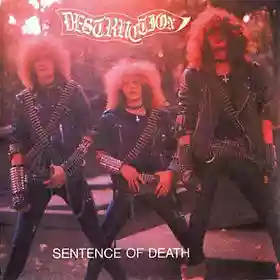
“Sentence of Death”, which follows a year after the sublime yet muddled demo “Bestial Invasion of Hell” (1983), is their first work served in a “professional” guise: a succulent five-track EP that today belongs by right to the manual of extreme metal, along with the two full-lengths that followed it, “Infernal Overkill” and “Eternal Devastation” which constitute very important essays in the manual of the perfect thrasher, under the entry “how to kick ass without knowing how to play a damn thing.”
In “Sentence of Death,” more than anything, there is “Total Desaster”, a five-star track that not only defines the entire career of the Lorrach trio, but remains an inexhaustible source of inspiration for the raw of the world, inhabited or not: a place within which we can find at least three musical genres, present, past, and future, whose blending contains the seeds of what will later be defined as black metal. The true black metal, I mean, not that of Venom. And, with apologies to purists, in my opinion the true black metal, at least as we understand it today, is what we find in the fundamental “A Blaze in the Northern Sky” by Norwegian Darkthrone, almost a decade later.
We are indeed still in 1984: the track opens with a cacophonic introduction of epileptic solos in perfect “Hell Awaits” style, after the growl of a guttural voice served the fetid dish like a maitre possessed by Satan himself. A machine-gun drum burst comes crashing in, dragging us on a tremendous ride where the listener is given no respite. Where is the black metal, you might ask? The form is, in effect, always the typically thrash of early in the decade, where sharp guitars grind repetitive riffs carrying the horrendous falsetto of a throat-chafed who calling a singer would be a criminal act. Yet, aided by the poor technique and equally bad sound definition, we already witness that apotheosis of muddled noise that will elevate the speed typical of black metal to a metaphysical status. The chorus is only slightly preceded by the crumpling of the snare, but the drum continues its mad dash, and even in this, we find a typical characteristic of the black metal to come: setting the atmospheres of a track on thematic variations grafted onto a fundamentally tempo-change devoid rhythmic pattern (thus surpassing the typical ultra-mosh break still typical in thrash metal of the era). But it is from the middle of the piece that we can begin to seriously talk about black metal, when a militant warring riff digs ever deeper into the meaning of the word "violence," emancipating the piece and bringing it to an exaggeratedly epic dimension (not in the Viking sense of Bathory), while Schmier's agonizing scream becomes a horrible croak that will open many paths. It is no coincidence that the piece would be covered by Marduk themselves in their hefty live “Germania.”
Four tracks follow that are overall honest, which will certainly delight everyone who loves the blistering eardrum.
“Black Mass” opens with solos that seem to aspire to a melodic sense, but it's just a mirage: the track will end with a blast-beat ante-litteram, confirming the good intentions of the three destroyers, rightful standard-bearers of the most advanced frontier of metal of that period along with their Swedish colleague Quorthon, another champion of the black metal to come.
“Mad Butcher” is another classic of the repertoire, another assault weapon in hand, a metallic tour de force torn by lightning solos and riffs that don’t rest in the incredible dynamism that good Mike Sifringer, although not being Malmsteen, managed to confer to his compositions. An arpeggiated march guitar (another cliché typical of more atmospheric black metal) concludes the track and opens the next one, “Satan's Vengeance”: another whip where the initial melody is soon forgotten.
And despite their lack of grace, I have always recognized in Destruction, at least in their early records, a compositional intelligence, a healthy creativity in being able to craft, in the simplest way possible, successful compositions, catchy refrains despite the clunkiness of the structures and the near-complete absence of melody. Take “Devil's Soldiers”, for example, and its bone-breaking tempo changes, where a deadly mid-tempo breaks in, thrashing our ears like it will happen with the best Immortal over ten years later.
What else is there to say, folks: these guys write in less than twenty minutes a great chapter of extreme metal. And I, who have written so much nonsense, have at least managed to lay down a review of Destruction without naming Sodom and Kreator... if you think that’s little...
Loading comments slowly
Summary by Bot
This review praises Destruction's 1984 EP 'Sentence Of Death' as a landmark in extreme metal history, highlighting the intense energy and rawness of tracks like 'Total Desaster.' It contextualizes the release within the 1980s metal evolution and its influence on emerging black metal. Despite technical imperfections, the band's creativity and aggressive style are celebrated. Overall, the EP stands as a fundamental work for thrash and early extreme metal fans.Tracklist Lyrics Videos
Destruction
Destruction are a German thrash metal band from Lörrach, commonly cited (alongside Sodom and Kreator) as part of the core German/Teutonic thrash triad. The band is strongly associated with bassist/vocalist Marcel "Schmier" Schirmer and guitarist Mike Sifringer, and is known for aggressive, direct thrash and a notably abrasive vocal style.20 Reviews
