
 •
Rating:
•
Rating:
THE REVIEW
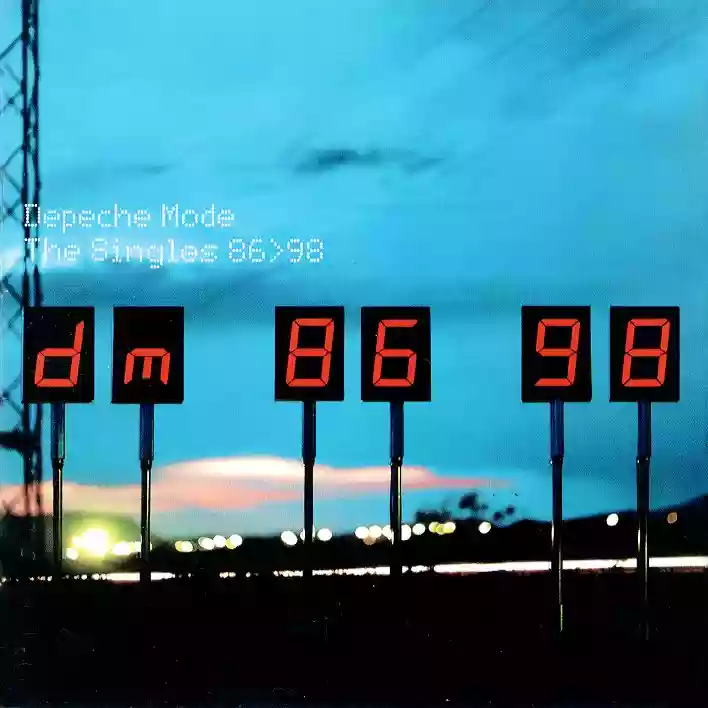
The Singles 86>98 is a collection from the golden era of Depeche Mode; here we find some of the most beautiful songs by the English group. But beyond a collection of songs, we are also faced with the rise of a band, their explosion at a global level, their explosion (in the negative sense of the term) at a human level, and then their rebirth and continuation of their journey. The band's ascension is part of the 1986-1990 period where it is already evident that the group has class, that Martin Gore knows how to write, and that Dave Gahan can sing like a god.
It starts with "Stripped", a dark, black song where Dave's voice is heard and merges with Martin's in the finale, the piece captivates the listener, and the darkness of the song envelops the listener; truly a great start. A drum intro leads us to "A Question Of Lust", sung by Martin, it is certainly a very commercial, very melodic piece, in short, a hit parade; Martin sings well, but, at least for the reviewer, Dave's voice is preferred. Contrasted with "A Question Of Lust", we find "A Question Of Time", fast, danceable, lively: the whole band here is at their peak, and (oh my!) Dave's voice is very similar to that of an unlikely Marilyn Manson, surely this piece is one of the best tracks in the collection. We leave the Black Celebration period and dive headlong into Music For The Masses with the band increasingly approaching worldwide consecration (the album reached 10th place in the UK, 35th in the US). "Strangelove" is the first single released from the album; it is a catchy song, really well done. Then comes one of the most beautiful songs of the eighties and one of Depeche Mode's masterpieces, namely "Never Let Me Down Again", which, with that electric guitar intro supported by a massive drum, makes everyone, absolutely everyone, dance. Dave's singing is seductive, enveloping, the presence of this song alone is worth purchasing the collection. The final part of the song is sung by Dave and Martin: a masterpiece!! "Behind The Wheel" is also a dark, brooding track with the singing entrusted to the brain and arm of the band. The worldwide explosion of Depeche Mode occurs with Violator (2nd in the UK, 7th in the US) which, thanks to its singles, proves to be one of the best-selling Depeche records. It starts with "Personal Jesus" and Martin Gore's brilliant riff: a song that makes you dance, moves even the walls, thanks to the guitar and the very present drums, in short a masterpiece that still today makes fans jump at concerts. One masterpiece follows another, let's now talk about "Enjoy The Silence", a song of such beauty, of such minimalism that it's scary, a peak reached by Martin Gore, incredibly difficult to repeat twice (he managed... listen to "Precious"). "Policy Of Truth" and "World In My Eyes" then close the Violator period: certainly two good singles, with which the first CD ends. The second part of the collection is the worldwide explosion of the band; the pressure is now palpable and even in the 1993 album Songs Of Faith & Devotion, the tension is tangible. Another riff, less effective than "Personal Jesus", leads us to "I Feel You", where Gahan's voice reigns supreme; the song is very beautiful, and immediately you can hear that the band has somewhat set aside electronics to play with "real" instruments (let me use the term). A few piano notes introduce "Walking In My Shoes", which I find very moving, it really becomes difficult to hold back a few tears when listening to songs like these: beautiful, a jewel in DM's discography. "Condemnation" brings us to a more relaxed, more intimate atmosphere, a nice song where once again Dave's voice steals the spotlight. "In Your Room" is another gem, very dark as in the best DM tradition, once again trying to describe what you feel while listening to it is a vain endeavor, everyone here feels what they want and is swept away by the sea of notes that envelops the listener. After the worldwide explosion, there is the human explosion of Dave, who between 1993 and 1997 attempts suicide multiple times and nearly loses his life due to an overdose. The period is one of the darkest from a human standpoint while, paradoxically, the global success leads fans to demand a new album. A new album that indeed arrives in 1997 and marks the band's rebirth and Dave Gahan's return to new life (artistically and humanly). "Barrel Of A Gun" is very engaging, a very powerful drum and a very wah-wah guitar create a soundscape where Dave can begin again to do what he does best: sing."It's No Good" is a very commercial, very melodic song and certainly one of the best-executed tracks on the album. "Home" is a track introduced by a splendid drum part where Martin's voice joins in, a very interesting track with an ending that to call it superb is an understatement: worth a listen. The last single from Ultra is "Useless" with a very rock intro: a very engaging song that differs greatly from the English group's songs from the '80s. The continuation of the journey is entrusted to an unreleased track present in the album "Only When I Lose Myself", very dark, with Dave repeating endlessly "it's only when I lose myself, I lose myself". Also noteworthy is the presence of a touching "Little 15" and a live version of "Everything Counts".
This collection thus sums up twelve years lived dangerously, but, as in all good fairy tales, everything seems to have resolved for the best. The band will continue on their journey, later releasing Exciter in 2001 and Playing The Angel in 2005. I recommend it to those approaching the English band for the first time.
Loading comments slowly
Summary by Bot
The Singles 86>98 is a definitive collection showcasing Depeche Mode's golden era with iconic singles that highlight their artistic growth and personal struggles. From dark hits like "Stripped" to anthems like "Personal Jesus" and "Enjoy The Silence," the album captures the band's ascent and rebirth. Dave Gahan’s powerful vocals and Martin Gore’s master songwriting shine throughout. This compilation is essential for both newcomers and longtime fans of the band.Tracklist Lyrics
Depeche Mode
Depeche Mode are an English electronic music group formed in Basildon in 1980, led by Dave Gahan and Martin Gore. They built a global audience with synth‑based albums and large-scale tours and remain influential in synth‑pop and alternative electronic music.110 Reviews
