
 •
Rating:
•
Rating:
THE REVIEW
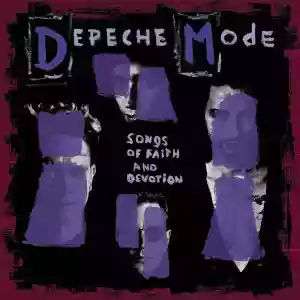
After reviewing "Violator" by Depeche Mode, I now intend to focus on what I consider their second most important work and, I believe, the album representing the dark crisis that was already hovering over the band. A dark crisis that led to dire consequences: Alan Wilder's departure from the Mode and Gahan's near demise, saved at the last moment from an overdose caused by a lethal mix of drugs.
It is 1993, Gahan had begun heavily abusing drugs, and his personal image was dangerously shifting towards the doomed, devilish rocker, with long hair, a scruffy and unkempt beard, almost an imitator of some of his colleagues whose lives had ended tragically. But even in the rest of the group, things didn't seem so rosy: by the end of the World Violation Tour aimed at promoting "Violator", the physical and mental forces of Gahan, Gore, Wilder, and Fletcher had been dangerously undermined, with fatigue becoming a harsh reality to coexist with. Challenges that until then had been seriously downplayed to keep the momentum of approval that had multiplied with the previous record.
"Songs Of Faith"... represents the peak of the "dark" period of Gahan & Co., a period that had been inaugurated with Black Celebration and had managed to break into the strict mainstream with Personal Jesus, included in the aforementioned Violator. Anyone intending to retrace the biography of Depeche Mode and carefully focus on those difficult years should analyze or at least listen to "Devotion" ("Songs Of Faith And Devotion" shortened), to understand the reasons behind certain almost fatal events.
"Devotion" also represents a novelty: until 1990, the Mode had consistently released a studio album almost every year or at least new singles and live recordings. From this point, that extremely prolific musical production is limited to the release of new material about every four years, a practice that continues to this day, also motivated by Gahan's solo choices.
In this album, the Mode, so to speak, place synthesizers and pure electronics in the background and open the doors to rock. A drastic change of sound that is mainly present in I Feel You, Mercy In You, Get Right With Me, Rush and In Your Room. Powerful riffs and decisive electric guitar strumming are felt in the album's first extract, I Feel You, an excellent track that mixes electronics and rock, accompanied by Gahan's tortured, almost desperate voice. A vocal tone that in most of the songs on the album seems full of anger, pain, suffering, almost shouting to the world, the fans, the public his truth, the truth of the Mode. Never in any of their previous works had such darkness descended.
The "stand-out" track is Higher Love, the album's gem, a song dense with atmosphere, theatricality, and melancholy, where the angry rock of I Feel You softens and becomes much more melodic, relaxing, and gentle. Regarding this song, I want to express my disappointment with its placement in the album, being at the end of the record. Such a profound track deserved a superior placement, even at the beginning of the tracklist: just observe the exact start of the Devotional Tour contained in the eponymous live DVD during which Gahan, or rather his shadow hidden behind a curtain, intones the first notes of Higher Love, a moment that reaches a peak of immense atmosphere and theatricality. This demonstrates how the characteristics of this song were perfect for an ideal opening of the entire album, more lyrical and intimate than I Feel You, the actual opening track.
Another melodic and particularly intense track is Walking In My Shoes, the second single from the album. Depeche Mode do not give up on songs almost devoid of percussion and riffs, instrumental: this is noted in Judas, performed by Gore. Still on the subject, much less valid is One Caress in which Gore fails to venture much further and gets lost in a track that is too lyrical and "classical." Gahan & Co. intend to explore other musical sounds as well in Condemnation, a clever mix of soul, gospel, and rock, a song favored by Gahan himself.
A compact, rich, and dark work, "Devotion" is a point of arrival and departure for Depeche Mode: the peak of their darkness, the black crisis. But also the beginning of the new Depeche Mode, far from the carefree rhythms of the '80s, more mature and experimental, open to musical variety, exploring other sounds, while still remaining within their ancient "brand", that is, electronics.
Loading comments slowly
Summary by Bot
Songs Of Faith And Devotion marks a deep, dark chapter in Depeche Mode’s career, reflecting intense personal struggles and a significant musical shift towards rock. The album blends powerful riffs with electronic elements, featuring standout tracks like I Feel You and Higher Love. It captures the band's transition from their 80s synth roots to a mature, experimental sound. This work embodies both a peak of darkness and a new beginning for Depeche Mode.Tracklist Lyrics Videos
Depeche Mode
Depeche Mode are an English electronic music group formed in Basildon in 1980, led by Dave Gahan and Martin Gore. They built a global audience with synth‑based albums and large-scale tours and remain influential in synth‑pop and alternative electronic music.110 Reviews
Other reviews
By egebamyasi
The album sounds dark, menacing, oppressive, but above all much more 'rock' and less electronic than the previous ones.
'In Your Room' is a jewel of rare beauty, and perhaps the best track in Depeche Mode’s history.
By Umberto
"Songs Of Faith And Devotion surprises by being extremely varied in its contents but at the same time incredibly homogeneous."
"Gahan surpasses himself, delivering one of the finest performances of his career."
By Nickmasies
"Songs of Faith And Devotion represents a point of no return for Depeche Mode, a sort of culmination of their musical style."
"'Walking in my Shoes' perhaps represents the most successful song of Depeche Mode’s entire career, with a mystical arrangement that invites deep reflection."
By Ago
"The electronic epicness is, in my opinion, the absolute protagonist."
"Walking In My Shoes represents the pinnacle of electronic symphony, and a music video that interprets its spirit to perfection."
By Alevox
"It was indeed a painful birth, that of 'Songs of Faith and Devotion,' but also labor from which a beautiful creature would be born."
"Much of the album can indeed almost be interpreted as a kind of prayer. For God, for a woman, or for oneself."
