
 •
Rating:
•
Rating:
THE REVIEW
I discovered Deicide and started forming an idea of what the most extreme aspects of heavy metal were around 1995, thanks to the typical schoolmate who was a fan of the genre and would lend me his "cassette" tapes with compilations of his favorite bands... I vaguely suspected that there might exist a more direct and violent fringe of a style that I had so far associated with the well-known Metallica, Iron Maiden, and Megadeth, but I hadn't yet experienced firsthand the brutality and imprisoned power. Of those compilations, which entertained my "aggressive" moments for several years with the antics of various bands like Cannibal Corpse, Slayer, Death, MZ412, and so on, Deicide were certainly the ones that struck me the most, they hit me in the stomach until they came out of my ass.
I will remember titles and songs like "Carnage In The Temple Of The Damned" and "Satan Spawn The Caco-Daemon" for my entire life, almost fondly. After all, I believe it's important to go through a "metal phase" at some point in one's life, and I had mine as well: I haven't yet understood why my preference has always leaned toward the more blatantly hard and almost anti-melodic genres, perhaps because in their context I saw them as flying kicks to the face of the melodramatic antics of Dream Theater or the abhorrent epic metal. Speaking of Deicide, then. A well-known, very well-known band, there is no need to add or repeat what has already been said on this site by other users who undoubtedly "feel" death metal much more than I do, just a mere external admirer. It was only right, however, to talk about a work that is certainly not among the most memorable in the career of the controversial Florida band, especially since it came after three albums that had redefined the characteristics of an entire musical genre and changed the appearance of the metal imagery, perhaps taking it to its extreme "aesthetic" and conceptual consequences, never entirely mitigated despite the series of controversies that invaded the media right mid-'90s, when realities like Deicide definitively emerged from the cult environment to reach the school desks of high school students, including mine.
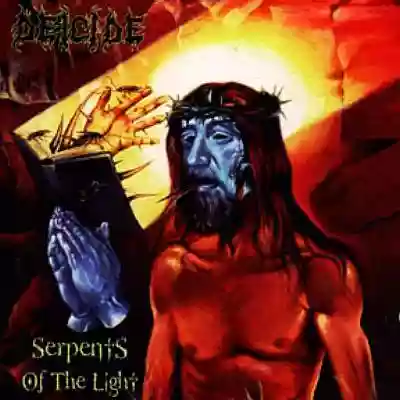
So "Serpents Of The Light" from 1997 is the first extreme metal album I listened to from start to finish and probably for this reason I didn't become a follower of the genre myself... sometimes the imprinting is important, especially during adolescence. Listening to it again today, after becoming acquainted with works of much different quality within the same genre (and within Deicide's own career), one can also understand the lack of evolution of this musical genre, which stalled on itself because it was unable to be exposed to a broadening of views, a continuation of a coherent discourse: because the discourse has always been the same. Interesting, but after a while, monotonous. Yet, yet, in the explicit ugliness of Glen Benton's growl and in the gruesomeness of tracks like the title track or the fantastic "Bastard Of Christ" (one of the band's signature songs), one can glimpse a vital force that goes beyond the terrifying sense of death and destruction that is mistakenly attributed to projects like this. In reality, the barrage of punches in the face, in the gut, and the kicks to the balls that these songs unleash on the listener (even if, in this case, often predictably and manneristically) hide a very personal point of view not at all close to the satanic antics that one assumes are the only message of the lyrics that accompany them.
Deicide's point of view is clarified in a nearly explicit manner, almost leaving no room for further clarifications: the prophets lie, don't waste your life at the mercy of a sacrifice that will only lead you to be a servant once again, rebel against your condition as a man enslaved by the machine. The concepts, rendered obviously much less "politically," are thrown in the ears of the listener amidst riffs grinding death and suffering, but it is a suffering of those who trust in their own anger to overturn a coin that has never fallen on their side. I could therefore assert that in Deicide's songs ("Blame To God" is an example), the rebellion against God is nothing more than a gigantic metaphor for life, an exaggeration of social revenge placed on a biblical scale, where slogans prevail, almost as if each track, instead of a march but of a ride into hell, were a sort of manifesto.
In their own way, Deicide are "working class heroes," and Glen Benton is the representation, taken to extreme (sometimes caricatured) consequences, of contemporary man's frustration and sense of repression... the reflection against religion is just one aspect of a whole series of considerations that could be made but that for reasons of time must be left in suspense. And we are still in the same (mined) territory as people like Nietzsche and Martin Luther. Before placing the ellipsis, I have to ask you a question: in art (and therefore in music), is it possible to hate God but simultaneously want to screw Him?… … … … … And is it better to reign in hell or be a slave in heaven?
Loading comments slowly
Summary by Bot
The review reflects on discovering Deicide’s intense death metal album 'Serpents Of The Light' in 1997 and its lasting impact. It highlights the album's brutal musical style and anti-religious lyrics as metaphors for social rebellion. Although not the band's most innovative work, it captures a vital force and raw emotion typical of its era. The reviewer discusses metal's stagnation but acknowledges Deicide's unique power and message. The album remains a notable entry in extreme metal history.Tracklist Lyrics Videos
Deicide
Deicide are an American death metal band from Florida, formed in 1987 (initially as Amon), known for extreme anti-Christian themes and for being a key name in early-1990s death metal.20 Reviews
Other reviews
By Bloodthrone
From the start, you encounter solos and riffs that are different and in some sense more mellow compared to Legion or their self-titled album.
The standout is definitely the title track which annihilates the listener.
