 •
Rating:
•
Rating:
THE REVIEW
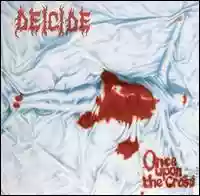
Noises. Louder and louder. A voice cries out in despair: "Father, why have you forsaken me?" And immediately hell breaks loose; devilish guitars and blasting drums seem to say that the plea will receive no answer. This is how Once Upon The Cross opens, the third sacrifice by Deicide (fourth, if we also consider the two demos reissued by Roadrunner in '93). The congregation led by Glen Benton needs no introduction: thanks to their harsh yet "square" sound, almost never chaotic, and thanks also to outrageous (if ridiculous) lyrics and statements, Deicide have imposed themselves since their inception to the attention of the more esoteric metal audience and are now known even to those uninitiated in death metal. However, their popularity has definitely decreased in recent years, mainly due to an almost immobile musical proposal that has somewhat worn on everyone. Nonetheless, this seems to not disturb them at all, as they continue to wearily revisit the sounds of milestones like the eponymous debut or Legion. Or like Once Upon The Cross, undoubtedly one of the most valid episodes in the Floridian band's discography. Nine tracks for a scant twenty-nine minutes: a very short album and yet not as blasted as one might expect. In fact, it's fair to say that in Once Upon The Cross the mid-tempos are the true masters, which the band skillfully alternates with sudden accelerations. This is already confirmed in the title track: after an initial burst, the song unfolds in mid-tempos only to suddenly reaccelerate near the chorus. Other pieces follow more or less the same dynamics, for instance, the following Christ Denied, which overall is more cadenced and is memorable for its piercing riffing. Or the furious Kill The Christian: here too a very fast pre-chorus gives way to a "doomy" and deep chorus (not certainly in textual terms, of course!).
At this point, however, it must be said that a track-by-track review is fundamentally useless given the compactness of the record (which should not be confused with monotony); it’s better to focus on the performances of the individual members. Excellent, therefore, is the performance of Steve Asheim, one of the best death drummers, who creates a real labyrinth of intricate countertimes in songs of the caliber of Confessional Rape or Trick Or Betrayed. Not to mention the earth-shattering Behind The Light Thou Shall Rise, where incessant martial rolls overlap the usual double bass drum wall.
On their part, Eric and Brian Hoffman create an unceasing lava flow of murky and evil riffs; impossible to resist When Satan Rules His World, with its pompous stride, to They Are The Children Of The Underworld, characterized by perfect intersections between guitar and vocal lines, or again to To Be Dead. The solos, although essential, manage to be evocative and hallucinatory.
To conclude everything, there is Glen Benton's growl, bestial and catacomb-like, albeit more standardized compared to the past. In some moments, like at the beginning of the title track (when he roars: "Fear him, fear him, fear him . . . Satan"), the Deicide vocalist adopts a characteristic chant-like and obsessive tone, a kind of blasphemous version of the songs sung during religious ceremonies. And indeed, listening to Once Upon The Cross, it really feels like being in the middle of a macabre gathering of fanatics. As for the lyrics, I would say it's not worth wasting too many words: as we all know, they are simply a jumble of absurdities about the final victory of the Antichrist and the extermination of Christians, which says nothing even to those interested in dark or esoteric themes. Pure and simple ravings devoid of any intellectual value, in short, but I must emphasize this point - they are not enough to dismiss a musical proposal that is (or rather was) objectively very interesting. In conclusion, Once Upon The Cross is a compact work without any drops in tone where all the technical prowess of Deicide emerges. (And also all their genius, given that at the time they had not yet become pale imitations of themselves). A masterpiece, perhaps the last great album of a band whose excessively uncompromising attitude has prevented truly significant evolutions.
Loading comments slowly
Summary by Bot
Once Upon The Cross represents one of Deicide's strongest albums, combining technical proficiency and memorable riffs. The album focuses on mid-tempo rhythms with sudden accelerations, showcasing stellar drumming and guitar work. Despite declining popularity, this album remains a compact and intense death metal experience. Lyrically, the content is blasphemous and provocative but largely superficial. Overall, it stands as a masterpiece marking the band's high point.Tracklist Lyrics Videos
Deicide
Deicide are an American death metal band from Florida, formed in 1987 (initially as Amon), known for extreme anti-Christian themes and for being a key name in early-1990s death metal.20 Reviews
