
 •
Rating:
•
Rating:
THE REVIEW
Line up (Mark I):
Ritchie Blackmore - guitar
Rod Evans - lead vocals
Jon Lord - keyboards
Ian Paice - drums
Nick Simper - bass
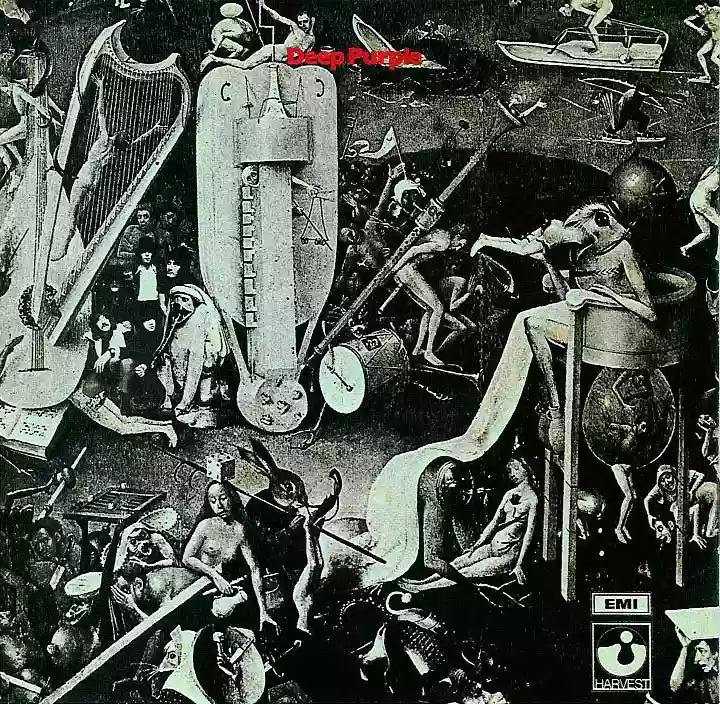
The self-titled album of the historic English rock band is the third and final chapter of Mark I. One might say "thank goodness!" The first three Deep Purple albums are indeed mediocre works: uninspiring compositions, poor production, bad sounds. However, one can already glimpse the technique and personality of musicians of unquestionable quality such as Blackmore and Lord (Paice at the moment is not even remotely comparable to the levels that will characterize him later). The type of music offered is quite in line with what was coming out of the great majority of rock and beat bands at that time. In short, nothing to do with what will be released just a year later with the advent of Gillan and Glover replacing Evans and Simper: a masterpiece named "In Rock," one of the most important albums ever, which will influence NWOBHM and generations of hard rock bands. The story of Deep Purple, the real ones, the magnificent ones, starts from there.
But let's go back to the album in question: as mentioned, it offers nothing innovative. It sounds like the work of one of many bands or sometimes of an uninspired band because they have already said everything. Compared to the two previous works, this album features fewer covers, only one. Tracks 5 and 6 are by all five members, track 4 is by all except Evans, track 1 is by Lord and Paice, track 7 is by Evans-Blackmore-Lord, track 8 is by Blackmore and Lord, and track 2 is by Lord alone.
Doing a track-by-track for this album is complicated, because the tracks convey few emotions and a lot of boredom. Before reaching the end of the album, you yawn several times, but luckily some nice imprints of Blackmore occasionally awaken the listener a bit. However, I'll try to give an overview as exhaustive as possible.
It starts with "Chasing Shadows" and you're immediately assaulted by Paice's unbearable drum sound: it seems like he’s using pots, and I'm not kidding. Equally rough is the sound of Lord's organ: it's annoying to hear on CD, let alone on a 1969 vinyl and record player! The song is bland and monotonous, and the unfortunate Evans certainly can't give any interpretation capable of making the song take off (I don't even want to dare comparisons with the likes of Gillan, Coverdale, Turner). Definitely better (not that it was hard...) is the second song, "Blind," which at least offers an interesting musical theme. The song is quite pleasant, and Evans's voice is definitely more confident compared to the first piece.
The third piece is the only cover present on the album; it's "Lalena," by the Scottish singer-guitarist Donovan. It's a ballad without particular pretensions, the kind that came out in packs in the Sixties. It moves on to the fourth song, titled "Fault Line" and right away you hear the extremely annoying sound of Lord's organ again and little else: a minute and a half aimed only at filling an empty space or, if you wish, at introducing the next piece "The Painter," a decidedly more rhythmic and aggressive composition, in which Lord and Blackmore find a way to take the lead with some enjoyable solos. Nothing memorable, mind you, but at least there’s a bit of a rock feel in the air, a prelude to the next song "Why Didn't Rosemary?", in my opinion the best track on the album. Here, too, Blackmore comes up with interesting riffs and solos, and Lord provides his unmistakable imprint with an organ that is finally pleasant and appropriately inserted. Perhaps it is also the piece that most anticipates what will be the style of albums like "Fireball".
It then moves on to "Bird Has Flown," a piece present in more than a few collections, maybe more for "contractual" reasons than anything else. The piece indeed marks a step back compared to the two preceding songs, aligning instead with the compositions at the beginning of the album. The last track is the twelve-minute instrumental "April". With rock now set aside, the composition is of a mild rhythm and varied instrumentation: in the central part, the longest, the strings dominate, returning at the end to give way to the album's standard sound; the piece concludes with Blackmore's guitar in the foreground, harmoniously accompanied by choirs.
Thus ends the adventure of Mark I and what I consider to be the worst work of Deep Purple after its predecessor "The Book Of Taliesyn". I would only recommend it to fans because, despite everything, that name is still on the cover. But the true Deep Purple will come later. To write the music history, to write "Smoke On The Water", to write the history of the Twentieth Century.
Tracklist:
1. "Chasing Shadows" 5:34
2. "Blind" 5:26
3. "Lalena" 5:05
4. "Fault Line" 1:46
5. "The Painter" 3:51
6. "Why Didn't Rosemary?" 5:04
7. "Bird Has Flown" 5:36
8. "April" 12:10
Bonus tracks in the CD reissue:
9. "The Bird Has Flown (alternate a-side version)" - 2:54
10. "Emmaretta (single b-side)" - 3:00
11. "Emmaretta (BBC Top Gear session)" - 3:09
12. "Lalena (BBC radio session)" - 3:33
13. "The Painter (BBC radio session)" - 2:18
14. "Lalena (instrumental)" - 5:00
Loading comments slowly
Summary by Bot
This review critically examines Deep Purple's self-titled Mark I album, describing it as uninspired with poor production and lacking innovation. While acknowledging the technical skill of band members like Blackmore and Lord, the album is considered mediocre compared to their later work. Particular tracks offer slight relief, but overall it fails to excite or engage. Fans may find some value, but the true Deep Purple legacy begins with the subsequent lineup.
Deep Purple
English rock band formed in 1968, pioneers of hard rock. Best-known for classic lineups (notably Mark II) and landmark releases such as Machine Head and the live double Made in Japan.82 Reviews
Other reviews
By jettero heller
How beautiful is this record!
A record to have? Absolutely yes, and proudly displayed in your collection!
