
 •
Rating:
•
Rating:
THE REVIEW
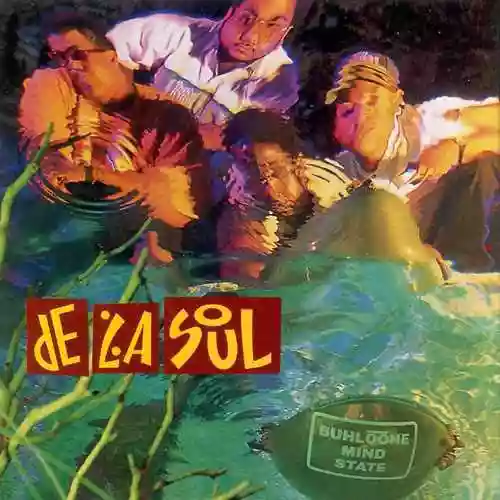
Crafting three masterpieces in a row is no easy feat. Sacred triads in discographies are favored by everyone, and I don't hesitate to consider such the sequence concluded with Buhloone Mindstate. An album often overlooked in their discography, released two years after the breakthrough of 3 Feet High & Rising, it aims to shake off the label of the mythical Hip-Hop of the late '60s that their debut in '89 had glued to them. And if much has been discussed about Hippie-Hop, now this De-La-odiata-Soul label seems irrelevant when discussing this album.
A modest outpouring of songs is the structure with which they reappear this time. Fifteen tracks compared to the nearly thirty of the previous albums: lack of creativity? Absolutely not. A well-focused and compact work, which thankfully avoids the risk of dilution that could have emerged in a sea of tracks. The style shows the touch matured over the years, but with new vitality. And so the trio wholeheartedly embraces the insights jazz-rap can offer, pushing beyond simple sampling: just like Ron Carter a couple of years earlier appeared on a record by their dear colleagues (1991, The Low End Theory), it's now Maceo Parker, Fred Wesley, Pee Wee Ellis playing directly on instrumental sketches of this album.
The De La Soul thus confirm a strongly musical rap, where the jazz-funk centered sampling counts almost as much as the rapping. They parade, stitch, tighten, glue, as always, but the wild Zappa-like experimentation is almost entirely abandoned. Amidst unexpected reprises, collaborations, rare scratches, the album continually changes temperature. Thus emerges an incredibly detailed work, and it is in the never banal details that De La Soul and this album show their strength. Colorful, positive, musical, unpredictable, engaging, they interlock samples with the vibrant creativity of a few, creating a Hip-Hop that doesn't fit the current stereotype at all. Weapons, money, "good" girls, big cars, crimes, and various nonsense don't belong to their world of pacifism and self-irony.
Here, you find Rap not necessarily aimed at those who could endure a bare flow in freefall purely spoken, but certainly more for those who find delight in the musical blend of the tracks.
Buhloone Mindstate confirms that reinventing oneself after monumentally diverse albums like the debut is not impossible. 3 Feet High & Rising, an unsurpassable pinnacle, from which the work in question stands very little apart, achieving this only because the novelty has already been flaunted.
It might blow up, but it won't go pop.
Loading comments slowly
Summary by Bot
Buhloone Mindstate marks the third major milestone in De La Soul’s discography, showcasing a mature, jazz-rap infused style that steps away from their earlier experimental hip-hop. With a concise tracklist and strong musical collaborations, the album emphasizes creativity and self-irony, avoiding typical hip-hop clichés. It is celebrated as a vibrant, focused, and unpredictable work, confirming the group’s ability to reinvent themselves while maintaining their signature musicality.Tracklist Lyrics Videos
De La Soul
De La Soul are an American hip hop trio from Amityville, Long Island, formed in 1988 by Posdnuos (Kelvin Mercer), Trugoy the Dove (David Jude Jolicoeur), and Maseo (Vincent Mason). Known for inventive sampling, witty skits, and a positive, alternative take on rap, they rose to fame with 3 Feet High and Rising and remain influential across hip hop.02 Reviews
