
 •
Rating:
•
Rating:
THE REVIEW
-
[ LÖW : FUTURE FUNK OF BERLIN ALEXANDERPLATZ ]
"Baby, I've been breaking glass in your room again. Listen.
Don't look at the carpet, I drew something awful on it. See.
Such a wonderful person, but you got problems. I'll never touch you."
Isolar II was the name of the 1978 tour that Bowie set out on to promote two of the three famous Berlin trilogy albums, in this case Low and "Heroes" (Lodger, recorded during breaks, never had its own live version and only six out of ten tracks were ever performed sporadically over the years and subsequent tours). The first Isolar tour dated back to 1976 and supported the Station To Station album, and generally the period when Bowie was staying in the United States.
Everything seemed distant and meaningless then, on stage the Aryan sound of the Thin White Duke, yet another pseudo-fascist, pseudo-romantic persona, perfect and devoid of any true emotion, artificial as only Bowie knew how to be in the same showbiz that was about to destroy him.
In Los Angeles, Bowie was simply going mad in a self-inflicted spell of spiritual impasse, with the gradual dissolution of his marriage underway and anxieties that would soon drain all his energies, fresh back from the lawyers’ meetings. The American years had seen the birth of crazy records, made in crazy states, in crazy and exhausted domestic situations. Bad records. Los Angeles was, for him, the most repugnant boil of the dregs of humanity; that filthy place, he said, should have been wiped off the face of the earth. A situation he had sought out, but whose side effects he could not handle. Fame, what you like is in the limo, what you get is No Tomorrow. Tour over. Heil. Eins, zwei, drei, vier und auf wiedersehen. Things would get better right after. What's your name? It’s Monday. New Music: Night and Day.
West Berlin, a serious city. Divided, nervous, isolated. Changing his way of living, and his way of living could no longer be rock'n'roll. It was different now, he was a businessman now, and the wish was to focus above all on making records. Alienation, Isolation, Residence.
Berlin would be his clinic, and more besides: a therapeutic experiment in chemical and spiritual detox. Berlin marked the definitive shift from Plastic Soul to a severe, martial, icy, mechanical Funky that would become the vanguard of the Berlin trilogy sound, an achievement more by Tony Visconti than by Brian Eno. To get away from sequins and glamour rock, it was necessary to move to a country that could finally foster the ultimate introjection of his para-fascist ethical and ideological fascinations / allusions, and that would allow him to find himself comfortable again by losing himself in the anonymity of a gloomy, bleak, tense city, rendered difficult by the oppressive presence of occupation forces. Berlin had the strange quality of making him write only important things. Berlin was the place of his regained mental and physical sanity, of his spiritual healing. Berlin back then, the darkest city in the world.
An apartment, a milk-based diet. Hansa by the Wall. TOTAL DEMOKRATIE.
Station To Station, as often happened in Bowie's albums, with its title track had prophesied all the work that would come on the next three records. A period musically influenced by that album, a new sound, derived from that track in particular and stripped of all the pre-Station To Station lipstick baroqueries, an essential but also ultra-saturated musical momentuum in the live sound. A documentation of collapse, of a sense of doubt, with much musical emptiness. Bowie was progressively dismantling himself, letting that instrumental void and its related symbology communicate for him. Low as in low profile, what the artist desperately sought after the historic hangover of success, fame, and money of the previous era; low as in depressed, the state he found himself in after experiencing all that spacetime. Low, the album, relentless and essential in its lyrics (few, fragmentary, unresolved, cyclic, not just for anti-narrative strategy, but because they were truly almost uninspired lyrically), spoke of simple, concrete, earthly (and consequently spiritual) things: separation from places, from people, from oneself, a kind of horror vacui / endured magnetism for depressed, solitary, war-devastated areas, and sometimes interstitial spaces (Warsaw, the Wall, Neukölln, the underground: quite plausibly in Dostoevskyan terms), and finally of a damaged life trying to be pieced back together and to be reborn elsewhere. "Heroes", truly heroic and majestic, splendidly hypertrophic and ultra-saturated and then anguished in its instrumental second part, which really seemed to let the listener smell the stench of the slums and their underbelly, with thriller atmospheres and cold, metallic underscapes, featuring Robert Fripp for just one night that lasted six hours while the master of frippertronics was on a break from his musical compositions. Lodger, the departure to other places, a shadowy and mute ending. A trilogy that attempted to portray not only Berlin, but real life in Western cities where people thought in fragments of reflection, cut-ups of intensive thoughts within environments and their things, from buildings to machines. Achtung für das Gesamtkunstwerk.
Bowie has always been and always did Pop. Here, his avant-garde consisted essentially in electronically filtering electric instruments in still-experimental compositions, in recordings sometimes deliberately lost, warped, discomforting. What he honed with Visconti was, first and foremost, a stunning, compact technological treatment much like the powerfully emotive pathos of a drummer like Dennis Davis, perfecting a rhythm section (with Carlos Alomar and George Murray) liquid Funk / Rhythm'n'Blues yet squared, blending with the European rigor of pianos, electric guitars, violins, synthesizers sometimes atonal and ambient more than atmospheric, to create a new (decadent yet shining) romantic lyrical and musical language.
Saturation. Before they knew it, Bowie/Visconti had achieved a sound never heard before. Tall in this Room.
Something in the Night, Something in the Day. Demagnetized tapes. Mercedes-Benz.
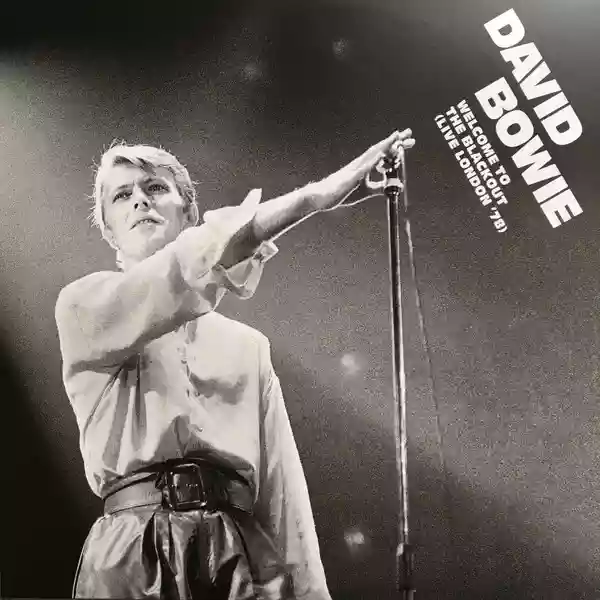
Welcome To The Blackout (Live London '78) documents in audio, along with Stage (★★★★☆), the live renditions of those albums and that era. The performance appears apparently more fluid, loose, relaxed, and thus less tense and cold compared to Stage (which, in truth, is preferable and where the tracks were deliberately slowed down for the recording), but it ends up definitely too long and distant from the essentiality, clarity, and justified iciness of Stage. And, after all, you should never completely trust Record Store Day releases that play on the buyer's collector's spirit.
Still, it's a double live album up to par, offering mental snapshots of a Bowie with a voice in great shape, beautiful and sexless like a stiff sun on a cold Berlin January day, with his aristocratic stage presence and the skill and charm of his regal, immobile, tightly controlled performances, in sober attire and no warm lights, only neon. Crystal crooning and a hysterical, piano-driven reality straight out of a 1930s Teutonic cabaret. The band particularly close-knit and synchronized in states and frequencies of grace, with a magnificent live sound, serving up a blazing, sparkling, electrifying version of Blackout, studded with feedback performances by Adrian Belew, a Station to Station with an even more Metall auf Metall intro, where Roger Powell further highlights the simulated symphony of railway tracks, a Moon of Alabama where all traces of the radiant Dionysus of the Doors are eclipsed, and in the shadows rules the canonical, European Thanatos, exalted by a chorus of macabre clowns from a circus of horrors and cruelty with large sections in a mechanical offbeat, a TVC 15 rendered even more boogie by Sean Mayes's piano, beginning with a pandemonium of zapping voices abducting girlfriends swallowed up by televisions long before Videodrome hit theaters. Memories of the delirium of a badly frozen and hallucinated period. And once again, an Art Decade that would so benefit the future of Japan. The flaws, which are (personally) the flaws of the tour itself, can be found in a setlist overly lightened by partial removal of repertoire from The Rise And Fall Of Ziggy Stardust And The Spiders From Mars, which, though performed with a brilliant sense of New Wave modernity, still remains a treacly romanticism that, in the concert’s economy, significantly lowers the levels of nervous tension and compositional strength (Five Years and the proto-punk of Hang On To Yourself aside); and finally, certain tom fill/grooves are too long, especially on the heroic, thunderously delivered, in the absence of Fripp, by Simon House's violin.
What should have always delighted one about that Bowie band at the end of the '70s, on the eve of Punk, was that in spite of such cold, metallic, ultimately Mitteleuropean music, during the Low/Heroes tour they were a multicultural staff all dressed in flashy Hawaiian shirts and/or Disco Music band outfits, with a drummer who would surprise you in unexpected Space Monkey attire. Yet another short circuit of meaning. Sula vie dilejo. Bahnhof Zoo.
Planned Accidents. Get me off the Streets, Get me on my Feet. Get Some Protection, Get Some Direction. Naples Zoo, October 2002. The Berlin trilogy albums have been very important to me. At the time, passing through towards another city made of iron and concrete, there were two things I always longed to listen to: the technological trilogy by U2 (especially Pop), and Bowie's Berlin trilogy, often replaced by the soundtrack collection of Christiane F.
All that was asked for were slashed, atmospheric, feedback-laden electric guitars, conjured up in mind and in large damp, empty industrial rooms. Darkness within. Even now, there's a return to those frozen places, and despite the totalitarianism of certain choices, of certain detractors, Lector, Scaruffi, Caspasian (Can you hear me, Major Tom?), Blackout is still considered one of the most beautiful and sublime tracks of neuromantic despair and burning desire for something that can never be obtained, in the history of all music, a piece whose musicality goes beyond, a song that the Beast will always dedicate to her love affair, of which the Beauty was never even aware, but it was she who brought him to the doctor, and he continued kissing her in the rain, because:
If you don't stay tonight, I will take that plane tonight,
I've nothing to lose, nothing to gain, I'll kiss you in the rain. Kiss You In The Rain.
Loading comments slowly
Summary by Bot
This review evaluates David Bowie's live album ‘Welcome to the Blackout,’ highlighting the powerful performances from his 1978 concerts in London. The review appreciates Bowie's stage command and the energy captured in the recordings. It commends the album for its sound quality and emotional resonance. The reviewer shares their admiration but acknowledges minor imperfections. Overall, the album is recommended for Bowie fans and live music lovers.
David Bowie
English singer-songwriter and actor David Bowie (born David Robert Jones, 1947–2016) was a pioneering, genre‑shifting artist known for his personas, musical experimentation and a career spanning pop, rock and avant‑garde projects.109 Reviews
