
 •
Rating:
•
Rating:
THE REVIEW
An Ironic and Electric Pierrot
or "David what should I do? They're waiting for me at the entrance!" "Don't ask me, I know no entrances"
"... a kind of purge. It was me rooting out the feelings from within myself with which I felt uncomfortable. You have to deal with yourself. You have to understand why certain things have happened. You can't just ignore them or push them out of your mind, or pretend they didn't happen, or just say "Oh, I was so different back then". It's very important to face and understand them. It helps to reflect on where you are now."
Yes, but where are we now? To find out, we need to take a step back and confront the past. I'll try to be as brief as possible. In '69, the young David Bowie, mime artist, painter, and singer, achieved success with the single "Space Oddity," from an album of new, slightly orchestral folk. He fell into obscurity for a few years during which he produced the story of a prog asylum entitled "The Man Who Sold The World" ('70) and "Hunky Dory" ('71), a mix of English and Lou Reed-esque decadence with a touch of cabaret. With "The Rise And The Fall Of Ziggy Stardust And The Spiders From Mars" ('72), "Aladdin Sane," and "Pin Ups" ('73), he analyzed every nuance of glam, from the symphonic to the hard rock, achieving sudden worldwide success thanks to the saga of his character Ziggy Stardust, a decadent alien descended to save the world but fails due to his sick and excessive costumes; he began various collaborations including a significant one with Lou Reed for "Transformer". In '73 Ziggy dies and transforms into an impressive apocalyptic freak named "Diamond Dogs" ('74), then converts to the plastic soul of "Young Americans" ('75), in the meantime, problems related to drugs and his image paranoia become interesting material for any psychiatrist. In '76 with the transition of "Station To Station," a mania for the occult and totalitarianism is added, and after acting in the reflective "The man who fell to Earth" in total madness in '77 he flees to France and finally to Berlin, whose bleak atmosphere influences the three electronic masterpieces "Low," "Heroes," and "Lodger" ('79), born thanks to the collaboration with Brian Eno and inspired by minimalism, oblique strategies, the thought of Nothingness and Death. During this detoxification process, Bowie subverts the rules of music, the business tied to the cult of image and the expectation from fans.
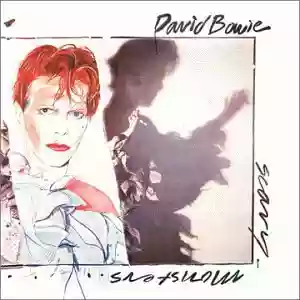
Now we're in 1980, a new decade is about to begin, yet another decade of musical and cultural changes and follies. Our protagonist is 33 years old, the age of Christ! A symbolic moment, not only because of the turning point and the achieved maturity, but also because, unknowingly, he's at the last important album of a career almost always on the rise, made, as we have just seen, of fundamental albums and boundless experiences. Do you know Hegel's triadic movement (or was it Kant?), roughly summarized as thesis-antithesis-synthesis? Well, this album is like that. If the thesis is Ziggy and the antithesis is the Berlin production, "Scary Monsters" is the synthesis. Didn't understand? Well, neither did I! But how can we fail to understand when we turn on the stereo, hear the pounding of the guitar, and the voice of a Japanese actress saying "Shiruetto ya kage ga kakumei o miteiru mo tengoku no giyu no kaidan wa nai"? How can we fail to understand when Bowie screams like never before and mocks himself right from the start, using once again that fantastic weapon to face the past called irony? These are extraordinary monsters, these silhouettes, and shadows at the end of the decade. This procession of super chills offers us all the previous ten years in ten songs, in a renewed, revolutionary guise, not rusty but frightfully aggressive and original! For the first time in a long time, we hear a David who with naturalness and a satirical approach enjoys himself with his band. There are no ghosts, no fears, no nightmares. The beginning with "It's No Game Part 1" is blazing and violent, then the glam of "Up To The Hill Backwards" and the claustrophobic title track are fought with electric sword strokes. Among other songs, there's "Ashes To Ashes," which is not only the return of "Space Oddity" in the form of futuristic funk that mocks Major Tom, but is also one of my girlfriend's favorite songs, and you can't ask for more than that! We have material to dance to with the new romantic "Fashion," a chart-breaking single, but Bowie mocks and criticizes the new wave generation, as we understand from the dramatic "Teenage Wildlife," a "Heroes" for the new millennium, an intelligent and delirious criticism (it says "one of the New Wave boys," but maybe it doesn't say "one of the No Wave boys"?), equipped with one of the best lyrics and melodies ever written by the ex-White Duke. "Scream Like A Baby," particularly with the sound find of "no athletic program, no discipline, no book...," will make us startle and amaze every time, and after the muted and choral tones of the cover of Tom Verlaine's "Kingdome Come," Bowie resumes an apocalyptic intro and variable rhythms in "Because You're Young." Like in a post-modern frame, this whole game closes in a circle with "It's No Game Part 2," a croonistic and calmer reprise of the first track.
Do you want to know more about the fundamental scope of the work? Perhaps it isn't enough for you to know that from "1.Outside" ('95) onwards all the "graduated critics" claim that each new release is the best since 1980, except for "...hours" and "Reality", the latter isn't even worthy of being on the same shelf (for me, any occasion is good to speak badly of "Reality").
Perhaps you also want to know that Bowie's new look resembles that of a glamorous and wobbly Pierrot (our dear one falls back into the image makeup, luckily this is deliberately comical), the famous video of "Ashes To Ashes" offers a futuristic visual support to the new wave and futuristic interweavings of the album, and thanks to the precious collaborations with Robert Fripp and Pete Townshend we can dive with greater involvement into this ocean of sounds and images, ironic criticisms, and satirical glances at the past... and let's absorb it and enjoy this dive well, because for the next thirteen/fourteen years we won't hear anything so significant again: a more than fertile musical and cultural era has ended, I would say perfect. It is a definitive goodbye to the '70s, to dreams, games, masks, turning points, strokes of genius, sound tricks, music made just for making music. If we look back, we see sun machines, supermen, whore queens, spaceships, and aliens armed with guitars and makeup, hell cities, coke stripes, thin white stations, crazy keyboards, and finally a Pierrot listening to a shoe... but it's time to look ahead, even if "the rest is boredom," as the poet said.
"Teenage Wildlife" translation taken from velvet goldmine
"Well, how do you explain that you only want tomorrow
With its promise
Of something hard to do
A real-life adventure
Is worth more than gold
Blue skies above you,
Sun on your arms
And the strength in your stride
And hope in those clear screaming eyes of yours
You'll receive a cold reception
Wherever you go
Blinded by desire
- I guess the season is open
So you practice fighting shadows, seeking the truth
But it's all, but it's all consumed
You've destroyed
Your million-dollar weapon
And still, you abuse, still you abuse,
still you abuse your luck
You're a magnate with a broken nose
One of the new wave boys
The same old story in a new disguise
Pushing itself forward, oh - ooh
Ugly as a millionaire kid
Pretending
It's a world of prodigy kids
You'll take me aside and say
"Well, David, what should I do?
They're waiting for me at the entrance"
I'll say, "Don't ask me, I know no entrances"
But they move en masse and corner me
I feel like I'm going against the flow, no-no
They can't do this to me
I'm not part
of that herd of juveniles
Those midwives of the past wear bloody robes
The password is that the prey is out there alone
You're alone maybe for the last time
And you breathe deeply
Then howl like a trapped wolf
And you do not dare look back
You fall to the ground
like a leaf from a tree
And you look one last time
towards the vast blue sky
You scream loudly as they take you down
No no, I'm not part
of this herd of juveniles
I'm not part
of this herd of juveniles
And no one will have seen
and no one will confess
The footprints will prove
that you wouldn't have made it
There will be others in line
to archive the past,
Whispering softly
I miss you, he just had to go
Well everyone for themselves, he was
Another piece of the herd of juveniles"
Loading comments slowly
Summary by Bot
This review celebrates David Bowie's 'Scary Monsters' as a powerful synthesis of his past musical phases, blending glam rock, new wave, and electronic influences. It highlights Bowie’s ironic and satirical approach, the album’s aggressive originality, and the cultural significance marking the end of an era. Standout tracks like 'Ashes to Ashes' and 'Teenage Wildlife' reaffirm his artistic genius. The review praises collaborations and visual style, establishing the album as a definitive and fertile moment in Bowie’s career.Tracklist Lyrics Videos
David Bowie
English singer-songwriter and actor David Bowie (born David Robert Jones, 1947–2016) was a pioneering, genre‑shifting artist known for his personas, musical experimentation and a career spanning pop, rock and avant‑garde projects.109 Reviews
Other reviews
By Mr_Iko
"Scary Monster represents a fundamental step in the Duke’s artistic career."
"Listening to it even today, it resounds fresh, lively, and sharper than ever."
By bogusman
Bowie says goodbye forever to his characters; for the catharsis to work, it’s necessary to bring them all back to life together.
Nothing to criticize about the conceptual/sonic depth of the work, too bad that the songwriting, although varied, doesn’t always meet the expectations.
