 •
Rating:
•
Rating:
THE REVIEW
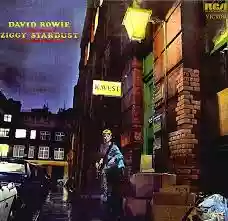
We like to remember him in the embodiment of his most successful persona, in the most brilliant of his many and creative disguises. At the peak of his artistic and commercial success, Mr. David Robert Jones (aka David Bowie) was Ziggy Stardust, literally "Ziggy Stardust," the protagonist of this album dated 1972.
Before outlining the album in its musical essence, a brief premise is necessary. We are at the beginning of the seventies, a period of ferment and 'cultural' and musical revolutions, the White Duke had just come off the great success of the first of his great albums, that 'Hunky Dory' capable of combining a refined avant-garde pop and a melancholic folk with retro tones, with occasionally surreal lyrics, gifting the audience timeless hits like "Life on Mars" and "Changes," the latter almost anticipating the philosophy of the character.
David Bowie decides to challenge the bigotry of the society of the time, to get serious, and finds his alter ego in Ziggy Stardust, an alien who has come to earth with a fanciful name and awkward, sleek movements, made up and pomaded like a drag queen with carrot-colored hair, able to unite in himself the transvestism and sexual ambiguity typical of the era and to represent a perfect union between art and commerce.
It is an alien whose appearance has a beginning and an end (The rise and fall..), a principle and then a rapid downfall, and is impersonated by Bowie, who enjoys parodying the ephemeral myths created by society and the easy throwaway celebrity typical of Western consumerism; in the figure of Ziggy, there is also a gloomy forecast of a dark and devastated future, of an "alien" and robotic man, seemingly disconnected from his peers, which sounds almost like a funeral prophecy that he will partially revisit in his later albums.
The first side of the album begins with Ziggy's rise, immediately the protagonist of an apocalyptic prophecy. "Five years left to cry in": we have only five years to live and there is nothing left but a "term" existence without escape for mankind.
A percussive drum sets the rhythms, the song starts slowly and then gradually swells into a vortex of pathos with Bowie's liberating scream; the second song is the pleasant "Soul Love," in which there is a sweet background of acoustic guitars and an extremely simple and expressive intonation, immediately after the dramatic rhythm of "Moonage Daydream" bursts in and here the character Ziggy is partially unveiled: "I am space invader, I'll be a rock n rollin beach for you" that is to say an ambiguous, irreverent being and "a whore" of rock n' roll, a symbol of the commodification and commercialization of art. The song takes the form of an electric ride, with guitar distortions galore and a rapid sax solo, in the purest glam-rock style.
Introduced by an acoustic guitar riff, "Starman" (which recalls the character of Ziggy) will remain one of the most famous bowiean melodies, and - how can we not mention it? - the splendid refrain is an example of how our man knew how to write beautiful music that was at the same time easy for the public to memorize.
"It ain't easy" is a short space-country interlude, a bit livelier in the multi-voiced refrain, and almost represents an introduction to "Lady Stardust," another absolute melodic gem exalted by the splendid pianistic figures of Mick Ronson (from the band that accompanies Bowie, the Spiders from Mars) and by the intense interpretation of David's voice.
The character Ziggy has by now become a "Star," a track featuring the gritty guitars of the Spiders from Mars and their rhythm section that propels it at supersonic speeds. The same rhythmic pulse is repeated in the punk rock of "Hang on to yourself," while the famous title track is opened by a guitar riff as famous as it is original and will remain identifiable as an evergreen of the White Duke.
That would already be enough for a beautiful and complete album, but here we want to go further: comes the splendid romp of "Suffragette City," a track with hypersaturated guitars and high speed, with little choirs here and there to enhance its ambiguity; the lyrics are indeed a hymn to prostitutes and the song will remain one of the battle horses of the glam era.
Finally comes perhaps the most exciting moment, the saga of Ziggy Stardust closes with a "Rock n' roll suicide": the acoustic guitar marks the slow initial moment, in which the farewell of the alien is celebrated in the most theatrical way possible, with a cigarette in his mouth (Time takes a cigarette, puts it in your mouth) and reaching up to the final crescendo with strings and brass, in which one last moment of closeness with the audience is celebrated by Bowie's in turn theatrical and neurotic singing (Gimme your hands, cause you're wonderful) accompanied by the sounds of the Spiders from Mars; this too will remain one of the "moments" to remember and that will see the shows with Bowie/Ziggy as a protagonist light up considerably. Maximum scores.
Loading comments slowly
Summary by Bot
This review celebrates David Bowie’s 1972 album The Rise and Fall of Ziggy Stardust as a pinnacle of glam rock and artistic innovation. It highlights Bowie’s alter ego Ziggy Stardust as a challenge to 1970s societal norms, combining theatricality with deep cultural critique. The review details key tracks, praising their musical depth and memorable melodies. It underscores the album's lasting impact as a cultural and musical milestone.
David Bowie
David Bowie (David Robert Jones) was an English singer, songwriter and actor famed for continual reinvention and theatrical personas. A pivotal figure in glam rock, he later shaped art-rock and electronic music with the Berlin Trilogy (with Brian Eno and Tony Visconti). His final album, Blackstar, appeared in 2016 shortly before his death.110 Reviews
