
 •
Rating:
•
Rating:
THE REVIEW
"I don't think art is of much use unless it shocks" David Bowie said in 1973.
After about twenty-five years of constantly raising the stakes, Bowie finds himself in the mid-nineties at a time when the average Western taste has already abundantly metabolized atrocity, as evidenced by the daily ambivalence between simulacrum and reality (on TV, mutilated corpses that seem like special effects and a Gulf War that looks like a video game and vice versa).
The perspective to look at reality is no longer the politically correct one of denunciation, nor the invention of an Orwellian world; in 1995 Bowie realizes that shocking is increasingly difficult and that the only way to "represent" contemporary horror seems to be through a cynical pop assemblage of the reflections that make up its image. A gigantic collage constructed by pushing to the maximum the mechanism of citation that simultaneously reunites and contradicts the most disparate aesthetic experiences of recent decades.
Art or not, reality or invention, one's own ideas or someone else's, it no longer matters; Bowie is too chic to be concerned with the genuine artistic nature of his expression and too aware that his work (and rock in general) now more than ever has to be derivative.
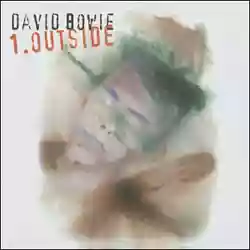
In 1.Outside, his tendency in his works to be not only works of musical "genius" but also and above all conceptual systems becomes even more explicit. Here his vocation for staging finds its definitive sublimation in a puppet theater/characters (about 7) gravitating in the most degenerate environments of a phantom-body art, somehow entangled in the murder-performance of little Baby Grace Blue: the clues span over a time cycle (but not linear...) of events ranging from a not randomly chosen 1977 to a similarly emblematic December 31, 1999.
From a musical point of view, the work presents itself as an absolutely contemporary synthesis of everything that in the previous twenty years had clashed with Bowie's explorations: a collision staged in 14 (splendid) tracks and 6 bridging narrations, amidst digested remnants of ambient music, contemporary industrial rock, mutant funk, fragments of glam and Berlin languor, and much more, all emulsified by a dissociated writing style, proceeding by accumulations, ellipses, and gaps, finding its programmatic reflection in the deliberately unfinished nature of an open-ended finale.
It's happening now
Not tomorrow
Loading comments slowly
Summary by Bot
David Bowie's 1.Outside album from 1995 is praised as a daring conceptual work blending music and art. It reflects the era’s complex reality through a collage of genres and narratives. The album's open-ended storytelling and fusion of styles make it a standout in Bowie's career and 90s music. It challenges conventional artistic norms with a sophisticated yet accessible approach.Tracklist Lyrics Videos
01 Leon Takes Us Outside (01:24)
05 Segue - Baby Grace (A Horrid Cassette) (01:40)
08 I Have Not Been to Oxford Town (03:49)
10 Segue - Algeria Touchshriek (02:03)
11 The Voyeur of Utter Destruction (As Beauty) (04:21)
12 Segue - Ramona A. Stone / I Am With Name (04:01)
15 Segue - Nathan Adler (01:00)
17 Thru' These Architects Eyes (04:22)
18 Segue - Nathan Adler (00:28)
20 Get Real (02:50)
David Bowie
David Bowie (David Robert Jones) was an English singer, songwriter and actor famed for continual reinvention and theatrical personas. A pivotal figure in glam rock, he later shaped art-rock and electronic music with the Berlin Trilogy (with Brian Eno and Tony Visconti). His final album, Blackstar, appeared in 2016 shortly before his death.110 Reviews
