
 •
Rating:
•
Rating:
THE REVIEW
"I'm sick, I'm really sick,
can you take me to the hospital?"
Just before the mid-'90s, a Roman singer-songwriter with a peculiar look was emerging on the horizon. Joyful, crazy, and committed at the same time. This was Daniele Silvestri.
Everything started with the release of his first work, a self-titled album from 1994 (now out of catalog, which back then won the Targa Tenco as Best Debut Work, featuring "Il Flamenco Della Doccia" and "Voglia Di Gridare": the latter was also performed at Sanremo Giovani). But that was not the end. A change was near that would lead him to decide to bring out the best of himself even more.
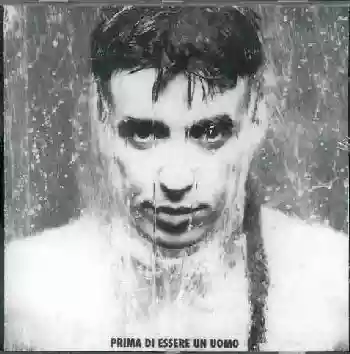
And Daniele chooses, in 1995, to release "Prima Di Essere Un Uomo".
What is this album? It is certainly his first egg outside the basket (thanks Primiballi), the definitive realization (along with the subsequent "Il Dado") of that imagination that Daniele didn't lack and seems to have partly lost today (does "Monetine" say anything, the remake of "Pozzo Dei Desideri", which however does not reach the levels of the original?).
"Prima Di Essere Un Uomo" is a panorama of the world according to Silvestri, a summary of what his senses perceive, the senses of a thoughtful young man even in the most unexpected moments (see the cover, where he seems to be in the shower): it goes from the anger of suffering men ("L'Uomo Col Megafono", with which he returns to Sanremo armed with signs during the performance, and having as an accomplice the ironic Anna Falchi who mockingly called him "the killer of a record") to a love declaration different from the usual one ("Le Cose In Comune"), from shock over things of little value ("L'Y10 Bordeaux", present in two versions), to the fear of being deluded by those moments tied to adolescence ("Illuso"). Until reaching a self-portrait (the title track), electronic experiments with a Woody Allen film in hand ("La Technostrocca ("S" Con Dario)", where samples from the film "Annie Hall" can be heard), the desire to forget certain bad moments, under a Latin panorama ("Frasi Da Dimenticare"), and even empathizing with a mother doing everything to save her son from an imminent explosion ("Lieve La Musica", which starts with a radio news report à la Lucio Dalla and ends with a wonderful guitar solo by Cesareo from Elio e le Storie Tese, where he even manages to surpass Brian May in style) or a man unsure if his wedding "should happen" ("Domani Mi Sposo" and "Sì, No...Non So (Comunque Ci Penso)", the latter also having Dalla-esque elements). But with the awareness of always having eyes pointed towards the future, watching many missiles about to launch ("Marzo 3039").
Anyone who knows they don't have a damn wall in their head (as Fossati said) should listen to this album and realize that Daniele Silvestri is not just the man of "Paranza" (a song I don't despise, but don't adore like the early ones), but a capable singer-songwriter at the time (as has been and still is his friend Max Gazzè a little later) of doing anything and everything, and who at the time "spoke" like his man with the megaphone, to the point of being nicknamed "Er Megafono".
"Because today the missiles launch,
I'll watch them and they'll be beautiful..."
Loading comments slowly
Summary by Bot
This review praises Daniele Silvestri's 1995 album Prima di essere un uomo as a vivid and imaginative work that combines social commentary, personal introspection, and musical innovation. It highlights the album's diverse themes, from political anger to tender love songs and playful electronic experiments. The review also positions Silvestri as a versatile artist capable of evolving beyond his early hits, encouraging listeners to rediscover his talent.Tracklist Lyrics Videos
Daniele Silvestri
Daniele Silvestri is an Italian singer-songwriter from Rome, frequently described in the reviews as an intelligent lyricist and a versatile musician able to move across many styles. Reviews highlight both his political/committed writing and his ironic side, with a noted mainstream breakthrough around the Sanremo 2002 era.11 Reviews
