
 •
Rating:
•
Rating:
THE REVIEW
HORSEY:
Terrify Not Man Lest God Terrify Thee:
Current 93
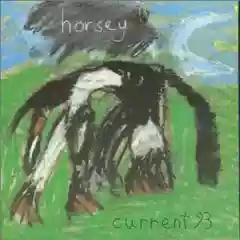
"Horsey" saw the light in 1997 and is certainly to be included in the list of atypical albums by Current 93.
In this experiment, which we can label as "folk/noise", David Tibet's indomitable poetry opens up to the roar of electric guitars, with results, however, not always convincing.
Talking about a real album is actually not entirely correct, since the material gathered here stems from two different sessions, recorded in different places and circumstances, with the contribution of different musicians.
The first three tracks are nothing more than the re-emergence of the EP "Horse", originally released in 1990 in a now very rare box, which originally contained, besides the EP in question, also "Lumb Sister" by Nurse with Wound" and "Lex Talionis" by Sol Invictus.
The last three tracks, on the other hand, stem from a live recording session in Shizuoka: an improvisation experiment in which Tibet surrounds himself with Japanese musicians capable of injecting into the tried and tested sound of the Current a good dose of jangling noise-rock (!!!).
Needless to say, the "English" part, strengthened by the participation of figures of the caliber of Steve Stapleton, Tony Wakeford, and Douglas P., is the more interesting of the two.
The first two tracks are genuine masterpieces: the opener "Diana", a cover of Comus, opens with a looped violin riff over which David Tibet's nervous poetry is grafted. This is followed by tragic piano tolls, the roar of the electric guitar, Wakefordian bass pulsations, in a crescendo that overall (improperly or not) recalls the electro-acoustic phrases of "Cupe Vampe" by our own CSI.
"The Death of the Corn" is instead the typical folk ballad of Current 93, in my opinion one of the most beautiful and intense ever, destined not by chance to become a true classic of the band. The references to the art of Sol Invictus are evident, especially for Tony Wakeford's unmistakable style on the four strings.
This first part closes with an uninvolving "Thee", a rather anonymous episode where the whistles of the electric guitars return to dirty David Tibet's ravings, eternally faithful to his visions: a reinterpretation of the terrible art of early Current 93 through the acidic and rusty sounds of a claustrophobic noise-rock.
While the "Japanese" part, though bolder in its intentions, does not settle on the same quality levels.
"Broken Birds Fly I (Maldoror Waits)", originally appearing as a bonus cd in the magazine "Plotemaic Terrescope", opens this second set with hypnotic and compelling sounds in which Tibet's ungraceful singing takes up the eternal theme of Maldoror, so dear to the English artist, proposed in all sauces throughout his personal artistic journey.
The piece, despite being a commendable attempt to transmute the spirit of the Current into a more genuinely rock-psychedelic dimension, ends up being tiresome, perhaps because it all sounds like an improvisation exercise for its own sake.
Better then the caustic ten minutes of the title track: "Horsey" is another exhausting electric crescendo, shaken by the nervous beats of the drums and paranoid guitar turns. Towards its middle, the track will have the audacity to turn into a true metal-flavored gallop (!!!).
For the record, there is also an acoustic version of this track, markedly better than this one: it is the "Hooves" never released by Nature & Organization of Michael Cashmore, later retrieved in the collection "Emblems: The Menstrual Years", often performed live and undoubtedly to be counted among the classics of Current 93.
"Broken Birds Fly II (Maldoror Wails)", which is practically the same as its first part, closes the dances without excitement.
Ultimately, a work lacking cohesion, this "Horsey", in which the different episodes suffer from the absence of a single concept to tie them together and give them a complete sense.
An album, however, that at times really excites and more generally highlights the courage and desire to experiment of a restless and tireless artist like David Tibet, who with "Horsey" gives us an unpublished part of himself, as well as another significant piece (the umpteenth one) in an incredible career rich with twists and turns.
Loading comments slowly
Summary by Bot
Released in 1997, Current 93’s Horsey blends folk and noise with electric guitars and poetic vocals. The album combines distinct sessions featuring varied musicians, producing uneven results. The English session tracks stand out for their artistic strength, while the Japanese live improvisations feel less compelling. Despite its lack of cohesion, Horsey showcases David Tibet’s fearless experimental spirit.Tracklist Lyrics
Current 93
Current 93 is an English experimental music group formed in 1982 and led by David Tibet. The project moved from early esoteric/industrial collages (Nature Unveiled, Dogs Blood Rising) into apocalyptic folk, dark chamber music, and various experimental forms across decades, often collaborating with figures such as Steven Stapleton and Michael Cashmore.55 Reviews
