
 •
Rating:
•
Rating:
THE REVIEW
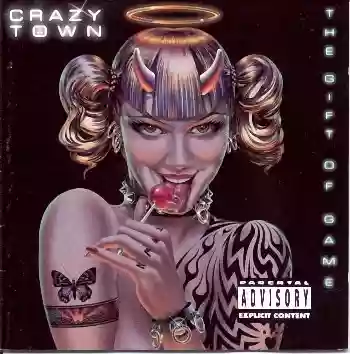
10 years after its release, I will talk to you about "The Gift Of Game", the first album by Crazy Town.
The group is often referred to as a 'One Hit Band', the tattooed guys of "Butterfly", yet I want to prove the opposite as much as possible. The band indeed has known from the start how to propose a style of its own, rebuking fans with a sound close to pop (as "Butterfly" and "Revolvin’ Door" attest) without ever forgetting to be fundamentally a rapcore band. The hybrid that formed, specifically the fusion between two rappers like Seth Binzer and "Epic" Mazur and the punk rock style injected by various A. Valli (guitar) and D. Miller (bass), is the driving force of "The Gift Of Game".
Ranging from the rough "Toxic", which serves as a precursor to various third-millennium chart hits by Linkin Park, P.O.D., and the like, to the more inspired "Darkside" and "Think Fast" that are greatly influenced by the 'rap-gangster' style worth the best outcasts of L.A.
Los Angeles, in fact, serves not just as a muse for the lyrics with transgressive sexual and drug allusions but also as a pivotal point for the band's name, indeed 'Crazy Town', as mad as the city itself.
Excellent too are the mixing work and the effective bases that serve as filler in tracks like "Black Cloud" and "Only When I'm Drunk", while what's persistent is the good harmony between the duo Seth/Epic, always in sync, one never stepping on the other's toes, allowing room also for instruments, drums, bass, and guitars even though marginally.
After a series of interesting pieces such as "Toxic" and "Darkside", the super-hit "Butterfly" arrives, with a sample from a Red Hot Chili Peppers track (from the album "Mother's Milk"). "Butterfly" becomes the band’s flagship, achieving excellent sales results in Europe and the USA, but as mentioned, it caused unrest among the earliest fans, who saw them moving away from the vigorous paths of hip-hop to tread the simpler rap/pop path. So great was the disappointment that after various boos at live performances during "Butterfly", the band began to perform the piece with an extra touch of aggressiveness.
Continuing, noteworthy are "Face The Music" (and here I'll open a parenthesis) and the softer "Revolvin' Door" which tried in vain on MTV to replicate the success of "Butterfly". I was talking about "Face The Music", the piece is almost identical to "Head For The Barricade" by Limp Bizkit, or rather, the latter is identical to the former since it was published 4 years later by Bizkit, in 2003 in the album "Results May Vary". This note should be considered exclusively as a personal opinion, but for those who know the works I've cited, the 'coincidence' is very evident.
In conclusion, I say that this first work is definitely superior to the next and last (as of today) "Darkhorse", of 2002, an album also reviewed by me which is decidedly more stereotypical of the historical period, meaning the melodic nu-metal trend (if it can be called that) that was very fashionable at the beginning of this decade. The band later broke up also due to drug-related issues involving one of the two vocalists (I can't tell you who, I believe Epic Mazur, for understanding, the one less tattooed between the two in the famous "Butterfly" video).
However, 7 years later and after a mediocre solo career by Seth Binzer, the group will return with a significant "Crazy Town Is Back" to be released shortly. We will see if besides the band, the much-sought success will return, also to definitively destroy the very annoying stereotype of 'One Hit Band', a stereotype that otherwise might strengthen with a work not up to expectations.
Loading comments slowly
Summary by Bot
This review reflects on Crazy Town’s debut album The Gift of Game, highlighting its unique fusion of rap and rock that goes beyond their hit 'Butterfly.' The reviewer defends the band’s distinct style and praises key tracks like 'Toxic' and 'Darkside.' They also discuss the band’s struggles and future comeback, emphasizing the album’s lasting relevance.Tracklist Lyrics Videos
Crazy Town
Crazy Town is an American rap rock group from Los Angeles, formed in 1995 by Bret “Epic” Mazur and Seth “Shifty Shellshock” Binzer. They are best known for the 2000 hit single Butterfly from their debut album The Gift of Game, followed by Darkhorse (2002) and the comeback album The Brimstone Sluggers (2015).03 Reviews
