
 •
Rating:
•
Rating:
THE REVIEW
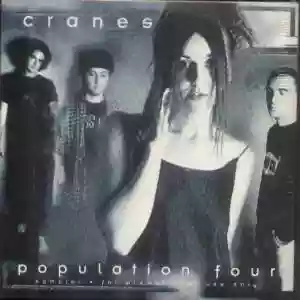
Chapter four, as the title suggests. At least officially, because considering the entire discography (from the semi-amateur double vinyl “Fuse”, to the debut mini LP “Self-Non-Self” onwards, including the collection of remixes), we should actually be facing the sixth discographic release from the Portsmouth band. After two critically discussed albums (in an ambivalent way), such as “Forever” and “Loved”, which for better or worse marked an artistic evolution for the group and established them among the general public, “Population Four” marks a clear stylistic and instrumental shift and requires, in my opinion, a retrospective reflection.
One can try to imagine the dream pop of the Cocteau Twins, sometimes whipped by “cold gusts of wind” (to quote a well-known contemporary writer), illuminated by the distant gleams of the post-apocalyptic Berlin of Einsturzende Neubauten and cloaked by the techno-rock-sampled roughness of the early Young Gods. This was the debut of Cranes, a band that staged “a ghostly universe of contrasts between dissonant industrial sounds and ethereal voices,” wrote Vittore Baroni.
After the double CD reissue of “Wings of Joy/Self-non-Self” in 1993, the subsequent “Forever” was decidedly influenced by the encounter with Robert Smith (the participation in the “Wish” tour projected the group onto the world “alternative” rock/pop scene) and so was “Loved”. What characterized those pieces of music was a greater presence of keyboards, a skillful “dosage” of feedback and piano, wider soundscapes, more varied rhythms, and some good quality songs like “And Ever” and “Sun And Sky”, followed by “Paris and Rome”, indicating the romantic fascination (in the literary sense) of Alison Shaw, the model of the “exploding track” (practically a kind of “Plainsong” updated to the rhythmic cadences of the group’s new “Mediterranean dream pop” hybrid), an authentic interest as confirmed by the theatrical work “La Tragedie d’Oreste Et d’Electre”.
Stylistically demarcated from its predecessors, it was said, this “Population Four”, appears a more “spartan” work compared to the instrumental sumptuousness and arrangements of its predecessors: drier, bare, and in its own way essential, from the opening “Tangled Up” marked only by acoustic guitar and voice, to the second track “Fourteen”, which seems to contain distant reminiscences of the beginnings, the entire work seems to proceed in an ascending way creating the expectation of a climax that never materializes, or so it seems… indeed, shortly after the midpoint of the CD, “Angel Bell” stages strings and distorted guitars in an almost “expressionistic” way, and the explosion of paroxysmal drumming mixed with guitar-noise vaguely recalls “Starblood”, to reach towards the conclusion one of the gems of the album: “On Top Of The World” (the poetics underlying the title is in continuity with “Wings Of Joy”). The entire work, on one hand, consolidates my (personal) opinion, that it is a group with notable talent and still partially unexpressed potential, and on the other hand seems to initiate a transition. One towards a sound and a genre increasingly less “codifiable” and “contained”, placing the Cranes outside the boundaries of the “stylistic geography” of certain British techno/rock/ethereal music (Curve, Bleach, Slowdive…).
It could, perhaps, truly be a surpassing of the past… so vivid and (in the end) reassuring as to overshadow (or “darken”) what, from a band located at latitudes more familiar to us in English, is asserted as a slogan: “Look Into The Future”.
Loading comments slowly
Summary by Bot
Population Four marks a clear artistic shift for Cranes, moving toward a spartan and essential sound compared to their previous richly arranged albums. The album blends dream pop with industrial and alternative influences, revealing the band's evolving musical identity. Thoughtful reflections highlight notable tracks like "Angel Bell" and "On Top Of The World," emphasizing transition and potential. While it lacks the lushness of earlier works, the album offers a moody, ascending atmosphere that sets Cranes apart in the British alternative scene.Tracklist Lyrics
Cranes
Cranes are an English band from Portsmouth formed by siblings Alison and Jim Shaw. Emerging in the late 1980s with industrial-tinged dream pop, they gained wider attention with Wings of Joy (1991), Forever (1993), and Loved (1994). Their sound blends ethereal vocals, dark atmospheres, and shoegaze textures, later incorporating minimal electronics into 2000s releases.08 Reviews
