
 •
Rating:
•
Rating:
THE REVIEW
So, there is this American writer, born in Georgia in 1925, Flannery O'Connor, who died at the age of 39 from SLE, systemic lupus erythematosus, author of two novels and some stories, who seems to have influenced several rockers and songwriters (among others Nick Cave, Bruce Springsteen, Natalie Merchant, Lucinda Williams).
At the time of their fourth album, the Timmins brothers stumbled upon the "country" and "clumsy Thomist" writer. O'Connor indeed lived in the countryside, raising peacocks, and loved Aquinas and his Summa Theologica.
This writer, defying the public of the Southern states whom she enormously scandalized, does not get lost in the convoluted labyrinths of consciousness nor in romantic drifting. Instead, she pursues an integral vision of the world. A concrete reality, which she perceives as unfinished and mysterious. To be contemplated in an anagogical vision, capable of seeing the different levels of reality in every situation and/or thing. Levels of a world built not of facts, but of relationships.
She deserves to be remembered even if only for how she commented on the event that saw her as a protagonist at six years old, when the state TV filmed her for having taught a chicken to walk backward. "It was the high point of my life. Everything that happened afterward was an anticlimax."
The three Timmins brothers, Margo singer, Michael guitarist and composer, Peter drummer, plus friend Alan Anton bassist, formed Cowboy Junkies in Toronto in 1985. After a spontaneous debut that paid homage to Delta Blues, with "The Trinity Session" (1988) they discovered their calling for Alternative Country, with slow, atmospheric, twilight ballads, even narcoleptic, that would influence Slowcore (Codeine above all). This is where their expressive peak should be sought. "Trinity" was recorded in the Church of the Holy Trinity in Toronto, live, without an audience, in a single day, equally dividing the material between original pieces and covers. It consisted of delicate, minimal, yet enveloping and mellifluous textures, for a gentle and evanescent voice.
Then, in the third work, they moved closer to the songwriting of Leonard Cohen.
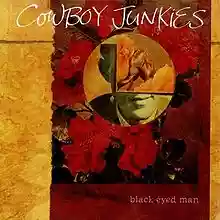
The fourth album, released in 1992, is this "Black Eyed Man", with Michael Timmins doing more personal songwriting, even self-producing the LP. There are only two covers of Townes Van Zandt. From slow, night-illuminated, and desolate ballads, we move to a more concrete, material, and vivid sound, with a more decisive instrumental approach. Country ballads, Blues and Folk, Dixieland and Waltz become present between the earth and the sky, between the bucolic and the mystical, open scenarios on the protagonists. Embodied, real, and material characters in these songs; not the abstract vastness of ideas or the turmoil of emotions. But characters. Men, their prisons, the Oregon dust, the Southern rain. And again Bobbie, Suzie, Marie, free horses on the prairie, women married too young, Mrs. Annabelle murdered in Trailer Park. Concepts do not make stories or songs. History is not made of events, but of relationships, concrete relationships between people.
Every detail enters the work. The "Black Eyed Man" should be a sort of liberator and instead, he is suspected of "poisoning the well water." Yet, against his will, he will learn that the endpoint is to "come to the experience of the mystery itself."
Enlightenment common sense is unsatisfactory to shed light on the world. The Cowboys too are interested in what is arduous, elusive, sometimes incomprehensible. They look to the past, the 30s, for this. They pursue their "anagogical vision" which, in biblical exegesis, concerns the secret connection and man's participation in God's life, beyond the literal, allegorical, and moral meanings of the Scriptures.
So these troubadours devoted to maple syrup, as good storytellers, always speak and sing of the whole world. What the artist creates comes from a realm much broader than their mind, which otherwise would hold no value.
The ineffable singing of these narratives, then, is their evocative glue. Margo's vocal interpretation is unique, sublime, dreamy, voluptuous and ethereal. Margo blends sensuality and innocence, purity and maturity, warmth and coolness.
Among the songs, all of very good level, stand out the disturbing "Townes Blues", "This Street, That Man, This Life" their most beautiful, bittersweet song at the same time, with exhilarating timpani rings, "To Live Is To Fly" a superb reinterpretation of Van Zandt: "Living is flying, low and high, so shake the dust from your wings and the sleep from your eyes."
Michael stated: "The record has a precise lyrical theme, which is that of love found, lost, and betrayed, the journey of the black-eyed man, a persecuted man, faceless, nameless." It recalls a character of O'Connor, from "Parker's Back", "Parker's Back." A man from the 1930s/1940s, an oppressed one, a loser, cynically defeated by life, who enigmatically had a Byzantine Christ figure tattooed on his back. Similarly, the "Black Eyed Man" almost appears as a messianic figure, among the dusty roads of Alabama (Oregon Hill).
"The fiction writer must realize that it is not possible to evoke compassion with compassion, emotion with emotion, or thoughts with thoughts. All these things must be given body, creating a world endowed with weight and thickness." So does the musician, so do the Timmins brothers. A journey into the dark regions of the heart where redemption is awaited, but the signs of grace are never missing. Redemption, then, as not having to be "our story" alone.
Loading comments slowly
Summary by Bot
Cowboy Junkies' fourth album, Black Eyed Man, marks a shift towards a more vivid, character-driven sound blending country, blues, and folk. Inspired by Flannery O'Connor's vision of concrete relationships and mystery, the album explores themes of love, betrayal, and redemption. Margo Timmins' ethereal voice and Michael Timmins' personal songwriting enhance this evocative work. The album stands as a significant contribution to alternative country and slowcore styles.
Cowboy Junkies
Cowboy Junkies are a Canadian band formed in Toronto in 1985 by siblings Margo (vocals), Michael (guitar, songwriter), and Peter Timmins (drums) with Alan Anton (bass). They rose to acclaim with The Trinity Sessions, recorded live with a single microphone at Toronto’s Church of the Holy Trinity, and are known for hushed, atmospheric alt‑country and slowcore-inflected songs across a decades-long career.05 Reviews
