
 •
Rating:
•
Rating:
THE REVIEW
Many of us remember 1969 primarily because that year five young men led by Robert Fripp transported music to a new world never heard or seen before, a dimension made up of expanded, sumptuous, threatening compositions, populated by visions similar to intoxicating smoke led by the majestic pace of mellotron and solemn guitars. That epoch-making album symbolizes the full bloom and maturation of the progressive seeds that people like the Nice, the Moody Blues, or the Procol Harum had been sowing for a couple of years.
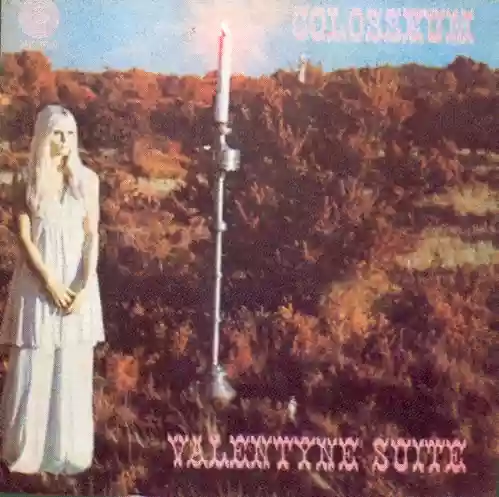
Few, as I have observed, remember instead that in the same year as the Crimson King, a jazz-rock formation released an album that, in my opinion, is not celebrated as it should be, perhaps because Colosseum was indeed a jazz-rock band, perhaps because David Greenslade's genius got a bit lost in the annals of history. It must be said that this unique “The Valentyne Suite” is a decidedly fragmented and non-unified work, and only the imposing final composition, a true epitome of progressive brass and keyboard music, is worthy of directly entering the myth.
Of the five tracks that make up the work, four are little more than harmless, appreciated mainly for the excellent work of a dream rhythm section composed of Tony Reeves on bass and Jon Hiseman on drums, and for Dave Greenslade's organ counterpoints, while the rest, from Reeves' very "black" voice to Heckestall-Smith's winds to James Litherland's guitar remains at very high technical levels but fails to astonish. It starts with the pseudo-prog jazz of The Kettle, characterized by distorted guitars that also perform lacerating riffs; the drums are dry, violent, and precise, but the rest, including the voice, is quite anonymous. In Elegy, Hiseman lays down some impressive brushwork, Greenslade remains in the background with his organ, good sax interventions for a fast and very jazz piece; more hammond instead and a mild rhythm in Butty's Blues, a nighttime piece, from the Thirties, very elegant and well played, but again nothing exceptional. Better is the following The Machine Demands A Sacrifice, more distinctive, sung with a hoarse and ungraceful but effective voice and characterized by intense percussion work. Note, beyond the picturesque title and lyrics, the organ interventions and the "double ending" with the song fading to silence, only to rise again suddenly for one last, threatening breath.
Turn the record over, and we are greeted by a disturbing bass riff immediately supported by a distant organ and then by an excellent drum. You are dazzled, and then you find we are facing January's Search, the first theme of the incomparable "Valentyne Suite". It is not jazz, it is not rock, it is not psychedelia, it is pure progressive, it is history taking sound and form. Everything, from Greenslade's beautiful keyboards, to Heckestall-Smith's fabulous and acrobatic sax, to Jon Hiseman's superb and indescribable drumming, is absolutely perfect, balanced, impeccable, exciting. The first theme is a majestic and smooth digression like a fabled river, and it grows with grace and kindness, but exudes an underground power that drags and carries on unforgettable riffs; a slowdown, a dark piano passage, the saxophone wafts into a nonexistent desert, the rhythm expands, then a bass emerging from the shadows with a menacing urgency gives life to the second theme, February's Valentyne. I dare say the initial organ solo is one of the most beautiful in all of progressive rock and rises to epic heights never touched before, evoking a sort of cathedral, a gothic creation without spatial boundaries that marks the listener forever. You are shocked at the next tear, when the sax and drums suddenly double the bass theme, and Greenslade unleashes his keyboard creativity with a devilish solo. The music proceeds vigorously with perfect precision, then slows again, and ethereal vocalizations float in our minds with the sax crafting elegant figures engaging us ever more. Praiseworthy is the musicians' ability to juggle rhythms and atmospheres with disarming simplicity, now calm, now insistent; indeed, the end of the second theme is characterized by violent and majestic drum rolls and bursts of winds that open the door to the next section, The Grass Is Always Greener. The scene is set for the bass, which with single notes cradles a tormenting sax riff with a threatening pace that once again leaves us astounded and admired. Beautiful is the entrance of the monstrous Hiseman, a percussive genius, excellent Reeves who weaves the framework of yet another triumph chiseled with power by Greenslade. Here also appears the electric guitar which, after a brief bass solo, enters with tensely and distorted notes, echoing distant and icy; soon you realize the rhythm is imperceptibly but inexorably increasing, and gradually the organ and drums become more pressing and faster. The music becomes a dizzying whirlwind that envelops and captures only to calm down in a few moments and leave us alone before another threatening bass progression that throbs alone; the initial sax theme returns, and after seventeen minutes the creation of this immense masterpiece of modern music is accomplished.
Without any blasphemy, we find ourselves before a temple consecrated to art and the pursuit of the sublime. Such words may seem exaggerated, but very few musical compositions can encompass such a quantity of styles, influences, atmospheres, techniques, and evocations. This suite, I believe the first of all those composed in the golden years of music, really is something that leaves a mark, and with each listen surprises and impassions, leads us to discover something new. It is a transcendent quality of music that only a few great artists have managed to achieve.
The forgotten Colosseum will exhaust their task here, drying up in a very short time, but those who love music will never forget what they created. Baroque, metaphysical, plastic, and demonic suggestions, an immortal papyrus written without words, only music and instruments, something that nearly forty years later still seems absolutely fresh, unique, and unreproducible. Legend within the legend, this is the first album of the progressive-psychedelic (but not only) label par excellence, Vertigo. The diaphanous and elegant maiden Valentyne is always waiting for us: let us freely give her seventeen minutes of our minds.
Five stars, but it is truly not enough.
Loading comments slowly
Summary by Bot
The review highlights Colosseum's 1969 album Valentyne Suite as an underrated masterpiece of progressive jazz-rock. While some tracks feel fragmented, the final suite stands as a legendary composition showcasing superb musicianship and timeless artistry. The album is praised for its diverse styles, complex arrangements, and emotional depth. It remains a vital and fresh recording almost fifty years later.Tracklist Lyrics Videos
Colosseum
Colosseum are a British jazz‑rock/progressive rock band formed in London in 1968 by drummer Jon Hiseman. Famed for virtuosic playing, they made their name with Valentyne Suite (1969) and incendiary live shows, later reuniting in the 1990s for acclaimed albums such as Bread & Circuses and Tomorrow’s Blues.07 Reviews
