
 •
Rating:
•
Rating:
THE REVIEW
I’ll start with a disclaimer: I don’t know much about rap and hip hop, I admit it. I’ve listened to, appreciated – and often loved – quite a few albums from the Italian school, without ever really exploring rap’s origins. My knowledge of rap classics, basically, stops at Wu Tang Clan and Run DMC, neither of whom, with their super-American vibes, ever managed to win over the heart of someone who still feels the roaring Tuscany of social centers and the suburbs.
But this is exactly where CDF come in. With just one difference: they’re not from Tuscany.
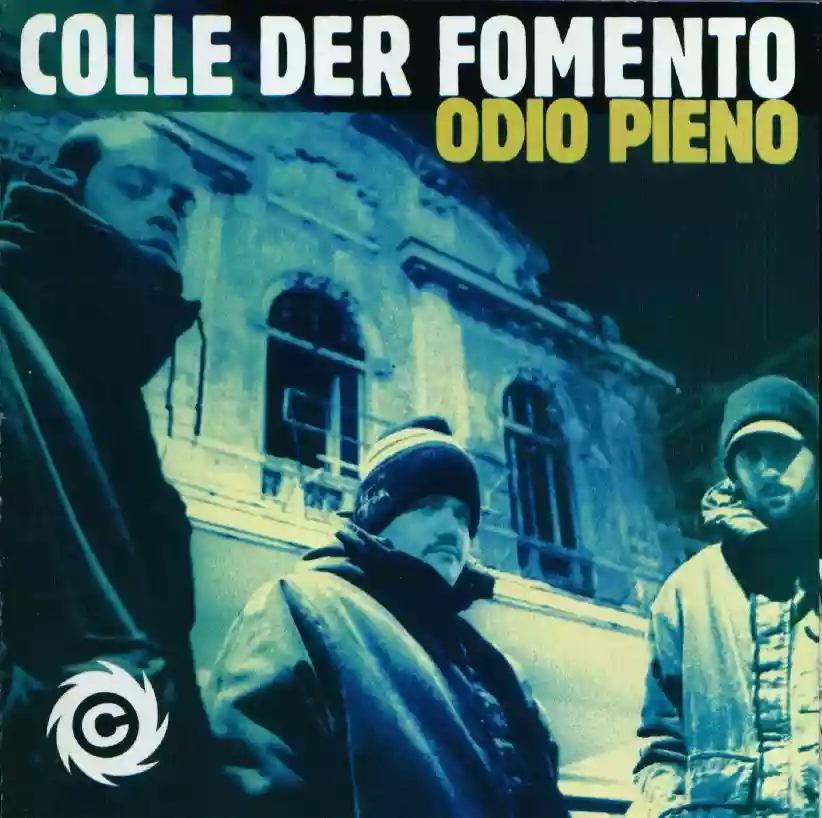
I love to say that truly great albums fall into two categories: those that immerse you in a certain atmosphere only if you’re predisposed, only if you know that mood; and those that grab you by the hair and throw you into it. “Odio pieno” is a challenge: “Odio pieno” looks at you with nocturnal eyes and says, “You know you’ll be hypnotized from the cover art alone.” But it keeps you waiting, plays hard to get, taking a long time to truly appreciate. It took a while—back then—especially for someone like me who was used to Caparezza and Rancore’s ultra-tight rhymes or the easy-going vibes of the early, majestic Bassi Maestro. But “Odio pieno” has an atmosphere all its own. It decides what it wants to be. Innovative? No. Personal? Avoja. It’s one of those albums that plays between the extremely ethereal and the extremely real, between the raw and the dreamlike. “Odio pieno”, it’s true, you have to put in the effort to understand it and feel it burning inside, because it’s complex, not because it’s shallow. There’s no cheapness—which actually would have worked fine—throwing in some emotional song about the pains of suburban kids.
The intro is breathtaking, enveloping you in its atmosphere. “Solo hardcore” is the first punch. Don’t expect verses packed with internal rhymes and wordplay, Colle is very raw and direct (I recall that when, hypnotized and fascinated, I put this album back on after listening to it once and then letting it gather dust for a while, I was surprised because I remembered the meter as a lot looser than it really is, though it’s far from tight). The vibe is clear. Nighttime, dark, but not necessarily violent. Picture a small-town suburb, ‘90s, central Italy, there’s the usual bar with plastic chairs and a moth flying around the lamp. And three guys looking at you the wrong way. Maybe you’re one of them, but for now, they’re giving you that look. The chorus: a voice with effects, as if it’s coming from another room. From the other room of the bar, about to close, another shady character overhears your conversation and butts in, delicate as a knife—but you gotta know how to use it. “Perché flippo solo hardcore, non regalo niente perché flippo solo hardcore.” Let me spend a moment quoting another couple lines: “Cristo Iddio non capisco, un meccanismo c’è ma l’hanno messo ben nascosto” (angry lines that seem to take on all the philosophy itself) or “faccio rap, solo rap, tu ci ridi sopra, ci giochi ma col rap non ci si gioca”, four words strung together making two verses with an imperfect, but unexpected, quick, brilliant rhyme. “Quello che ti do” is weary, it drags itself along, as if in the bar that’s about to close Danno leans on the table and talks to you in a low voice: “Accendere il fuoco che è in te, mi basta solo una scintilla, per fare più bella questa sera: posso anche amarti, ma amarti alla mia maniera.” The soul incursion is textbook, and Danno’s tender braggadocio, calling out Guendalina, his girlfriend at the time with whom he stayed for ten years, is truly touching. Still sky-high with “Sopra il colle”, a self-referential track where the slightly raucous vocals once again merge with a stripped-down beat that takes a while to fully get. “Quando verrà il momento” has an elephantine beat with an odd rhythm, coming in heavy. Then comes the beautiful “Ninna nanna” and the brief, wonderful “Elfo scuro.” You’ve left the bar, Danno twists his mouth and looks toward the sky, Rome’s black night, and starts talking to you again. Maybe my favorite. An interlude called “Pornorockers” and then the witty but not earth-shattering “Funk Romano.” The short “Sempre vero” gives way to the incredible, maybe musically the best and the meanest, “Ciao ciao”, with mind-blowing beat changes. In my view, the line “Se qualcuno non ci sta, tanti saluto: scopati i buchi di un formaggio con i buchi!” is brilliantly funny, nonsensical, and incomprehensible. Well, of course, if a cheese had no holes, how would one… well, you get the idea. And why, if someone’s not with you, should they find solace with a Swiss cheese? Mysteries of rap. “Cinque a uno” is disillusioned and gorgeous, and the next one, “Non ci sto”, is anything but an excessive anthem; it’s restrained, dragging, a hymn to intoxication. The “Outro” ends it perfectly.
And you look at the cover again. And you realize it’s easy to make huge albums that bring to mind those big nights out, the epic shows when you were young, maybe your first crush. Try making one that reminds you of an empty bar in the suburbs. Raw enough, taking its time to admire the dark, murky sky of Rome, rooted in its city, on its asphalt, political if needed, never messy just for the sake of it, never venting too much because that’s just not its nature. But never forget one thing: this is a mean, resentful, murky album. Roughly produced and even more roughly played, this masterpiece stands out in the history of Italian rap.
“Perché il cielo sopra me sta diventando più vero, più duro: è odio pieno, giù dall’elfo scuro”. Score: 90/100.
Loading comments slowly
Summary by Bot
This review highlights 'Odio pieno' by Colle der Fomento as a powerful and authentic Italian rap album. The reviewer praises its raw energy and connection to urban realities. The album stands out in the Italian hip-hop scene for its lyrical prowess. It's recommended for fans seeking genuine street rap. Overall, the album receives a strong and positive assessment.Tracklist Videos
01 Lato oscuro (02:15)
02 Solo hardcore (03:14)
03 Quello che ti do (04:14)
04 Sopra al colle (04:17)
05 Quando verrà il momento (05:22)
06 Ninna nanna (05:15)
07 Elfo scuro (02:15)
08 Pornorockers (01:25)
09 Funk romano (04:46)
10 Sempre vero (01:38)
11 Ciao ciao (05:55)
12 Cinque a uno (04:11)
13 Non ci sto (05:08)
14 Outro (01:11)
16 Non ci sto (05:01)
18 L'attacco dei funkadelici quattro (03:32)
Colle der fomento
Colle der Fomento are an Italian hip hop group from Rome, active since 1994, known for classic boom‑bap production and uncompromising lyricism across albums from Odio pieno to Adversus.04 Reviews
