
 •
Rating:
•
Rating: THE REVIEW
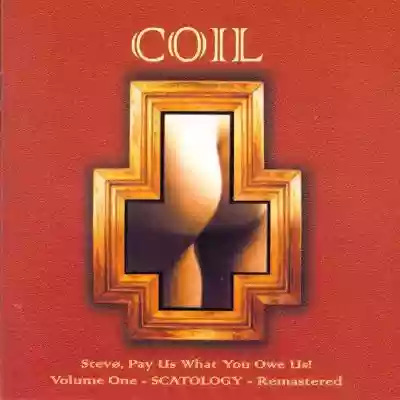
A butt embedded in a golden frame shaped like an inverted cross: the cover of "Scatology," the first official full-length launched in 1984, perfectly encapsulates the intended program of the esteemed Balance/Christopherson duo.
The butt undoubtedly represents the imagery of free sexual expression underlying the band's poetic vision. The golden frame, on the other hand, recalls the cultured and intellectual nature of the proposal, rich in references from the world of art and philosophical reflection (from Nietzsche to De Sade, Dali, Jarry, up to Manson and pulp literature) and, musically speaking, is traceable to an avant-garde tradition that stems from the destabilizing work of formations like Throbbing Gristle and Tuxedomoon. The inverted cross, finally, symbolizes the dissatisfaction with any form of pre-established institution, such as the Church, for instance, which in society bears a reactionary and conservative value. Not to mention the disturbingly esoteric shades that have always tainted the dark evolutions of Coil's music (let us remember that Coil was born under the banner of esoteric industrial, and that their debut EP "How to Destroy Angels," from the same year, bears little deviation from the proposal of fellow countrymen Current 93 from the friend David Tibet).
Talking about industrial is limiting when we discuss Coil: it is true that Christopherson, a former member of Throbbing Gristle and Psychic TV, was one of the founding fathers of the genre. It is true that "Scatology," compared to their past work, shifts towards more canonically industrial shores, influenced, in my opinion, by Killing Joke, among the first to combine industrial avant-gardism and rock linearity. It is true, finally, that the album is produced by Jim Thirlwell, the mastermind behind the Foetus project and one of the greatest minds in industrial music ever. However, the Coil experience, thanks to the visionary and sick talent of John Balance, also an ex-Psychic TV member, far surpasses the industrial approach to reach dark's darkest depths. Coil's invention lies precisely in combining industrial and gothic music. So much so that we can effectively speak of post-industrial, since Coil's music, while adopting the axioms of the genre, no longer cultivates the original intent of representing the alienation and dehumanization typical of social reality in the industrial era. The repetitive looped sounds, the pulsating drum machine, the claustrophobic and hallucinatory atmospheres, thus assume psychoanalytic connotations, the restless contours of a mad mind. And so, with Coil, industrial gets tainted with blood. Blood and sperm, if we want to say it all: these are indeed the years when the fear of A.I.D.S begins to spread: fears that go to muddy and stain with unease the sexual life of the new generations. It's no coincidence that, as a bonus track, we find Soft Cell's "Tainted Love" (slowed to the extreme and transformed into something truly alienating), originally released as a single, among the first initiatives ever to help those affected by the HIV virus.
But the visionary and excessive art of Coil takes us much further, leading us into the depths of a dark and vile underworld, made of abuse, excess, and violence, both physical and psychological. Thus, Coil's music is no longer a mere metaphor for reality, but rather represents an escape from this reality. An unconscious quest for one's lost humanity accomplished through the unrestrained expression of the deepest and most beastly instincts: the recovery of man, therefore, through the beast. And if the poison is conformity, forced order, and repression of instincts, the antidote is chaos, the unbridled unleashing of the instincts themselves, and the abandonment to excesses. The path indicated (and practiced) by Coil is far from assuming constructive and positive connotations (in the sense of an orientation towards the better) but rather assumes the extremization of the negative premises inherent in society, a cure that contemplates only the satisfaction of the flesh, which effect can only be destruction and, above all, self-destruction. The dark and nihilistic aura that envelops Coil's music is therefore given by the implosion, the collapse of the psyche, and above all by the gray and restless tones of a tragic epilogue lurking just around the corner. In this sense, I consider Coil an entirely genuine incarnation of the art of the early Velvet Underground.
In "Scatology," the sound of Coil is bare but effective in evoking that sense of squalor and grime that the world they narrate exudes: sodomy in a filthy toilet of a treacherous London suburb, the desperate search for a dose of heroin in the most notorious alleys, the violent blows of a pimp demanding his share. Sadism, madness, obscenity but also lots and lots of irony. The drum machines, ramped up, are called to support assorted samples, incursions of guitars, synths, and horns (the contribution of multi-instrumentalist Steve Thrower, who will later become a full-fledged member of the band, is providential). Balance's euphoric singing does the rest, and if there's something to say regarding the arrangements, the refinement of the sounds, and the details, our friends will have a long way to go; "Scatology" presents us with mature artists with a strong artistic identity (after all, the two are not exactly newcomers). The work thus reveals itself as already irredeemably laden with that morbidity which will be the band's distinctive feature. The adopted solutions are never trivial, often fishing from imagery far from the canonical industrial: right from the opening notes of "Ubu Noir," which kicks off with the perverse manipulation of a village fair clarinet, we realize we are facing something far from ordinary. The album continues with raw '80s assaults, danceable parts, gloomy gothic passages, and unmistakable flashes of genius.
The influence of a certain early-decade wave is unmistakable, reminding us of the sounds of Depeche Mode's early works, but stripped of the more pleasing tendencies: Gore and company's synth-pop is transfigured and reduced to dark spirals of paranoia and perversion; new-wave, more generally, is reinterpreted through lessons of madness and instability from masters Virgin Prunes, an essential reference point for the band's artistic formation. In this sense, the best examples remain "Panic" (sung by Thirlwell himself) and "The Spoiler," which will remain among Coil's most enduring classics. Noteworthy is also the frantic piano run in "Clap," another essay of carefree anxiety.
There is still room for more disturbingly meditative moments, like the desolate clarinet solo in "At the Heart of it All," accompanied by minimal guitar effects and catastrophic piano chords, or the vampiric "Tenderness of Wolves," featuring, not coincidentally, the sick vocals of Gavin Friday, singer of the aforementioned Virgin Prunes. The friend Marc Almond, who over the years will become an almost fixed guest in Coil's house, appears instead in "Restless Day," an alienating and somewhat catchy tune demonstrating the band's ability to transform a potential hit into something haunting. The apotheosis, in my opinion, is reached with the hallucinatory crescendo of "The Solar Lodge," a dark ritual with a shaky pace where Balance's paradoxical voice is a lament and at the same time a threat. The ensuing tracks continue in the same vein, reviving the gloomy and esoteric atmospheres of the previous EP, amidst the slow and obsessive beat of the percussion, hallucinatory vocal performances, bursts of dark synth, and the "decadently triumphant" peplum-style horns.
This last glimpse of the album well represents the essence of the band, whose music becomes a descent into hell through the hole of the butt, a journey where the anus acquires metaphysical and symbolic connotations, becoming a real temple, a door to another world: it is the escape route from the comfortable, yet also brutalizing world of the vagina.
Loading comments slowly
Summary by Bot
Coil's debut full-length album 'Scatology' (1984) delves into dark, avant-garde industrial music infused with gothic and esoteric themes. The album's provocative cover art symbolizes free sexual expression, institutional rebellion, and artistic depth. Produced by Jim Thirlwell and influenced by early industrial pioneers, it combines unsettling atmospheres with psychoanalytic depth. Notable tracks showcase a mix of raw 1980s sounds, gothic textures, and haunting vocal performances, representing Coil’s unique post-industrial vision.
Coil
Coil was a British experimental music group formed by John Balance and Peter Christopherson, active from the early 1980s until 2004. They are known for blending industrial, ambient and electronic approaches and for a later "moon-music" phase.35 Reviews
Other reviews
By Cervovolante
"Scatology appears today as a rough diamond; not everything works perfectly, but it contains a handful of masterpiece songs."
"The atmosphere of 'Tenderness Of Wolves' is truly unsettling and speaks to us of vampires and the infamous serial killer Fritz Haarman."
