
 •
Rating:
•
Rating: THE REVIEW
Late 50's, a composer named Karlheinz Stockhausen begins to infuse his contemporary classical music works with hints of electronic sounds. In 1959, he records his first fully electronic piece "Kontakte," a daring, conceptual, and bewildering experiment played entirely with an electronic pulse generator and magnetic tapes. During those years, electronic music was mainly used as accompaniment in experimental electro-acoustic compositions, and so it was at least until the early 70's.
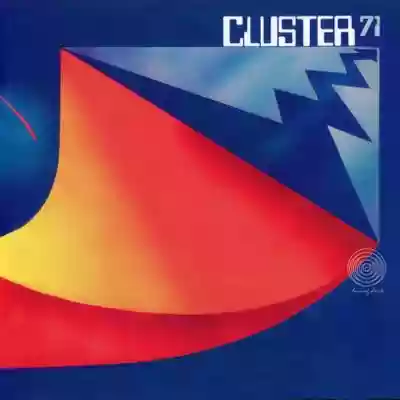
With the advent of Krautrock in Germany, experimental artists like Klaus Schulze, Tangerine Dream, Kraftwerk, and Cluster created new sounds, with impressive setups based on synthesizers, sequencers, and various avant-garde machinery often built by the musicians themselves. They revolutionized not only electronic music but also influenced many stylistic trends in the years to come. If Schulze and Tangerine Dream essentially invented "cosmic music" by filtering entire classical orchestras into an ocean of electronic and synthetic sounds, Kraftwerk went in the opposite direction, creating sonic frescoes much closer to the song form, embraced in synthetic and minimal textures. Cluster, on the other hand, formed by Dieter Moebius, Hans Joachin Roedelius, and Conny Plank, went the opposite way, at least with this debut from '71 and (partly) with the subsequent "Cluster ll."
The work is based on 3 fully electronic suites far from any minimal concession to melody and rhythm, intense and gigantic synthetic drones impregnated with artificial and dissonant noises, an intense and layered sound, a sort of hypnotic and catatonic cybernetic journey where noises and electronic surges rise as undisputed masters of the long compositions. While in "cosmic music," these experiments were accompanied and sublimated by electronically filtered orchestral melodies, here the synthetic detonations rise fearfully in the void, echoing on bare and cold metallic layers, in a certain sense, pushing the experiments of Stockhausen from the past decade to an extreme.
With the next album, Cluster will tone down the mood of this debut, gradually adding more musicality and melody to their sound, and throughout the 70's, they will collaborate with Brian Eno. Certainly, Cluster were not on par with giants such as Schulze, Tangerine Dream, or Kraftwerk in terms of artistic importance, but they are nevertheless to be remembered among the great electronic experimenters of all time, especially thanks to their avant-garde genius poured into this unsettling work.
Loading comments slowly
Summary by Bot
Cluster's 1971 album '71 is a bold and intense exploration of fully electronic music, characterized by synthetic drones and dissonant noises. Positioned alongside Krautrock pioneers, the album pushes the boundaries of early electronic experimentation without concessions to melody or rhythm. It contrasts with contemporaries by focusing on stark, hypnotic soundscapes and extreme electronic experimentation. This debut helped establish Cluster as significant, if somewhat lesser-known, innovators in the realm of avant-garde electronic music.
Cluster
Cluster are the German electronic duo of Dieter Moebius and Hans-Joachim Roedelius. Emerging from Kluster in 1971, they pioneered krautrock/kosmische and ambient approaches, evolving from stark drones to melodic minimalism. They collaborated with Brian Eno and, alongside Michael Rother, co-founded Harmonia.08 Reviews
