
 •
Rating:
•
Rating:
THE REVIEW
Sand. Dust. Blood. Wind. Bullets. Death.
An insignificant island in the middle of the ocean. A filthy piece of land from which to send war materials to Japan. All for this. For this, they fight, for this, they die.
Every Japanese soldier knows it's the end. Knows that digging a trench means digging his own grave.
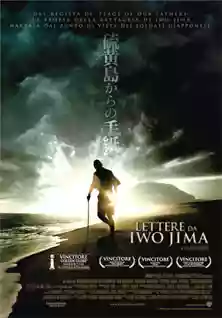
With "Letters from Iwo Jima," Clint Eastwood brings to the big screen the second chapter of the Pacific island saga that began the previous year, in 2006, with "Flags of Our Fathers." If with "Flags," Eastwood wanted to show us the battle from the American point of view, with "Letters," he brings to the forefront the Japanese difficulty in outlining a resistance to the enemy's advance. "Flags of Our Fathers" emphasized the political and propagandistic machine moving behind the war conflict and showed us how an action carried out by some men can become a symbol of an entire nation. With this second film on the battle of the Japanese island, Clint Eastwood highlights the anxiety preceding the confrontation. He presents with a photography that borders on black and white the tense moments before the American landing.
In a dark, almost apocalyptic scenario, the war progresses jerkily, between suicides, heroic actions dictated by honor and love for the country, dysentery, deliberately altered commands. A resistance destined to perish before even being organized. An inferno between the waters, where the only salvation is to be able to write letters to one's family. Pieces of worn paper, which will remain only memories of a struggle lived among the rocks, on the sands, with eyes perpetually turned to the horizon...
In "Letters from Iwo Jima" there is no hope. None for the troops, aware of their end. None for the viewer, equally aware of the characters' deaths. It is the preemptive surrender to fate, but it is still the desire to fight at all costs for one's nation. The only hopeful moments are represented by the writing or reading of those famous pieces of paper, and in this, Eastwood is a master at recreating moments "of relief" even in the most dramatic situations, thanks also to an extraordinary soundtrack that emerges suddenly as if to celebrate life when it is closest to being lost.
The 28th directorial work "of the nameless stranger" is a film with a strong visual impact, with an essential, sparse photography, so much so that it feels like reliving the battle firsthand. A work that, as always in the director's career, is purely classic, never exceeding in superficial representation of the war conflict. It is not so much the war itself that matters, but those who fought it.
"Letters from Iwo Jima" is undoubtedly a great film, born from a man who has accumulated significant experience over the years. It is difficult to see such depth in another director's hands in showing us the difficulty in the face of difficulty, in making us see how war is only self-destruction and tears...
Oscar 2007 for Best Sound Editing.
Loading comments slowly
Summary by Bot
Letters from Iwo Jima offers a powerful and emotional portrayal of the doomed Japanese defense during the Battle of Iwo Jima. Clint Eastwood contrasts his previous film by focusing on the anxiety and honor driving the soldiers' resistance. The film is visually striking, almost black and white, and uses moments of letter writing to introduce rare hope amid despair. Awarded an Oscar for Best Sound Editing, it stands as a classic and deeply human war film.
Clint Eastwood
Clint Eastwood (born May 31, 1930) is an American actor and film director, known for his roles in spaghetti westerns and for directing acclaimed dramas and war films.35 Reviews
