
 •
Rating:
•
Rating:
THE REVIEW
In 1973, Baglioni releases another concept album about love, gone. The scene slightly shifts from Rome, to the countryside and the sea. Step by step, it leads to dissolution.
This album features an introduction and reprise under the same title; while the 1971 track where the title is mentioned ("Cincinnato") is revisited to become "Casa in costruzione".
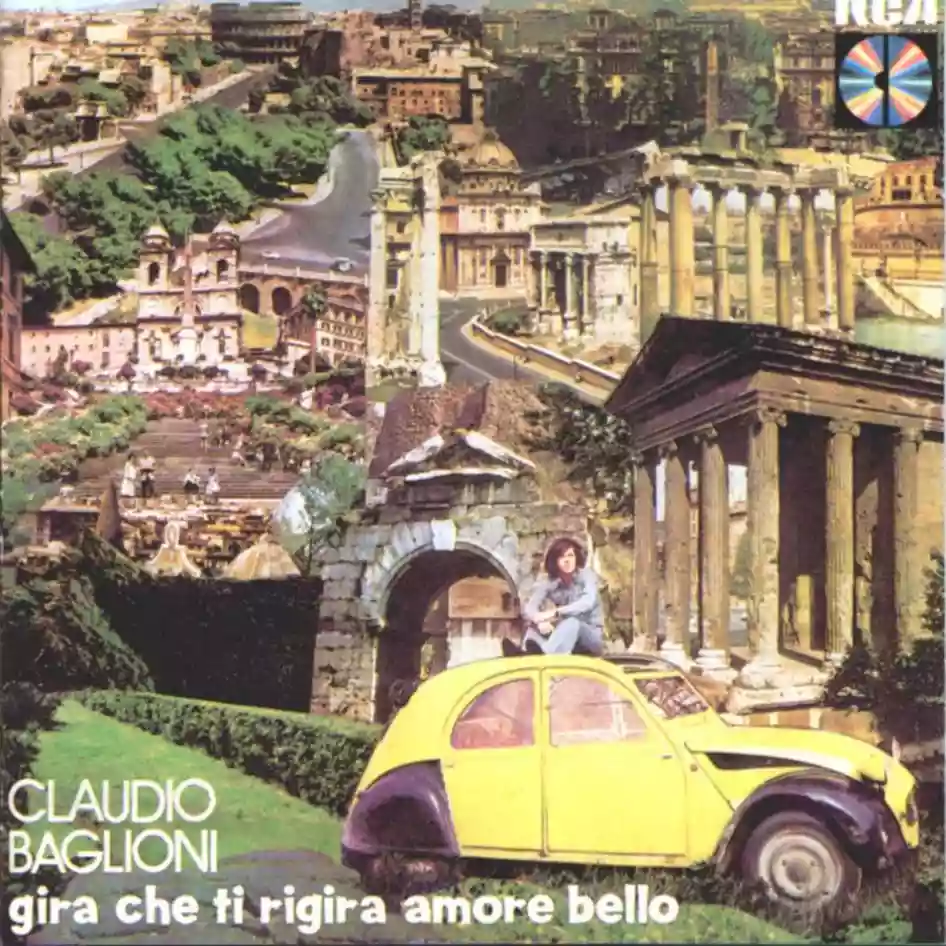
The protagonists have gone from two to three: Him, Her, and Camilla, the Citroen 2CV.
"Gira che ti rigira" intro and reprise act a bit like opening and closing credits for the second album, and in the final reprise, the protagonist expresses his desire to do many other things, but there's no more time.
The journey starts with him waking up not in great shape (dry throat, gaunt face, etc.) and he heads off with his Camilla to her house (70,80,90,100... in progression). On the road, he meets an English hitchhiker with whom he interacts amicably, even giving her a peck; but getting too carried away, an arm under the blouse leads to him continuing the journey alone ("Did I do something wrong?/Boh!/Maybe a touch of etiquette/but she wasn't Queen Elizabeth") (and everyone sings "Hurray hurray/hurray for England/peace women love freedom...", but to what extent?).
The journey continues to her house, where arguments and misunderstandings ensue between them. At one point, he expresses his desire to live elsewhere ("a house...to start over").
But the discussion ends with her sleeping and him "sinking down (alone)".
The argument continues with him threatening in a fit of anger to commit suicide (a veiled reference to "Messaggero" ("...you'll see...if it's not true...")). He slightly regains himself shortly after, confessing that many things said were only under the impulse of anger, and he goes to park Camilla for a moment.
He starts the engine and...
("I'd leave" - "And open that door")
...and, somehow, he spies on the young girl from the attic. The young girl is a farmer's daughter with a somewhat retrograde mentality, evident in the "five fingers" of the father on her face because of a lipstick...
She looks at her legs and then her breast; she flips through a comic (perhaps a photo novel) because "the actor is handsome and daring"; then she makes the sign of the cross ("peasant culture" as I mentioned); looks in the mirror and stares at the beams (nervous about something).
He, who spied on her "holding his breath" and stood still "inside the crack", steps out and... makes a fool of himself!
"Don't tell your father/otherwise something bad will happen...!"
The "country girl" and he find themselves near a "house under construction", telling each other various "strange stories:/about witches and past loves" and imagining that house already furnished for them, for when they get married. Then the beautiful moment flees...("Don't leave me alone (don't leave me alone)...").
The two move to the "Miramare" but their love story begins to falter: the things she loved in the past she no longer likes. He can't take it anymore, and the doctor ordered him to stay away from her. Disobeying, he came with her and found him, interested in her. He goes crazy, can't see anymore, and storms out "dressed as a Sioux".
The ending, in my opinion, already occurs with "Amore bello", where love ends with her departure, his attempts to recover something but his surrender to the evidence of the facts. Certainly, listening to the song, I don't think we've ever seen a more classic farewell scene elsewhere.
"Lettera" should have been, in my opinion, like an appendix to the album, perhaps a "ghost track", because it's somewhat foreign to the story (but there's Camilla, she can't be left out). The young man writes to his mother reassuring her (and here we see Baglioni suspended between the '60s and '70s: "tied" to the family (1960s) and emancipated in love (1970s)).
And the reprise ends orchestral, from a certain point onwards, with a background of children in a round dance, and then a child separating from the group discovers the car that has "departed" (doesn’t work anymore), but is lost in the woods...
This album carries some flaws compared to "Questo piccolo grande amore": maybe it doesn't completely captivate the listener, but it's not a bad album. Then it has a cover that is beautiful: a postcard with all the monuments of Rome behind the singer's shoulders and his car. A very nice cover...
Loading comments slowly
Summary by Bot
Claudio Baglioni's 1973 album 'Gira che ti rigira amore bello' is a concept album exploring the journey of love fading away. The story shifts from Rome to the countryside and includes recurring characters and symbolic elements like the Citroen 2CV named Camilla. While it doesn't fully captivate like its predecessor, it offers a thoughtful narrative with a nostalgic cover and intricate storytelling themes. The review notes some flaws but appreciates the album's ambition and emotional depth.Tracklist Lyrics
Claudio Baglioni
Claudio Baglioni (born 1951, Rome) is an Italian singer‑songwriter (cantautore) known for melodic pop and ambitious concept works. Breakthroughs include Questo piccolo grande amore (1972), Sabato pomeriggio (1975) and the chart‑topping La vita è adesso (1985). He has collaborated with figures such as Vangelis and Luis Bacalov and pursued expansive projects from Assolo (1986) to Oltre (1990) and Viaggiatore sulla coda del tempo (1999).28 Reviews
