
 •
Rating:
•
Rating:
THE REVIEW
Uh-oh! We are informed that this review also appears (in whole or in part) on kalporz.com
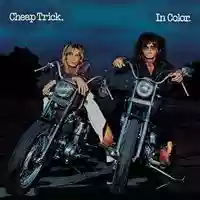
There's nothing progressive about "In Color," the second album by Cheap Trick. But calling it Power pop is also quite risky; Cheap Trick has always been a band either hated or revered, something that their almost gaudy nouveau riche look and the complete title of the album "In color and in black and white," only accentuated.
Ben Carlos, the drummer, seems to have been born from the crossbreeding of a banker and a nightporter from Sydney, Rick Nielsen, guitar and leader, an authentic baseball fan with fish-eyed looks, Robin Zander, guitar and vocals, and Tom Petersson, bass, are essential prototypes of the '70s rocker, very dashing and tending towards super macho. But if in this respect the group stands out conspicuously, on the musical front, Cheap Trick are as anomalous as they are devoted, Beatles fans. But not in the sense of the Raspberries or Elton John or the Bay City Rollers. What's surprising is that these four nephews of Uncle Sam considered the most important repertoire of the Fab Four to be the hard rock pieces of their last production, specifically "Back In The USSR," "Helter Skelter," "Yer Blues," "I Want You," and "Come Together."
Using a phrase that might shock someone: "In Color" sounds as if the Divine Duo had fallen in love with aggressive guitars and glam atmospheres. If Lennon and McCartney had survived until '77, why not indulge in this possibility, given John's very rock intentions in his later years? Leaving aside these temporal utopias (everyone is free to ponder them, as the Beatles proved capable of practicing a vast range of musical genres), the ten tracks that animate the album are palpable sensations of irresistible success and a truly remarkable sound evolution, but it should be stated that in the analysis, all the cardinal and reference points used in this field are unusable. "Hello There" harkens back to the ancient vestiges of the dirty rock of "Birthday"; "Big Eyes" opens with an explicit reference to that disconnected sonic labyrinth, connected only by Lennon's minimalist verses, which is "I Want You." "Oh Caroline" has the same subtly enchanted effect as the best rock of Abbey Road. Nielsen and Zander owe a great debt both to George for the great inventiveness in making the strings chirp and to John for the undeniable vocal gifts, but the Trick are not merely derivative, as could be the case for Boston, because they constitute much more than the sum of the notes they manipulated, especially if they did it with great skill.
A list of the group's influences is surprising for what it includes but also for what it excludes: obviously, the Yardbirds and the Who occupy an important place, but there is a total absence of any reflection of Cream and the Jimi Hendrix Experience. But these omissions concern a larger design: Nielsen writes his songs with great care and Zander's robust harmonies are used instrumentally, rather than verbally. Something similar could be said for Steely Dan, but Cheap Trick has the added advantage of accessibility. What should be mentioned is that Cheap Trick had already won the battle against the convention that punk rock was about to wage, supported by a never too cynical characteristic: the sense of humor. Hence an album presented as a very substantial feast, whose existence has always been largely ignored.
If by chance Robinson Crusoe were to ask you to spend some time with him on the deserted island, immediately pack this record, which has an encyclopedic flavor but never boastful, with that aftertaste of pure pleasure that never borders on stupidity or exhibitionism.
Loading comments slowly
Summary by Bot
This review praises Cheap Trick's second album 'In Color' as a compelling power pop record with strong 70s rock influences and Beatles-inspired hard rock. The band is recognized for their energetic and skillful songwriting, original sound, and engaging sense of humor. The album is noted for its accessibility and enduring appeal despite being often overlooked. Highlights include references to classic rock predecessors while maintaining a distinct identity.Tracklist Lyrics Videos
Cheap Trick
Cheap Trick are an American rock band formed in 1973 in Rockford, Illinois. The classic lineup features Robin Zander, Rick Nielsen, Tom Petersson, and Bun E. Carlos. Fusing power pop and hard rock, they broke through globally with the live album At Budokan; signature songs include I Want You to Want Me and Surrender, and they scored a late-80s No.1 with The Flame. Inducted into the Rock and Roll Hall of Fame in 2016.06 Reviews
