
 •
Rating:
•
Rating:
THE REVIEW
The American quartet Cheap Trick has always played its own unique formula of heavy yet light rock, a mix all their own of Beatles-esque pop and punk fury and rock'n'roll. This is their third album release of their career and it's one of the best, the year is 1978.
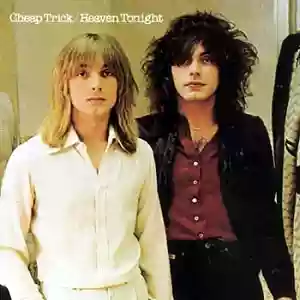
The cover recycles the idea from the excellent previous album "In Color...and In Black & White", featuring on the cover the two handsome ones, that is, the blond guitarist and singer Robin Zander and the heavily styled bassist Tom Petersson. In contrast, the two nerds are on the back cover, meaning the lanky leader and guitarist Rick Nielsen and the chubby drummer Bun.E.Carlos.
The strength of this lineup lies primarily in Nielsen's compositional vein, an obsessive collector of guitars and a creator of textbook harmonic and melodic progressions. The rest is done by the strong personality of all four musicians, each of whom, pretty or not, puts in a good amount of uniqueness, whether artistic, performative, or technical.
Carlos looks like a San Diego tobacconist, but he has a highly effective way of playing, strong and simple and confident, on his instrument. He forms a vigorous, yet melodic rhythm section with his partner Petersson, a pioneer of the eight- and also twelve-string bass guitar.
Rick Nielsen combines his rational, educated, and attentive interspersions of rock'n'roll stereotypes borrowed from Chuck Berry, Jimmy Page, Pete Townshend, and a thousand other role models he carefully studied, with unique extroversions and extravagances on stage: he flails, hops about, makes faces, changes guitars with every song, entertains and amuses, naturally without missing a note. He is certainly not the best guitarist in the world; for example, he couldn't care less about solos even though he knows how to play them, but he is certainly among the most active performers in the world.
"Surrender", placed at the opening, is a classic of the repertoire. It's practically a punk song, except Zander sings in tune, there are keyboard embellishments here and there, and above all, it's missing a bit more speed. But the tune remains one of extreme simplicity and accessibility.
The beautiful and powerful voice of the blond frontman, a mix between Lennon and McCartney's, drawing the timbre from the former and a good range towards the high notes from the latter, dominates the following, pulsating "On Top Of The World", with its hammered piano that even brings it closer to Supertramp.
"California Man" and "On The Radio" are instead very melodic rock'n'rolls, the kind that the poor John Lennon himself would have liked at the time. Nielsen prints a very competent '60s solo in the former, and a radio DJ tirade in the latter, and the job is done.
"High Roller" and "Auf Wiedersehen" are classic Cheap Trick hard pop songs, without much inspiration except for Nielsen's excellent guitar sounds, whichever instrument chosen from the dozens at his disposal. He may play the clown on stage, but the tonal attention to every note he plays hints at what a focused and studious musician he is.
"Takin' Me Back" recycles a typical guitarist trick with fourth chords, always effective, but then the song gets lost amidst too many keyboard flourishes (handled by guest Jai Winding), even though Zander works hard with falsetto choruses of unmistakable Beatlesque roots.
The album's title track is also its qualitative peak (unless one hates baroque and pompous style): it proceeds stately and dramatic, somewhat akin to Queen, with Robin Zander maximizing his expressiveness, as well as, if not more than, a Freddie Mercury, changing his singing style several times, especially showing off a fantastic low falsetto in the chorus.
"Stiff Competition" starts off like Led Zeppelin, attacked by the chameleon Zander with his most harsh and powerful tone, then it diversifies into more open passages, plunging into Who-style hard rock, complete with tonsil-tearing Daltrey-like screams... in short, a (derivative) hodgepodge full of energy.
The ending is splendid: "How Are You" is a two-four maneuvered by hammered piano, which grips in the verses, resolves momentarily in the chorus but then quickly returns to pump healthy tension and exquisite musicality. Nielsen's guitar counterpoints are grand, real feline strokes. The usual Townshend-style riffing concludes the song and album... or actually, no, the disc in my possession still has a brief live insert, a minute or so extracted from a piece called "Oh Claire", not even credited in the booklet.
It's a brief moment, but enough to sense how much more effective Cheap Trick's sound and energy are in their concerts: no keyboards in the way (the space left to guest Winding on this record is overmuch) and an expansive, gigantic, satisfying sound, with the singer's big voice towering without problems and echoing off the walls of the hall. No wonder this band's most famous and best-selling records are indeed the live ones... A great live band, intelligent and captivating with its hyper-amplified tunes, good for the teenagers of yore, and still good today as rock enthusiasts can savor, then as now, its clear merits.
Loading comments slowly
Summary by Bot
Cheap Trick's 1978 album Heaven Tonight brilliantly fuses Beatles-esque pop with punk and hard rock elements. The band's unique chemistry, especially Rick Nielsen's guitar work and Robin Zander's powerful vocals, drives the album's standout tracks like 'Surrender' and the titular 'Heaven Tonight.' Despite some keyboard overuse, the album captures the band's energetic spirit, especially evident in their live sound. This record remains a classic for rock fans appreciating melodic yet intense music.Tracklist Lyrics Videos
Cheap Trick
Cheap Trick are an American rock band formed in 1973 in Rockford, Illinois. The classic lineup features Robin Zander, Rick Nielsen, Tom Petersson, and Bun E. Carlos. Fusing power pop and hard rock, they broke through globally with the live album At Budokan; signature songs include I Want You to Want Me and Surrender, and they scored a late-80s No.1 with The Flame. Inducted into the Rock and Roll Hall of Fame in 2016.06 Reviews
