
 •
Rating:
•
Rating:
THE REVIEW
"CCCP is a segment in the life of each of us, very significant, decisive, and often illuminating. We have already written somewhere that before CCCP we lived and we will live even after. It will end, of course, we neither feel nor have ever been rock'n'roll stars, nor are we interested in a musical career. On the contrary, if it were so, perhaps there would be reason to worry..."
August 1990 - Giovanni Lindo Ferretti
Nostalgia, the real one, manifests itself in different ways within what we all commonly define as spirit. There are various kinds, divided into emotional states, the stronger one dominates the weaker one, only to be overcome by the latter again, and so on towards the infinitesimal quest for a non-solution. Towards the end, towards misunderstanding.
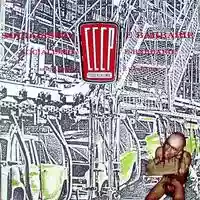
"SOCIALISMO E BARBARIE" is the last chapter of the numerous social trenches (believe me, nothing to do with the Soviets) that CCCP with humility and tenacity, avidly defended to the end, against those who were a bunch of one-directional idiots who could not and would never understand its unique spiritual meaning. Human beings before artists, existentialists even before "musicians".
The "Faithful to the Line" knew they held in the palms of their hands, what was the surrender, albeit not willingly unconditional, towards a future of uncertainty that they remarkably managed to depict through qualities of theatrical dramaturgy and mixed Middle Eastern punk in their inimitable live performances, which never found precedents in Italy. What prevails in the album right from the start is the forewarning of a farewell to a lifestyle that conditioned their existence for at least seven years, starting from the filthy taverns laced with remnants of Turkish food, left to rot in the desolate outskirts of Berlin, to then reach the "tragic-comic" signing with Virgin: a factor that struck those who never even attended one of their concerts, and who sacralized the right to a cult devoid of any meaning.
The metric outlined in this auditory testament fully cites each of the countless passages that conditioned the "band" along the path that allowed them to silence the various Italian-clones pro Duran-Duran, homophobic and presumably inclined to self-derision. Affectionately, the verbal-melodies proposed by this emotional mile-green span from "A Ja Ljublju Sssr", a post-punk revision of the Soviet anthem, an entrance head-down into what promises to be a very difficult path, albeit not devoid of irony and cynicism as in the irreplaceable "Per Me Lo So" where allusions are spared in a way that best imprinted upon this band: the confusion and misunderstanding that dominated their artistic work.
"Tu Menti" aims to be (obviously with "doubtful" references) a very polite response towards those who, for obsolete and inexplicable reasons, had condemned them to the servitude of the Majors, of which very likely their own parents were shareholders. "Rozzemilia" instead resonates as the endless struggle against the cultural-mental abyss that with unpredictable greed brutally dominated the plains of the Po Valley of the time, full of infinitesimal and imperceptible desolations, almost a negative answer to the potential questions of the distant "Emilia Paranoica", within which the appropriate and unique ascetic path was embodied in the abuse of self-destructive methodicity.
Methodicity rendered with singular expressive capability in "Stati Di Agitazione", a true glimpse of altered perception involving shadowy psycho-paralysis in which asceticism finds space in the ever-sacred "Libera Me Domine", characterized by a more than due ceremonial recitation in Latin, in which the extra-worldly asceticism definitively occurs. The History in CCCP, as well known, found a vast scope of orientation in Soviet culture, whose melancholic soul is gently suffused by a poetry with rigid limbs that only "Manifesto" can ignite, inflaming the listening, up to the paroxysmal palpitations. "Hong Kong" continues what is the aspiration towards infinite admiration for the East by each of the CCCP who intend to praise its essence, only to then head further west, along Tibet ultimately corresponding with the Middle East. Here the notice announced with "Sura", finds an explosion of pure mysticism mixed with Pravda, whose soft and clear melodies take shape in "Radio Kabul": a veritable dreamy flight over the Afghan desert, which if well envisaged, can appear less distant than one might imagine, in its decay, in its pungent scents and its jagged corrosive sands.
A true mental excursion, as well as thermal. This stretch of induced spiritualism, concludes its cycle with a return to Emilia, the unique homeland capable of extending "from the Adriatic to the Yellow Sea". It transitions indeed to "Inch'Allah-Ca Va" which foreshadows the final return to the proto-ballads of smooth/punk capable of tormenting Raùl Casadei in person, as well as naturally the Italian State, harshly criticized in the concluding "Oh! Battagliero" and "Guerra E Pace". My impression is entrusted to what are my reminiscences concerning a singular and unique approach to music: interpreted not as a means of achieving impossible hierarchical locations, at least prophetic, but rather as a natural and necessary freedom of expression and social communication, this particular, of a rarity to make shiver those with a skin to understand.
After them, nothing more similar on the Italian peninsula.
"Outside time and History, away from Eternity, from cycles and Projects, from radiant Futures, from the Sun of Tomorrow, from the glorious Armies, from the Stars, from the Symbols, from the Humanitarian Dawns: the Past has deflated, the Present: is a Market!. . . Watch out, kids, watch out for the dealers, watch out for the sugarcoated ones!". G. L. Ferretti - "Militanz"
Loading comments slowly
Summary by Bot
Socialismo E Barbarie, the last album by CCCP Fedeli alla Linea, captures their unique blend of post-punk, theatrical drama, and deep social commentary. The album reflects a farewell to a significant era, mixing spirituality, cultural critique, and political irony. It stands as a rare and powerful statement in Italian alternative music, celebrating freedom of expression beyond commercial ambitions. This review highlights the band's unmatched artistic identity and influence.Tracklist Lyrics Videos
CCCP Fedeli alla linea
CCCP Fedeli alla linea were an Italian punk/post-punk band formed in 1982, strongly associated with a Berlin–Emilia cultural axis and known for drum-machine driven rhythms, provocative slogans, and theatrical live performances featuring Danilo Fatur and Annarella Giudici. Their core figures include vocalist/lyricist Giovanni Lindo Ferretti and guitarist Massimo Zamboni.19 Reviews
