
 •
Rating:
•
Rating:
THE REVIEW
Let us forget the witty singer-songwriter of the early '70s, forget certain sounds with a clear Mediterranean influence, certain Hellenic, Slavic rhythms, and the calmly philosophical, sometimes meditational tone of past works. Cat Stevens, after living two decades, is far from the artist just outlined, he is the latest Stevens, who retains little of the psychological style and intimate, elegiac writing he once used along with his innate intuition for melody. After Buddha And The Chocolate Box (1974), Numbers (1975), Izitso (1977), after a long series of mediocre, perhaps even decent works but lacking the dramatic tone, the apocalyptic touch, the dryness of the message that flowed copiously in the young Stevens and his involved, restless search for the right path, Back To Earth eminently sounds like a farewell, the resigned departure of the singer-songwriter and his fervent desire to question life through the notes. Stevens culminates his career thus in the uncomfortable comfort of a haven gained after exhausting changes of course and troubles, with the monastic life already well present in his mind, the doubt is dim and he can do nothing but lie down under a thick blanket of faith. Return to nature, sheltering in the womb of the earth, dissolving into the placid and blue zephyr. Faith like nature, a refuge in which to vanish, clouds swept by the wind on the horizon, the scent of cedar needles and streams that is lost just beyond in the morning.
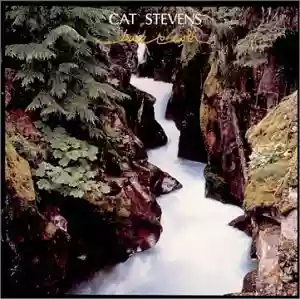
Back to Earth, at first glance seems like a chest of green events and unconfessed secrets, of naturalistic evocations, it seems like a painting of simple elements and an alpine landscape. And yet, shortly after the first meeting, we find a slight taste of green foliage and feel sprinkled with sensations and aromas emanating from nearby urban nuclei.
The album is based on a new intuition of melody, far from the ethnic fascinations of the past, founded on a core of mostly Anglo-Saxon chords and arrangements and a musical line supported by piano and acoustic guitar with some synthetic gloss, which strongly and ominously foreshadows the decade at its onset. While retaining some of the style we have defined as psychological and a certain melodramatic tone, Cat Stevens' song has almost completely lost that color of inner reflection, deep, at times sacred, of the individual and thus the tepid vibrating of human feelings. The ten tracks flow lightly, hiding some melody that will satisfy the older followers of the singer-songwriter, are graceful and do not lose the simple but elegant style befitting an intimate author like Yusuf Islam is today.
The opening of the album “Just another night” is in some ways the most faithful song to the artist's old baggage and perhaps for this reason remains calm and does not stir the torpor, in fact, fueled by the sad sensation of deja-vu for an artist once so histrionic. “Daytime” is an intense piece tied to an introspective melody as in the best season, made opaque by the choice of sounds that calling them plastic, for such worthy material, is an act of clemency. “Bad brakes” and “New York Times” are two rock lashes that find no reason and sense in the context they are placed and are moreover laden with the same patina of artificiality mentioned earlier. Equally dull, the instrumental pieces that generally should satisfy the urgency of a particular melodic intuition or present themselves as an interlude to different moments of the album, in this record, result careless and once again victims of cumbersome computer sounds. “Randy” and “Father” almost touch on the ballad, but the strength and transportation shown make them two good pieces that give a Stevens closer to the Central European canons and busy investigating the necessity of dependence and support inherent in the human soul. The path ends in the woods, “Never” is perhaps the song and the landscape expected from the first moment one embarked on the journey, leaning on a few hints of piano, the clear sound of a folk guitar, and the power of the voice, which Stevens, an interpreter of rare skill, has never lost. Who knows if the message is not hidden just beneath this artificial layer, if it is not much broader in the last Stevesian reflection than purely musical. Not finding what one expects, realizing little balances only after a long conflict, finding the song form suitable for the album only at the end of it, imagining a life and coming to terms with reality, necessarily having a father to rely on and a blanket in which to find warmth.
A work that, after years, still needs to be given meaning: too simple to consider it as an announced definitive stage, too ambitious to attribute it the value of a symbolic and realistic parable of life. Objectivity is not akin to art, but I believe no one frowns if I assert that this work entirely relies on Stevens' strong shoulders, on his energetic charisma and his unrepeatable performance, and that, without these, such notes would have been largely overlooked and neatly stored away in a drawer.
Loading comments slowly
Summary by Bot
This review examines Cat Stevens' album 'Back To Earth' as a reflective and somewhat resigned farewell work. It notes a shift away from his early 70s style toward more synthetic sounds and a less intimate lyrical approach. Some tracks show moments of emotional depth, but the album is overall seen as uneven and overshadowed by artificial production. Still, Stevens' strong performance remains a highlight. The album embodies a thoughtful exploration of faith and life's complexities, though it leaves room for interpretation.Tracklist Lyrics
Cat Stevens
Cat Stevens (born Steven Demetre Georgiou) is a British singer-songwriter whose early-70s acoustic albums—blending folk-rock with Mediterranean color—made him an international figure. After a late‑70s conversion to Islam, he adopted the name Yusuf Islam, later resuming recording and touring as Yusuf/Cat Stevens.07 Reviews
