
 •
Rating:
•
Rating:
THE REVIEW
“Once upon a time… — a King! — my little readers will immediately say. No, children, you are wrong. Once upon a time there was a piece of wood…”
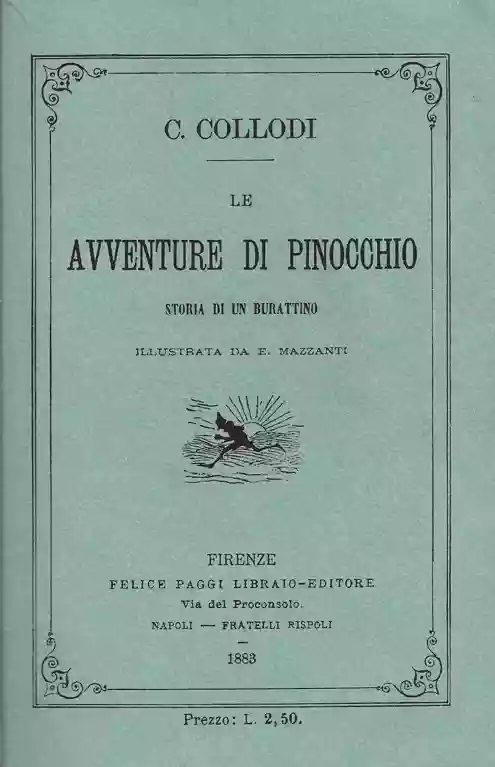
Who doesn't recognize this opening? Or rather, who doesn't know it? It is from “The Adventures of Pinocchio: story of a puppet,” first published in serial form on July 7, 1881, in the “Journal for children” and then in volume in Florence in 1883, author Carlo Lorenzini, known as Collodi.
This work is considered a masterpiece of children's literature, but I don't believe it is just for them, and for many, it would represent a good treatise on pedagogy. In reality, I believe there isn’t much that is pedagogical: it is Pinocchio who, through his experiences, ignoring the advice of others (read: Geppetto, Talking Cricket, Blue Fairy...) lives life his own way, stringing together a series of mistakes that lead him in and out of prison, risking himself in total freedom of choice and finally, making a U-turn on the road full of blind curves of his short existence, “rebirths” to a new life.
If by pedagogical we mean educational, I think our puppet should be considered a self-made …child, because no one managed to educate him with the usual systems: Good Advice. Yet there must be something true: an author like Collodi does not invent such a story only to entertain; Benedetto Croce is also convinced of this, seeing “in the piece of wood, humanity at the beginning of its novitiate: a puppet, but entirely spiritual
.”
It is impossible to think of Pinocchio and not remember his nose, indeed it is precisely his nose that makes him unique and makes you remember him: if it hadn't been so strange, after all, it’s made of wood, perhaps it wouldn't have struck us so much, perhaps we wouldn't have that frightening image of an appendix that grows disproportionately when he utters a falsehood... a lie, perhaps we wouldn’t know that there are two types of lies: …there are lies that have short legs, and lies that have long noses…
It’s possible that in that context, talking about institutionalized lying might be a bit excessive, but it's the impression I got from multiple rereads, certainly an adult interpretation, and after careful research on the Web (an article! Pinocchio's nose for a didactic of lying) I discovered that others before me had done thorough research and that “the didactic of lying
” was a reality: astonishing!
I don't believe that this interpretation can overturn the naive and mischievous vision that our puppet-child left in our childhood visions, but it certainly makes him as relevant as ever, in our world where lying is institutionalized and unfortunately, long noses and short legs are countless!
I haven't mentioned the story, as it seemed out of place and not very nice towards the readers… but all the characters populating the pages of this tale are unique and unforgettable; Mangiafoco, Lampwick, the Cat and the Fox, the Dogfish, and the Tuna are those forgotten, yet they actually made Pinocchio into what we all hoped: a great little person!
Loading comments slowly
Summary by Bot
This review reflects on Carlo Lorenzini's timeless work, 'The Adventures of Pinocchio,' highlighting its relevance beyond children’s literature. Pinocchio's experiences symbolize freedom, mistakes, and rebirth rather than traditional pedagogy. The iconic growing nose is examined as a metaphor for truth and lies, offering deeper adult interpretations. Memorable characters shape the story, making it a profound tale of personal growth.
Carlo Lorenzini
Carlo Lorenzini (1826–1890), known by the pen name Collodi, was an Italian author and journalist best known for Le Avventure di Pinocchio, first serialized in 1881 and published in book form in 1883.01 Reviews
