
 •
Rating:
•
Rating:
THE REVIEW
“Professor Guidobaldo Maria Riccardelli used to force employees and their families once a week to endure terrifying screenings of classic films. In twenty years, Fantozzi has watched and re-watched: Dreyer's Dies irae (6 hours); Flaherty’s Man of Aran (nine reels); but above all, the most classic of classics: Battleship Kotiomkin (18 reels).”
Luciano Salce, Il secondo tragico Fantozzi, 1976
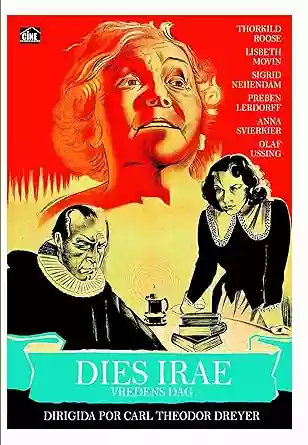
Yes, of course, Dies Irae, six hours... Let’s try to frame the film, looking beyond hyperbole and the Fantozzi satire. In reality, Dies Irae runs 97 minutes. Shot in 1943 in Nazi-occupied Denmark, it recounts, in strictly chronological order, the story of Anne, a very young bride trapped in an unhappy marriage with Absalon, an old Lutheran pastor. When Martin, Absalon’s stepson from his first marriage, returns to the family home, the closeness between the two young people gives life to an incestuous love.
The theme of the unhappy love between an elderly husband and a young wife has given rise, in the history of literature, to mocking plots and long-lasting, highly successful comic intrigues. One example comes from that multifaceted collection of medieval stories known as the Decameron, which offers more than one example; in the same way, a similar plot is the core of La Mandragola by Machiavelli. In medieval and Renaissance tales, the young wife, stuck in an unsatisfying marriage, by clever stratagems, would reclaim what the old husband had deprived her of—what would naturally be her due. Society, at least in the tale, tolerated or even rewarded youthful vitality and punished and mocked senile folly.
None of that in seventeenth-century Lutheran Denmark; the climate here was different from that of fourteenth-century Italy: here, the amorous impulses of Anne and Martin are not cleverness; they are innate sin. A tragic fate hangs over human beings. However, while Martin begins to feel this sense of guilt growing, Anne, still intoxicated, celebrates the happiness of love:
“Anne, if only we could die!”
“Die, die, and why?”
“So as not to sin!”
“Sin? Is it a sin to love? Don’t tell me anything Don’t think about anything Just remember that we belong to each other, like a hard fruit among the forest trees, I want to sit in your shade.”
The religious climate has made customs rigid, severe, and austere: all are victims of it. The sinful man, however, can cross to the other side of the barricade: Martin chooses the law of men and abandons Anne. More than an adult, he reveals himself to be a "man-child," lacking the strength needed to make a personal decision, but endowed with the instinct to take refuge in social orthodoxy at the fatal moment. His inner conflict is not enough to mask his cowardice.
Anne, on the other hand, once betrayed, cannot help but accept her tragic fate. Archetype of so many later protagonists—not only Medea, but also Bess, Selma, and Grace, all the women of von Trier, how much they owe to Dreyer’s women!—Anne is a marvelous character, able to challenge a male-dominated society but helpless before the betrayal of her beloved: as is underlined from this moment on by all the images—from above, looking down, as if to oppress her—that frame her alone. The director thus emphasizes her defeat before the human tribunal: isolating Anne, accentuating her vulnerability, and recording her final collapse.
Loading comments slowly
Summary by Bot
This review examines Carl Theodor Dreyer’s 1943 film Dies Irae. The reviewer considers its somber tone, intense exploration of religious themes, and visual style. While acknowledging its cinematic power, the review notes the film's grimness and emotional weight. Dreyer's direction and the performances are highlighted. The review is balanced, recognizing both strengths and potential challenges for viewers.
Carl Theodor Dreyer
Carl Theodor Dreyer (1889–1968) was a Danish film director and screenwriter whose austere style, expressive close-ups, and profound spiritual themes shaped world cinema.03 Reviews
