
 •
Rating:
•
Rating:
THE REVIEW
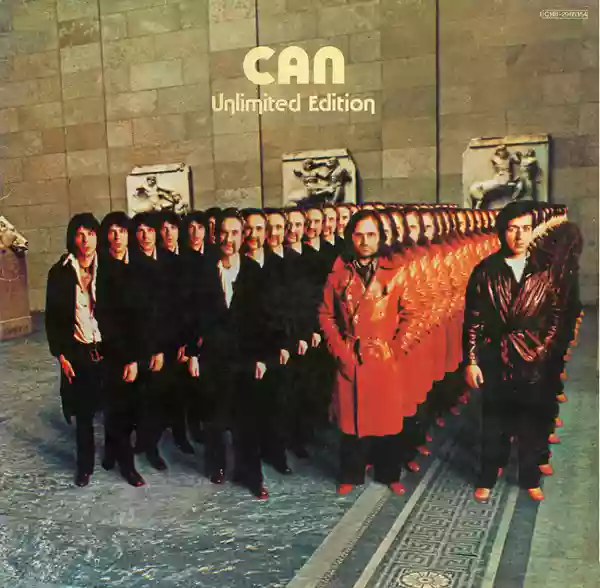
In 1974, the "Limited Edition" was released in 15,000 copies, the one with the cover featuring little mice, later expanded from 13 to 19 pieces in 1976 in the double LP "Unlimited Edition", with the cover of infinite duplications of the German band members, immersed in the framework of the metopes and statues of the Parthenon, looted from Greece by the English at the beginning of the 1800s and still illegally preserved at the British Museum.
The album is a selection of tracks ranging from 1968 to 1975, extracted from the elusive "tapes", a mountain of music recorded and accumulated of impressive quality, predominantly performed at the Schloss Nörvenich castle, their mythical "Inner Space" studio. A small taste of the infinite material available, which you should not think is of lesser quality; on the contrary, in its synthesis of exploring a seven-year period of experiments, improvisations, jams, and sessions, it provides us a time machine to keep up with what these phenomena have pulled out from their superhuman appearance.
Thus, we have present, in addition to the Teutonic base of Karoli, Czukay, Schmidt, Liebezeit, the two historical singers Malcolm Mooney & Damo Suzuki, and the album is thus configured in the timeless, ergo reality. Alien ethnic music, that's what comes to mind when listening, further mystified by those E.F.S. (Ethnological Forgery Series) where the repeated ethnological forgeries hide, more than a joke, a communication that shifts to the psychic, to the transmission of thought.
And returning to the cover, our heroes seem to suggest in their infinite duplication that the musical corpus is nothing more than the noise of all their reincarnations and the eternal returns to come, where, on the reflections of Phidias's sculptures behind them, the Hellenic Temple is the astral spaceship of the interpenetration of their universes, where the cacophonous, non-chronological pile-up of the tracklist lets us relive eternal glories also familiar to us.
And we are pulled into an unforeseen, unexpected, magnetic zone, yet present in its invisibility due to our ham-covered eyes not grasping the immensity of absence. Lulling us into a mature childhood of the boredom game of Paradise is an incentive to ascertain the Faith conquered, stripped of monotheistic burdens. A kaleidoscopic light provides us with the thrill of lucidity in the absence of thought.
There is such diversity from one track to another that absurdly one savors the Unity where the antiquity of expressed freedom can be disturbing in accepting impersonal humor, but where the cynicism of produced honesty brightens the erasure of ephemeral superstructures and makes us participants of pure compassion in proposing journeys into our inner God.
And so, compared to the bacchanal of previous masterpieces, this record stands for its "transparent" nature somewhat understated and understated in its aggregating message, but where in conscious renunciation of a holy pride (evident is the internal photo of the four "knights" looking at a point outside themselves), it suggests that true triumphs are always found close to ruins, possibly our own.
Loading comments slowly
Summary by Bot
Can's Unlimited Edition is a compelling compilation highlighting the band's prolific experimental output from 1968 to 1975. Featuring performances by legendary vocalists Malcolm Mooney and Damo Suzuki, it showcases immersive improvisations and innovative sonic textures. The album cover’s symbolic imagery complements its boundary-pushing music, reflecting timeless and cosmic themes. This collection serves as a rich time capsule of Can's groundbreaking krautrock and avant-garde explorations.Tracklist
01 Gomorrha (05:41)
02 Doko E (02:26)
03 LH 702 (Nairobi-München) (02:11)
04 I'm Too Leise (05:10)
05 Musette (02:08)
06 Blue Bag (Inside Paper) (01:16)
07 E.F.S. No 27 (01:47)
08 TV-Spot (03:02)
09 E.F.S. No 7 (01:05)
10 The Empress And The Ukraine King (04:30)
11 E.F.S. No 10 (02:01)
12 Mother Upduff (04:28)
13 E.F.S. No 36 (01:55)
14 Cutaway (18:49)
15 Connection (02:20)
16 Fall Of Another Year (03:20)
17 E.F.S. No 8 (01:37)
18 Transcendental Express (04:37)
19 Ibis (09:16)
Can
Can were a German experimental rock group central to krautrock, known for hypnotic repetition, improvisation, and studio tape experimentation. Key members included Holger Czukay, Irmin Schmidt, Michael Karoli, and Jaki Liebezeit; early vocals featured Malcolm Mooney, later replaced by Damo Suzuki.24 Reviews
