
 •
Rating:
•
Rating: THE REVIEW
Around the world in just under 80 minutes.
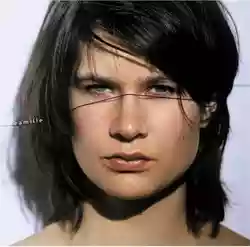
Even our sister nation (or stepsister for many) France occasionally treats us with some unusual and "impertinent" albums outside of the usual big names. We're talking about this new lolita called Camille, who in 2005 released this CD with songs very different from each other, held together by a thin and barely perceptible "connecting thread." An "odd" and intentionally non-homogeneous album with its ups and downs (very few downs, to be honest) that manage to pass unscathed through the most diverse genres and styles: from the similar trip-hop of the first track "La Jeune Fille Aux Cheveux Blancs" to the soul/break-beat experiments of "Ta Douleur," from the Gabriellian World of "Assise" to the typically "a cappella" pieces of "Janine I."
A close cousin of Dani Siciliano or Herbert in many passages, although young Camille seems to have more arrows in her quiver, given the wide range of expressive possibilities proposed.
The journey continues with "Vous," an almost Afro song sung by hypothetical choirs borrowed from Paul Simon's Graceland, carrying on this sort of "around the world in just under 80 minutes" with the proto-funk of "Baby Carni Bird." There's something for everyone and perhaps the lack of a certain stylistic linearity could represent the real and only limit to an album so varied that it becomes difficult to categorize.
With "Pour Que L'Amour Me Quitte" the tone shifts again, bringing our singer's thin and slightly hoarse voice to singer-songwriter registers perhaps more suited to her.
More purely vocal experiments of minimalist style reminiscent of Steve Reich (!!) with the track "senza" and the subsequent "Janine II," also indebted to the sound research of J. Cage and the late Bjork.
Flying low, around Paris, with the next track "Vertige," with the lazy gait typical of "chansonne francaise" to pick up again with the almost-scat track for rhythm and voices ("Au Port") with wind instruments borrowed from the best Mano Chao of the good old days.
An album, I repeat, impossible to classify due to its many stylistic contaminations and references from which it draws so heavily. With "Pâle Septembre" in Aznavour style, the journey winds down, reserving the "surprise" of a track, "Quand Je Marche," that stretches for a few actual minutes yet extends for at least half an hour (!!) of an impalpable silence made of a single note taken to the extreme, without an apparent logical connection. Like a Zen closure. As if after so much traveling, one wanted to catch their breath and better understand what to do next. Like the calm after the storm. As if the light thread accompanying this girl's somewhat ungraceful whisper never wanted to end.
An album in some ways minimalist with one great instrument in the spotlight: the voice. Split, reverberated, overdubbed, light, hoarse. . . in short, a versatile and colorful voice that will continue to be talked about. I am sure of it.
Loading comments slowly
Summary by Bot
Camille's 2005 album 'Le Fil' delivers an inventive mix of styles, from trip-hop and break-beat to minimalist and a cappella. Despite its genre-hopping nature, the album is unified by Camille's versatile voice, explored through layered and reverberated techniques. The record's eclecticism and vocal focus create a captivating listening experience, concluding with a striking minimalist silence. This album challenges categorization yet remains compelling and memorable.
Camille
Camille is a French singer‑songwriter known for adventurous, voice‑driven records that blend chanson, pop, and experimental a cappella. Key albums include Le Fil (2005), Music Hole (2008), and Ilo Veyou (2011).03 Reviews
