
 •
Rating:
•
Rating:
THE REVIEW
After the excitement with which I listened to and reviewed “You Have a Chance” in 2013, I wondered when my friend Valerio Smordoni’s Camelias Garden would release a new work. The answer comes in this intense and prolific 2015. The first work received considerable feedback on the web, receiving very positive comments and even allowing the band to temporarily appear in the strip of the most popular bands on Progarchives.
Smordoni (who will read the review) now returns with a new lineup to accompany him, but with the same desire to convey freshness and emotions. This time, however, we do not have a real album in our hands but have to settle for an EP; only 6 tracks for a total duration of 29 and a half minutes. Usually, there is often something that leads me to snub this type of publication, probably because I consider them as small productions not taken seriously by those who make them, like collections of leftovers, like stuff of the type “yes, we have some new little songs but we don’t have the will to make an album, to do something serious around them, just to let you hear,” like not very important pieces of the production and not decisive in the analysis of the band’s evolution; however, I often make exceptions with bands I am particularly attached to (I recently listened to the one recently released by Riverside); here it was even a distant friend whose debut album I had listened to passionately and I was in any case excited by the idea of being able to listen to new material.
The band continues to move halfway between modern indie-folk and classic prog-rock, adding and modifying something, as demonstrated by the use of altered voice in some tracks, a greater presence of electric guitar—which thus breaks a bit of the more markedly acoustic tradition on which the band was initially founded—and even some timid electronic elements appearing. However, the insertions of flute, violin, or cello that gave that extra touch in the debut album are missing; in all senses, there are things that come and things that go. Nevertheless, here too there is no real fusion between the two genres (which I think would make the band make a real leap in quality) but rather an influence of one on the other, with results still brilliant, just as brilliant and clear is the production, which makes the sound tremendously sharp, clean, and engaging.
Let’s say that we could divide the EP in this way: two more purely folk and acoustic songs, two more “electric” and decidedly far from folk, and two that somehow fuse the two genres. In the first category, undoubtedly fall “Rise” and “Red Light”: energetic acoustic strumming in the former, the latter is more delicate and dreamy with a keyboard work as vintage as it is brilliant, that emulation of old organs really seems to catapult the band into a more than ever 60s atmosphere.
Decidedly deviating from the folk influence are “Making Things Together” and especially “Useless”: the former is undoubtedly the least stunning and perhaps more “ordinary” track of the lot, essentially centered on a lively electric guitar and characterized by a good crescendo of mellotron in the final part, the latter completely foreign to the folk influence and totally devoid of acoustic parts, plunges headlong into pure prog showcasing a capable band even in this guise (as already noted in the debut with “Mellow Days”); dominated by orchestral-sounding keyboard accompaniments, its real strength lies in its emphatic bass lines, which are best especially in the more lively central part, also offering a beautiful electronic loop crescendo almost comparable to those audible in pieces like “On the Run” by Pink Floyd, “Isolation” by Ayreon, or “Take a Bow” by Muse.
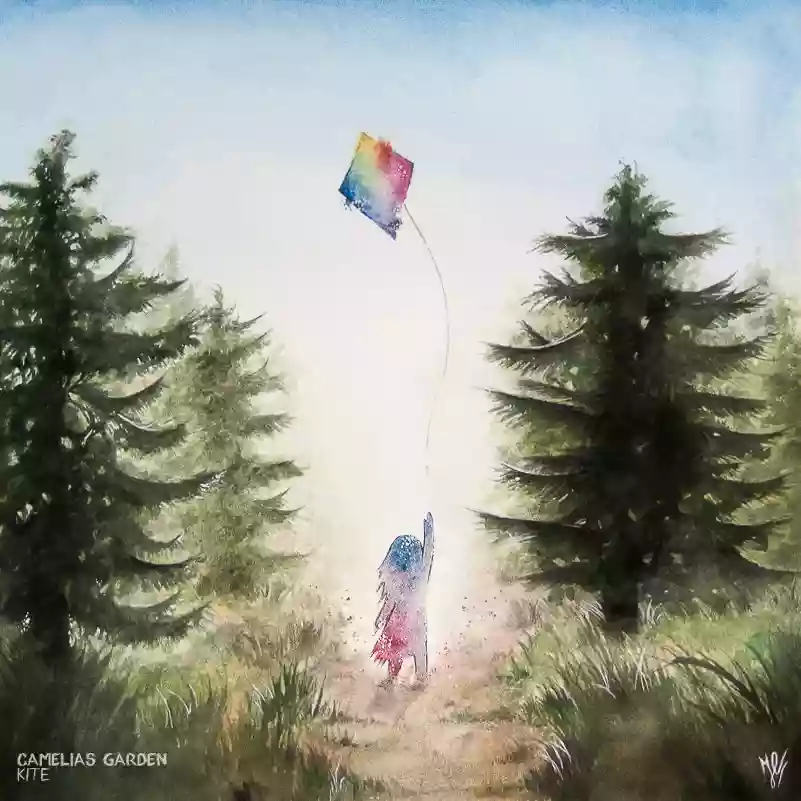
And then there are the two pieces more to be labeled as prog-folk. “The World Inside You” decisively leans towards folk, with again fast acoustic strumming, immediately reminding me of a “Wind at My Back” by Spock’s Beard, same guitar style and beat but everything faster and with a more folk approach, but the track also knows how to evolve and change rhythmically, thus also showing a prog vein, although not very pronounced. But the real highlight is represented by the title track “Kite”: here there is really a perfect synthesis of all that Camelias Garden are; a first part clearly of folk extraction, first with brilliant acoustic arpeggios, then more lively, bordering on country, with energetic acoustic and electric strummings overlapping; the second part, however, offers an interesting electric guitar crescendo that truly catapults the band into post-rock (a genre much loved by Smordoni, in the show we conducted together dedicated to prog we routinely squeezed a post-rock track into the lineup), first with delicate touches and then with a full-blown electric explosion, followed by a heavy repeated electronic loop and final orchestral arrangements. It is probably the track on which the band should reflect and use as a guinea pig for the future, it is a perfect coexistence (albeit not simultaneous) between two quite opposite styles, yet the evolution of the track sounds perfectly natural!
It's only 29 and a half minutes, but enough for Camelias Garden to confirm themselves as a fresh, vital band and a promise for the future. I hope soon to be able to listen to a real new album, but at the moment the band has once again laid the foundations for an excellent future work.
Loading comments slowly
Summary by Bot
Camelias Garden returns with the 2015 EP 'Kite,' showcasing a blend of indie folk and prog rock with fresh electric and electronic touches. The six-track EP features a varied mix of acoustic and electric songs, including the standout title track 'Kite' that fuses folk and post-rock. Despite being a shorter release, it highlights the band's continued evolution and promising future.Tracklist
Camelias Garden
Project led by keyboardist Valerio Smordoni; debuted with the 2013 album You Have A Chance and released the Kite EP in 2015. The project began as a solo act and later expanded with additional musicians.02 Reviews
