
 •
Rating:
•
Rating:
THE REVIEW
Sifting through the overly crowded pages of Rock History, you can find the most disparate situations. You can find bands that with a total discography of 40 minutes condensed into 26 songs encode and kickstart a genre that, twenty years later, is still in excellent health and has a huge following; bands that in 25 years of long career manage to keep their fans close by releasing less than one record every five years; bands that have never done and will never do concerts, perhaps because they are made up of a single member, who might also be locked up in jail for murder… and then, much more humbly, there are bands that are little—or at least not sufficiently—known, that have always played with honesty and passion and have exercised a much greater influence on the music that followed them than their low-profile name might suggest. You can find many examples of the latter case, but the ones I find most endearing are the Buzzcocks.
I find them endearing because they knew how to play just right and almost always remembered to tune their instruments; because Pete Shelley's voice was sometimes on the verge of being off-key and sometimes beyond; because they could play a single open guitar string and make it sound like a real riff. But above all, they are endearing because their records tell you “Hey, playing is easy! And it's a whole lot of fun!”.
This message, which in theory is somewhat that of any band (in various ways) definable as punk, with the Buzzcocks comes even more spontaneously and directly. They tell you “what's the point of knowing how to tap with your gums if with three guitar notes (not chords, NOTES!), a drum fill on the toms and a guitar solo that even my aunt could do, you can put together refined tracks like 'Fiction Romance' or 'Promises'?”. True, it’s the same thing that the Ramones, the Queers, and down down to the Lurkers or the Groovie Ghoulies have always told us. But add in a delicious and veeeery English proto-pop ambition, and there come the Buzzcocks. Because here, besides grinding out chord after chord, cranking up the Marshall distortion to the max, and speeding up the TUM-PA TRRRRUM-PA of the drums as much as possible, there's something more. Or better, less! Here they play by subtraction. Here, the distortion is lowered, the speed halved, there's time to “arrange” some more harmonies here and there, with some single guitar notes placed ad hoc, to emphasize or counterpoint the melody.
If Blur had been their contemporaries, the Buzzcocks would have been the "poor cousins" who, to make up for shortcomings in technique and production, would have had to rely only on a great deal of good taste and a lot of care in chiseling small songs made of nothing. And they would have succeeded perfectly.
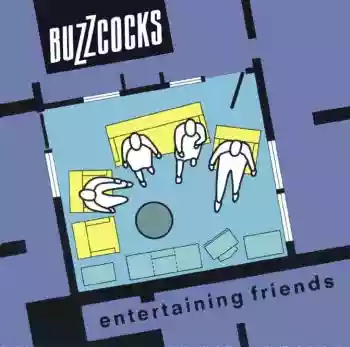
This live is their document that I prefer, probably because it brings together all their mouth-watering songs, including the historic “What do I get?”, also re-played (with a sound a little too much like “Marshall overdrive with compressor” for my taste) by Prozac+, and especially “Everybody’s happy nowadays”, with a wicked melody that sticks to you, like a strawberry BigBabol. But I also prefer it because here there is absolutely none of that (anyway little) more polished air of their studio productions. Here it almost sounds like you can hear fingers scraping on the strings between one chord and another, drumsticks accidentally hitting the rim of the drum in the middle of a roll. It’s a record still alive, smelly, breathing down your neck!
But it's also true that they’re not “just little songs”. Because in this 1979 record (and generally in most of their works of the time) there is practically everything—or almost everything—that was happening and would happen in Britain for at least the next ten years. The riff opening “Autonomy”, with its mechanical and obsessive drums and depersonalized guitar, carries within it the “dark wave” of Joy Division and Sister of Mercy; “Noise Annoys” and “Promises” sound more like English pop-punk (see Ash); “Have you ever fallen in love…” is brit-pop ante-litteram; anything in the Buzzcocks' music sounds like something else that most often came after.
Rediscovering this band that history has left in a somewhat sidelined position can only do good, at least to remember that Manchester has not only been the home of the (great) Joy Division, the Happy Mondays and—unfortunately—the Oasis. And because the impact they had on the music that followed was enormous. But perhaps they wouldn't even like to hear it said, and they prefer to remain so, in the background; after all, as they themselves defined, they were just “four people from Manchester who just make music”.
Loading comments slowly
Summary by Bot
This review highlights Buzzcocks' live 1979 album as a compelling document of raw punk energy and enduring influence. It praises their honest, spirited playing and songwriting simplicity. The live recording captures the band's unpolished, authentic sound. The review emphasizes Buzzcocks' significant impact on later British punk and pop movements despite their understated profile. Overall, it champions their musical charm and legacy.
Buzzcocks
Buzzcocks are an English punk band formed in Bolton in 1976 by Pete Shelley and Howard Devoto. Blending punk velocity with pop melodies, they became key figures of the Manchester scene, releasing classic singles like Ever Fallen in Love (With Someone You Shouldn't've?) and albums such as Another Music in a Different Kitchen, Love Bites, and A Different Kind of Tension. They reformed in 1989 and continued after Shelley’s death in 2018, led by Steve Diggle.05 Reviews
