
 •
Rating:
•
Rating:
THE REVIEW
Charles Hardin Holley, known as Buddy Holly, was born on September 7, 1936, in Lubbock, Texas. From a young age, influenced by artists like Hank Williams, Jimmie Rodgers, Bill Monroe, Lightnin' Hopkins, John Lee Hooker, and Ray Charles, he decided to dedicate himself fully to music.
It's 1953, and the young Holly, called so because his original surname lost the "e" due to a transcription error on a poster of one of his early performances, forms a country-western and hilly-billy vocal duo, Buddy & Bob, with a schoolmate. An apparently ephemeral group that, thanks to a very popular radio program of the time bearing their name, achieves a satisfactory public response, allowing the duo to make some recordings. It's 1955, and the performance at the Cotton Club in Lubbock of a young and dynamic Elvis Presley pushes Buddy Holly towards rockabilly. This is the initial spark of a brief and dazzling career, among the most important and influential in original rock'n'roll. An artistic journey so eclectic and fundamental that it had a huge impact even on the Beatles. It was also in that year that some performances of Buddy & Bob, including one opening for Presley, attracted the interest of a talent scout, Eddie Crandall, who decided to take Holly to Decca at the same time Elvis Presley was making a significant move to RCA. Decca wanted the young Texan to follow the path paved by Presley, and so in 1956, Buddy Holly recorded a series of songs at the Nashville studios, including a raw version of "That'll Be The Day," which were released under the name Buddy Holly & The Three Tunes without success. These tracks, including "Blue Days Black Nights" and "Modern Don Juan," failed to satisfy anyone, leading to an immediate end to the relationship with that record label. It was at this point that Holly decided to turn to Norman Petty, in charge of a recording studio in New Mexico, who was completely captivated and fascinated by the repertoire of the smart and young musician. Petty had him rerecord the old "That'll Be The Day," already recorded for Decca but inexplicably unreleased. Norman Petty also decided to become Buddy Holly's full-time manager, helping him set up a permanent band, the Crickets, featuring Niki Sullivan on guitar, Joe Mauldin on bass, and Jerry Allison on drums.
With this legendary band, Holly began recording songs that became a rightful part of rock'n'roll history for the Coral and Brunswick record labels, both Decca affiliates. Additionally, to avoid legal issues with Decca, Buddy Holly's manager imposed a curious marketing strategy: the group's recordings would be released under Crickets for Brunswick and Holly for Coral. Within a few months, the first recordings of a unique and hugely successful repertoire were released, based on simple rhythmic patterns that softened rock'n'roll's sharpest edges and mixed the usual country coordinates with the more sensitive rhythm'n'blues ones. Immortal tracks with lyrics recounting quintessentially adolescent tales sung by Holly with his inimitable syncopated or hiccupping style, which would be highly influential in the following Sixties.
Titles like the aforementioned "That'll Be The Day," which topped the charts in both the United States and Britain in 1957, "Peggy Sue", "Not Fade Away", "Oh Boy", "Words Of Love", "Maybe Baby", and "Everyday" immediately demonstrated the vast talent, intuition, and genius of this bespectacled, shy, and sweet Texan. A unique and innate talent that made him one of the most important and sensitive authors of the entire rock saga. That faraway year of 1957 was when Buddy Holly managed to reap the rewards of success pursued for years and additionally marked by a famous performance on December 10 at the prestigious Ed Sullivan Show. An innovative style, that of this great artist, which found its culmination the following year with another series of unforgettable songs titled "Rave On", "Think It Over", "It's So Easy", "Listen To Me", "Early In The Morning", "Heartbeat" and "Well... All Right". All successful musical postcards humbly showcasing Holly's guitar technique with his Fender Stratocaster, his very peculiar vocal timbre, and the innovative use of vocal and guitar overdubs. All revolutionary and essential elements in the evolution of rock'n'roll and of enormous influence for artists like the Beatles, Everly Brothers, and Beach Boys.
At this point, Buddy Holly is a major star who has long been asking for more creative freedom and feels a strong artistic need to explore other musical genres. Thus, the Texan musician, after secretly marrying a young Puerto Rican girl and settling in New York, decided to break his artistic partnership with both Norman Petty and the Crickets. So in October 1958, Buddy Holly's last official session took place, producing songs like "True Love Ways", "Moondreams", "Raining In My Heart", and the innovative piece composed by Paul Anka, "It Doesn't Matter Anymore", enriched by the elegant presence of a string section. These are the last gems of an artist who, for several decades, would represent an inexhaustible treasure and source of inspiration for the Beatles, Rolling Stones, Kinks, Grateful Dead, Eric Clapton, Steve Winwood, Elton John, Bruce Springsteen, Elvis Costello, Linda Ronstadt, Joe Ely, and dozens of other musicians. Buddy Holly's bright comet would indeed end its short but luminous journey on a cold February night in 1959 due to a tragic plane crash that also claimed the lives of fellow musicians Big Bopper and Ritchie Valens. Holly's sudden and untimely death left the entire rock world in disbelief and trapped in negative sensations that would be wonderfully simplified in Don McLean's song "American Pie".
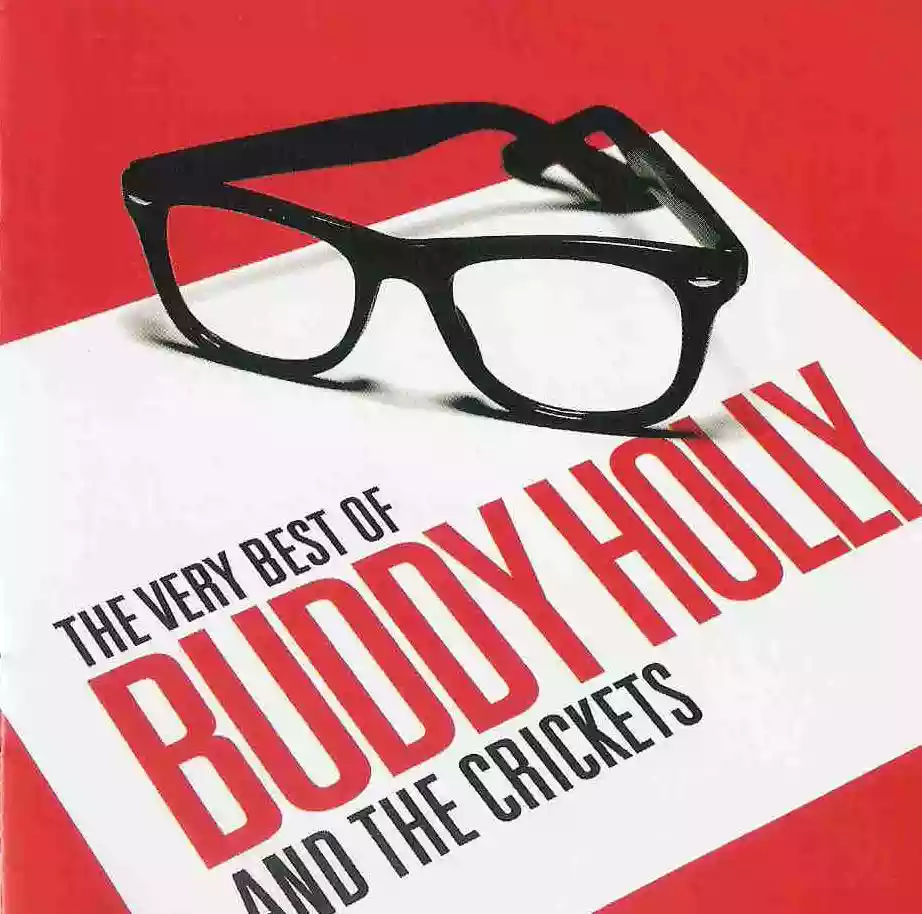
Published in 2008, "The Very Best Of Buddy Holly And The Crickets" is the ideal collection for anyone wishing to approach the music of this important musician. A complete and well-structured collection that, in its fifty tracks, contains much of the history of the first and true rock'n'roll. Listening to these historic songs one after another, it's easy to perceive the talent of this young man who perfectly combined rhythm, melody, and immediacy. A talent that, unfortunately, vanished too quickly but, in the brief span of less than two years, managed to change the rules of rock'n'roll, revolutionizing the composition style of the tracks, enriching them with melody and giving rock its most pop aspect. Besides his work, there remains only the question of what other artistic goals he might have achieved had he not boarded that cursed plane on that unfortunate night in February 1959. It is the same unanswered question we ask ourselves every time we think of Otis Redding, Lynyrd Skynyrd, and Stevie Ray Vaughan, who share the same tragic fate with Buddy Holly.
Loading comments slowly
Summary by Bot
This review chronicles Buddy Holly's influential, albeit brief, rock'n'roll career, from his early beginnings to his major hits with The Crickets. It highlights his innovative style, key songs, and lasting legacy. The album 'The Very Best of Buddy Holly and the Crickets' is praised as a comprehensive collection perfect for newcomers. Holly’s tragic early death only magnified his status as a pioneering figure in music history.Tracklist Lyrics Videos
Buddy Holly
Buddy Holly (born Charles Hardin Holley, 1936, Lubbock, Texas) was an American singer-songwriter and guitarist who helped define early rock and roll with The Crickets. His innovative songwriting, recording techniques, and concise, melodic hits influenced generations. He died in a plane crash on February 3, 1959.03 Reviews
