
 •
Rating:
•
Rating:
THE REVIEW
Who doesn't know Bruce Dickinson, the charismatic singer of the most well-known and, for better or worse, most talked-about heavy-metal band: the Iron Maiden? Well, after over 10 years of honorable service in the ranks of the Iron Maiden, good old Bruce decides that it's time for a change of scenery and to try new things; perhaps due to the deteriorating relationship with the historical leader Steve Harris, perhaps due to the criticisms that rained down on the group following the release of the two albums after the end of the group's "golden years"... or maybe it was also the excitement and new energy he got from composing the soundtrack for the film "Nightmare on Elm Street 5," which then culminated in the release of a real album (the decent "Tattooed Millionaire").
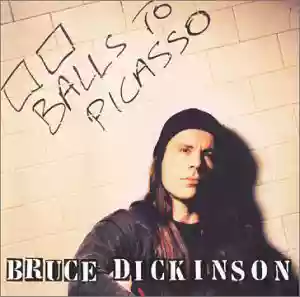
The fact remains that, in 1993, at the conclusion of the exhausting "Fear of the Dark Tour" with the Maiden, Bruce packs his bags and says goodbye to everyone, initially taking a "period of reflection" and then embarking on this new solo adventure; he recruits as companions the talented guitarist Roy Z and his band, the "Tribe of Gypsies," and in 1994 releases his second solo album, "Balls to Picasso."
An album that, despite the preparation of the band members, is nothing exceptional: Bruce's real masterpieces would come a few years later... it's not bad music or bad songs, but simply the album doesn't have a well-defined personality: to complex and elaborate songs like the opener "Cyclops", which gives hope for the quality of the entire platter, are contrasted by decidedly weak and lackluster tracks like the bland "1000 Points of Light" and "Fire". Moreover, the pieces seem disconnected from one another: some still appear tied to the more purely metal template in the Maiden's vein, while others venture into different and slightly more varied territories: this is the case with the melancholic ballad "Change of Hearts", with its almost jazzy flavor (it's worth noting that Bruce knows how to compose slow pieces well...), or the unusual but captivating "Sacred Cowboys", where the singer engages in a sort of rap in the verses, before reaching a more conventional and very catchy chorus!
The CD is a succession of highs and lows: in addition to the aforementioned ones, notable are the epic "Gods of War" and the rather banal "Hell No", which seems composed almost exclusively to be performed live, due to the middle part where Bruce incites a phantasmagoric crowd to join him in chanting the song's chorus (of course, singing "Fear of the Dark" is another thing entirely, but be as it may...); there's also room for the cheerful "Shoot All the Clowns". The album's peaks are found in "Laughing in the Hiding Bush", where, interestingly, Bruce's son is also among the authors: a piece with sharp riffs, and rightfully so, will be a constant in the numerous tours that will see Bruce traveling all over the world, with the audience warmly participating and shouting the rousing refrain at the top of their lungs; the true gem, however, is in the last position, fortunately closing with a great finale: the majestic ballad "Tears of the Dragon", perfect in every part, from the subdued acoustic guitar intro to its melancholic verses, reaching the splendid chorus, impossible to forget once memorized; also noteworthy is Roy Z's work, at times delicate in accompanying Bruce's voice, at other times more decided in the instrumental section where he also stitches an excellent solo, which then fades into almost folk atmospheres. A piece that's a top score, perhaps not very original, but that alone raises the overall quality of an album that's a bit rough around the edges: perhaps Bruce wanted to take too many risks and maybe he hadn't yet clearly decided on the direction for his new career away from the "Maiden house," as the following "Skunkworks" would later prove, light years away from anything done before by the singer, only to return to more congenial (and profitable) territories with the subsequent masterpieces "Accident of Birth" and "Chemical Wedding"; here, with "Balls to Picasso," we're still halfway: certainly not a masterpiece, but not an album to discard either.
Decent, nothing more...
Loading comments slowly
Summary by Bot
Bruce Dickinson's 'Balls To Picasso' marks his second solo album after departing Iron Maiden. The album showcases a mix of metal and experimental styles but lacks a defined personality. While some tracks like 'Tears of the Dragon' and 'Laughing in the Hiding Bush' stand out, others feel disconnected and weaker. Overall, it is a decent effort that hints at Bruce’s evolving solo direction rather than being a definitive masterpiece.Tracklist Lyrics Videos
Bruce Dickinson
Bruce Dickinson is an English singer best known as the lead vocalist of Iron Maiden, with a substantial solo career spanning hard rock and heavy metal releases.13 Reviews
