
 •
Rating:
•
Rating:
THE REVIEW
Conor Oberst is 24 years old (I hate this guy). Talented, sure. And incredibly arrogant: presumptuous enough to publish, some time ago, a collection of songs written when he was just 15. So full of himself that he presents himself, at the beginning of 2005, cold and scarce in releases, with not one but two CDs (I hate this guy).
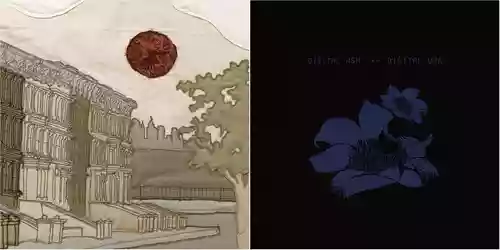
How it turned out is easy to imagine: finding himself with about twenty songs on his hands, instead of doing what any sensible musician would do—choose ten and leave the rest in oblivion—he decided to split them between two releases. In defiance of a stagnant and sluggish music market, here they are: "I'm wide awake it's morning" & "Digital ash in a digital urn," twin albums already refined in the titles. Finding himself in the embarrassment of having to justify such a market move, he had a stroke of genius: give the two protégés production styles as opposite as possible: as much folk and minimalist the first as bombastic and electronic the second (I hate this guy).
After the success of the previous "Lifted," the young Conor earned the permission to meddle with myriad sonic toys in the recording studio. Of course, being a good intellectual wannabe, he does everything to hide it, but don't be fooled: behind the sparse and fragile sounds of the first CD, behind the Babel-like cathedral of electronic clamor of the second, is hidden a production as meticulously crafted as that of the latest Britney Spears (I hate this guy).
But let's go in order: "I'm wide awake it's morning"—the "Bright Eyes" album of the pack—continues in a sense the path started in 1998 with "Letting off the happiness": singer-songwriter style modeled after Bob-Dylan-From-Nebraska adjusted with epic turns, lengthy and intimate lyrics, nasal and whining voice. Here he decides, however, to abandon lo-fi recording, preferring an alchemical sound that rather recalls much ‘70s folk. He even calls Emmylou Harris, an old country star, for support. As if this were enough to make a CD... (I hate this guy).
Simple harmonic laps construct minimal structures; the rest is his effeminate voice, his life laid bare in whispers for 40 minutes of music. Let's listen to it:
"...You were born inside of a raindrop / I watched you falling to your death/ And the sun, well it could not save you / It had fallen down too, now the streets are wet..." "...But me I'm a single cell / On a serpent's tongue / There's a mighty field / where a garden was / And I'm glad you got away / But I'm still stuck out here / My clothes are soaking wet / From your brothers tears...".
These are just some snippets of the disarming confessions of this tiny mountain man (do I hate this guy?), who if you're not on your guard, can fool you, making you believe that what he does is sincere, that he’s not just a petulant poetaster speaking in metaphors, that maybe he is something more, a musician, perhaps.
Let's raise our guard again, then, and move on to the second CD.
"Digital Ash in a digital Urn" is a title that introduces well what awaits us: Ashes—the death—enclosed in an overloaded and deafening electronic Urn. The first track is even comprehensive: a powerful and geometric drum, wurlitzer and filtered guitars, the voice more metallic than usual, sampled external noises; it's a manifesto of intents, long and pretentious. For several seconds, you just hear him panting, huffing (I hate this guy).
When the voice comes, it whispers: "... death... data entry... ant hill law... encoded arc our common cause... drink liquid clocks 'til i see God... crystal display can't turn it off... shh... shh...
Loading comments slowly
Summary by Bot
This review critically examines Conor Oberst’s 2005 two-album release, highlighting the stark contrast between the folk-oriented 'I'm Wide Awake, It's Morning' and the experimental electronic 'Digital Ash In A Digital Urn.' The author admires the production value yet questions Oberst's artistic pretension and self-confidence. Both albums showcase different musical directions but evoke mixed feelings about sincerity and depth.Tracklist Lyrics Videos
Bright Eyes
Bright Eyes is an American indie rock project led by singer-songwriter Conor Oberst, widely associated with the Saddle Creek scene and known for lyric-heavy, emotionally intense songwriting that spans lo-fi folk, fuller orchestration, and occasional electronic experimentation.14 Reviews
Other reviews
By NickGhostDrake
"And yet then you listen to 'Lua' and what can you do - love is blind."
"What can come out if a little arrogant brat who grew up in the countryside of Nashville moves to New York... and projects himself entirely into the creation of the perfect chamber pop."
