
 •
Rating:
•
Rating:
THE REVIEW
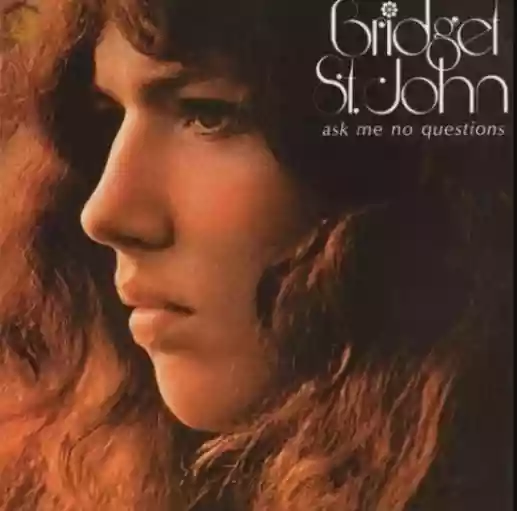
These days, I’ve developed a crush on Bridget St. John. It happens like that, instinctively. Involuntarily. Metaphysically. You fall in love with certain songs, a certain artistic vision, a woman (her profile, lips, nose, and pout). It seems like a stunning perspective to realign yourself to a world that, constantly, like a pinball, sends the last ball into the hole. No one will ever tell you enough about how fantastic Bridget was, except some David Peel of the “crazy flight,” just like no one will ever tell you the truth about their pinball scores!
They used to say about her: “She sounds like the voice of Nico, if Nico were in tune and capable of feeling desires.”
Or they describe her as “The Nico of buttercups, all sunshine, smiles, and cautious optimism.”
Nico, yes. But with a gentle and elegant charm. Her voice is deep, with severe ripples, yet educated; even when "stripped down" it can languidly soften. Not frigid like the Teutonic muse, yet similarly capable of distilling disheartening beauty. Her inspirations, in truth, were Helen Shapiro and Buffy St. Marie! And there’s a problem! St. John was a songwriter, and the label of “interpreter of late ’60s London folk” was too confining. She also had a particular guitar fingerpicking style: a clear, precise technique, a “filigree” inspired by her mentor, John Martyn.
1976, the world has stopped: I’m three years old, I’m annoyed by preschool (why do they make me spend the first month with the older kids?), John Peel has long been saying that Bridget Anne Hobbs, artistically known as St. John, is the best singer and songwriter of Albion. I get a small plastic pinball game that, if you don’t want a particularly dynamic game, yields decent results, St. John disappears.
Bridget was born thirty years earlier in Surrey to a family of accomplished pianists. However, she transitions from piano to viola to banjo; she manages to buy her first classical guitar only in high school thanks to her grandmother’s tips. My grandmother, on the other hand, didn’t give tips but only good advice, in the form of a Delphic oracle: “Did you wash your hands before eating? Do you know where the toilet is just now?” During her time at Sheffield University (she would reluctantly graduate in Italian and French), Bridget finally acquires an acoustic guitar, going to choose it with her friend John Martyn. Martyn soon gets her practicing with open tuning in D. In no time, she composes a dozen songs, which appear to her as “unconscious gifts”; a friend, aspiring poet Pete Roach, who revered John Keats as much as she did, introduces her to John Peel, who launches her on his show (Night Ride). It’s 1968. Shortly after, Peel founds Dandelion Records specifically to allow her to record those songs with maximum freedom, adding only some bird chirping from the BBC archives. Two five-hour sessions and “Ask Me No Questions” emerges.
An acoustic, self-written album, heralding innocence, poise, and wonder; with bucolic settings. It weaves sparse melodies, unremarkable yet unperturbed and pungent, aligning themselves under an ever-widening horizon. Her voice is like shadow rising from the ditches. She sings of "crystalline cradles of mist and dew", "crumpled leaves in October", "thin stems bent and torn", "whispers of water", "pine and cedar / Magnolia, yew, and tamarisks", snow and seasons, "the worn wings of butterflies", moles and pigeons, up to "the boy with the lizard's tongue"; then, the falling in love. "Don’t ask me questions / Don’t tell me lies if you don’t mind / And come with me / There, where the sun flies / There, where the sky is even bluer and where we’ll be." Her talent is narrating without enchanting, without concealing, without flattering, without deluding, without complaining. In her debut, she had already synthesized her character.
“Ask Me No Questions” is a simple, unadorned set, pure folk but wrapped in a lofty and sacred dimension, with the artist accompanying herself with only a guitar. John Martyn and future Fairport Convention member Ric Sanders appear here and there. Try the unique fragrance and existential aura of “To B Without A Hitch” and “Ask Me No Questions”!
It was 1969. Different times! Imagine that Bridget also performed with King Crimson, Deep Purple, and Jethro Tull. She played at David Bowie's venue, then at Les Cousins with her soulmate Nick Drake (a kindred spirit with whom she shared silences and shyness). Yet, she didn’t earn enough to break free from her family. Little changed with her other two excellent albums: “Songs for the Gentle Man,” produced by Ron Geesin (from Atom Heart Mother), with extended arrangements for a baroque folk that remained introverted, and “Thank You For...,” produced by Jerry Boys (Steeleye Span, Sandy Denny), where she dabbles in folk-rock, including significant covers (but the album wasn’t even distributed at the time because Dandelion failed). St. John also recorded a fourth work, “Jumble Queen,” oriented to soft rock, for Chrysalis, but it didn’t sell. I didn’t gain much either from the apple slices I brought home from preschool. Just a few reprimands.
So we’re back to 1976, when Bridget St. John left. Off to New York, Greenwich Village, where, after an initial brief stay, Bridget decided to live; her marriage had also broken down (to the point she had stubbornly lived in a very secluded cottage without water). Just settled, she discovers her boyfriend was living with another. However, her love for New York is fatal, instinctive, metaphysical. But here, within a few years, she progressively abandoned music for more lucrative jobs: dishwasher, bartender, cleaner, cook, bar manager, caregiver, artist assistant; she even became a mother. Only after about twenty quiet years is there a return to music, quite subdued, around the mid-'90s, for a Nick Drake tribute, some collaborations with Michael Chapman and Kevin Ayers. A return that continues to this day, with a band in New York, almost amateurish, that doesn't record, doesn't have a manager or its own website.
The star of Bridget St. John shone for just over half a decade, never with the support of sales. But this folk singer-songwriter does not live in regret, doesn't care about the cult status, of a success perhaps not entirely extinguished but transient. She still tells today, at seventy-five, that she was, instead, lucky. She transformed the randomness of her fate into the destiny of the soul, even though she always had to reckon with this world of men and pinballs. But she is happy and has an album of Kevin Ayers’ incompletes, with his daughter, Galen, in the works.
Meanwhile, I, who am in paradise with “Ask Me No Questions,” go to get my heart defibrillated.
Loading comments slowly
Summary by Bot
This review celebrates Bridget St. John's 1969 debut album, Ask Me No Questions, highlighting her unique voice, poetic lyrics, and delicate guitar work. The album is praised for its pure folk sound and metaphysical charm. The reviewer reflects on her brief but impactful career, her ties to the British folk scene, and eventual move to New York. Despite limited commercial success, Bridget's work is described as timeless and deeply affecting.Tracklist Videos
01 To B Without A Hitch (00:00)
02 Autumn Lullaby (00:00)
03 Curl Your Toes (00:00)
04 Like Never Before (00:00)
06 Barefeet And Hot Pavements (00:00)
07 I Like To Be With You In The Sun (00:00)
08 Lizard-Long-Tongue Boy (00:00)
09 Hello Again (Of Course) (00:00)
10 Many Happy Returns (00:00)
11 Broken Faith (00:00)
12 Ask Me No Questions (00:00)
Bridget St. John
Bridget St. John is a British folk singer-songwriter known for her deep, warm voice and open-tuned guitar style. Discovered and championed by John Peel, she recorded for Dandelion Records and later moved to New York, returning to music activity in the 1990s. Her cult-classic albums include Ask Me No Questions, Songs for the Gentle Man, Thank You For..., and Jumble Queen.02 Reviews
