
 •
Rating:
•
Rating:
THE REVIEW
But well, I hate how reviews start. All all all all all the same, I mean, either they start with a historical framing, or with a very cool aphorism, like "Rogito ergo soccavoli", "Life is a variété and ò cazz è comm ò rre!" or "My hair goes swiiish". Sometimes, however, one tries to do something different, you know, for example, criticize the ways in which a review is introduced. And this, in its small way, already seems to me a good basis to start from.
I think it's unnecessary to specify who Eno is. Our favorite Eno-logo Brian-zolo is indeed one of the standout figures of that music, but not only that, mind you, also of that other one, and yet another, well, a bit of all, particularly relaxing and with a vaguely soporific aftertaste.
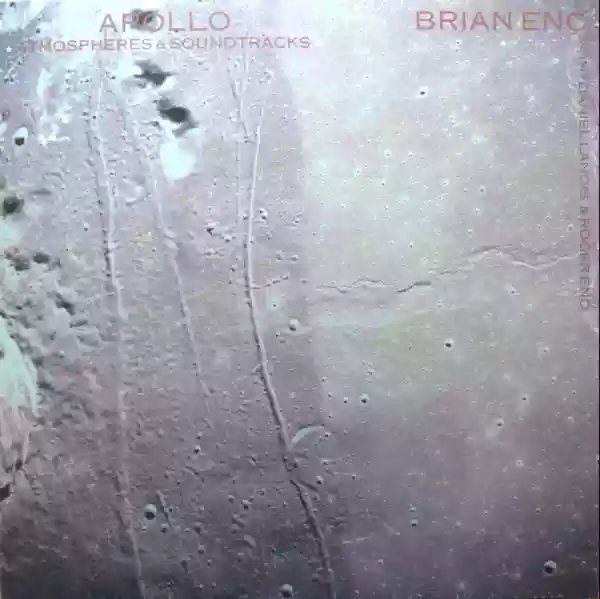
Well (or Ebene, just to cite ad canis cazzum my beloved Klaus Schulze), in 1983 the fiercely discussed "Apollo: Atmospheres and Soundtracks" becomes available.
Despite the album starting with good, but what am I saying good, very good, actually, excellent intentions (see for example An Ending (Ascent), an incredibly tear-jerking thing), the quality index of the record often and gladly plummets below worrying thresholds.
Take "Matta", for example: now, beyond the fact that a track with that name REGARDLESS doesn't inspire a particular sense of beauty and/or relaxation, well, maybe it could be that it's just me, but in any case, I can't explain why you hear sounds so completely out of context. I mean, why in an album that tells, or rather should tell, the depths of space, do you hear sounds similar to the cries of wildebeest?
And again, the bass. I wonder: is it really necessary to insert a bass so prominent and at the same time so inconsistent with the musical discourse? Standout examples are in Under Stars, Under Stars II, and Signals. Listen to believe.
Then I'm not saying there aren't interesting things, on the contrary, the already mentioned An Ending is a sublime example of Eno's subtle sound poetry. Weightless at the same time is a good example of how ambient should be done.
But nothing. Nothing can justify the atrocity of Deep Blue Sky. It seems like a waltz, but it's in 4/4, a bit like in that episode of the Simpsons (the difference is that the Simpsons have a comedic purpose, Eno shouldn't have...). Incomprehensible is the choice to put a primitive rhythmic section to an ambient track; to paraphrase another of the major musicians of recent years, Roach: «Ambient music consists of eliminating the time factor and holding the listener in an endless "now"».
In short, a mediocre album; if it weren't for those two strokes of genius, there in the middle of the album, which significantly raise the average, the record would be a 1. And said by a big Eno enthusiast...
Loading comments slowly
Summary by Bot
The review critiques Brian Eno's 1983 album 'Apollo: Atmospheres and Soundtracks' as largely mediocre despite a few brilliant tracks like 'An Ending (Ascent)'. It highlights puzzling sound choices such as out-of-context noises and inconsistent bass lines. The reviewer finds fault especially with tracks like 'Deep Blue Sky' for breaking ambient music conventions. Ultimately, the album's overall quality is disappointing even for an Eno enthusiast.Tracklist Lyrics Videos
Brian Eno
Brian Eno is a British musician, composer and producer, widely recognized as a pioneer of ambient music and an influential collaborator and producer across rock and electronic music since the 1970s.43 Reviews
Other reviews
By vonhesse
The music of this journey does NOT belong to us: it belongs to the stars, to the Milky Way, to the celestial mechanisms that regulate the laws of the Universe.
Eno has delivered back to us 12 fragments of stars ... 12 jewels from another dimension, 12 pearls that cannot be missed by those who seek a connection with a higher entity.
