
 •
Rating:
•
Rating:
THE REVIEW
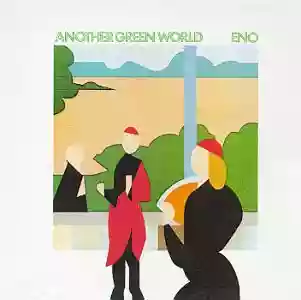
There are things in life that seem to be born naturally, spontaneously, apparently without any creative effort and "study" from man, such is their grace. Things that hide complexity behind a balance and harmony that make them appear very simple. "Another Green World" belongs to this category. It is situated in the middle phase of Eno's career, between experiments on song form and the pioneering future works of ambient music. It's what is commonly referred to as a transitional work.
One would then expect a somewhat fragmented, non-uniform work. But that's not the case. How is it possible?
Imagine a flowered meadow. We can admire its multicolored carpet from a distance and be enchanted by it, just as we can get closer and pick a rose or a violet, smell its fragrance, and be equally enchanted. "Another Green World" is like that. Its tracks are color notes, small crystalline pieces that shine with their own light and together form a marvelous picture. Technically this is possible because Eno uses the recording studio in a revolutionary way. That is, as an instrument. With his creative genius, he "manipulates," treats sounds like the canvas of a painting, he is mostly interested in tapes. And here even an incompetent person could work on it, assembling at will parts played by "competent" musicians. It's his theory of "music for non-musicians."
When the sound of the opening track "Sky Saw" fills the air, we begin to realize all of this. Staggering drums wrapped in brilliant swathes of synth, in the middle a hinted chorus, itself an "instrument" (the voice is no longer "front" in recording phase but is treated just like a "sound" and that's it)
Result? A sense of clarity and transparency unlike any other, a wonderful integration between classical and electronic instruments, with the latter never having sounded so natural until then.
The same enchantment is repeated by "St. Elmo's Fire," a catchy melody embellished by a warm and sparkling guitar solo by Robert Fripp that slices through the organ and piano textures as well as the heart.
"In The Dark Trees" introduces us to Eno's world of ambient suggestions, dark, threatening, and unsettling like a walk in the woods at night.
The peace returns in the sunny "I'll Come Running" where Fripp is once again the protagonist. The brief title track is as clear as a mirror of water rippled by the concentric circles of a pebble that gently dies at the bottom.
Another splendid miniature is "Little Fishies," so delightful it flows away each time without fully appreciating its taste.
Very tender and melancholic is "Golden Hours," with Eno's voice getting lost among sounds and its hopes.
The following "Becalmed" takes us adrift in a calm, nocturnal sea, in search of the utmost calm, so delicate and subdued that it is almost less intrusive than silence.
The album closes with unease in "Spirit Drifting," the last ambient piece with an undefinable flavor, floating among the darkest and remotest thoughts, fearsome and therefore repelled.
No doubt about it. An extraordinary album, of splendid taste, a precursor of concepts that would become a standard in the future (we are in 1975), an exaltation of the naif genius, the only thing, however, that cannot be taught in school.
Loading comments slowly
Summary by Bot
Brian Eno's Another Green World is a groundbreaking and harmonious album that bridges experimental rock and ambient music. It showcases innovative studio techniques treating the studio as an instrument. The record features contributions from Robert Fripp and balances classical and electronic sounds with clarity and emotional depth. Released in 1975, it remains a timeless and influential work in Eno's career.
Brian Eno
Brian Eno is a British musician, composer and producer, widely recognized as a pioneer of ambient music and an influential collaborator and producer across rock and electronic music since the 1970s.43 Reviews
Other reviews
By zotter
Like many small droplets of condensation on the glass, which vanish with a touch in familiar catharsis.
What is pop? Simplicity. Another green world.
