
 •
Rating:
•
Rating:
THE REVIEW
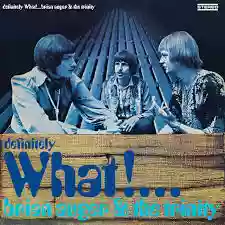
Everyone was still sporting Beatles-style mop-tops in 1968, the year associated with this album and its cover photo. “Definitely What!…” marks the debut of Brian Auger’s short-lived group Trinity. Auger, born in London in 1939 and still with us today, has been living in Los Angeles for some time with his Sardinian wife Ella, thanks to whom he can manage a bit of Italian.
Auger belongs to that category of keyboardists who always preferred the organ over the piano, not to mention synthesizers, which he barely dabbled with before quickly abandoning… so he roughly shares the same instrumental inclination as greats like Jon Lord, Gregg Allman, Ryo Okumoto, Ray Manzarek, Hugh Banton, Dave Greenslade, Ken Hensley, Tony Kaye, Gregg Rolie. Fluid and brilliant from a young age, Brian was at the forefront of the London scene as early as the early sixties, when everything was still about to happen. Around him—or rather, often with him lending a hand—were the Beatles, Dylan, Yardbirds, Cream, Hendrix, John McLaughlin, Stones, Stewart… people like that.
Indeed, the album opens with a sculpted instrumental “A Day in the Life”: bass, drums, organ, and orchestra. But the definite standout is surely the jazz guitarist Wes Montgomery’s gem “Bumpin’ on Sunset”, rendered here far better than the original, featuring Brian’s “nocturnal” organ, a’la Jimmy Smith (his undeniable inspiration), which first paints quietly then increasingly vividly a captivating path, this in spite of the rather invasive orchestra with its over-the-top interventions.
Utterly unbearable, however, is the choice to render a famous anthem like “John Brown’s Body”—already quite hateful to my mind—with an out-of-tune chorus, off-key trumpet, and gratuitous Hammond splashes scattered here and there.
The instrumentals are in any case preferable to the tracks where he also sings, as Brian simply cannot sing well at all. His amateurish intonation stands in total contrast to his supreme, communicative, creative, and virtuoso abilities as an instrumentalist. And on the piano, when he deigns to play it (here only on the penultimate track “If You Live” by the illustrious Mose Allison), he performs splendidly.
The “song” that closes the album and gives it its title is quite endearing, as it exemplifies those distant times when record labels still let musicians do as they pleased: eight minutes of intertwined solo improvisations from the bass, drums, flute (and who the hell is playing it? Maybe someone from the orchestra), and organ. Those were different times.
Loading comments slowly
Summary by Bot
The review explores Brian Auger & The Trinity's 'Definitely What!', highlighting its blend of jazz, rock, and soul influences. It praises the group's musicianship and the distinct sound of Auger's Hammond organ. The critic provides an in-depth look at standout tracks. Overall, the album is seen as a strong entry in genre-blending music of the late 60s.
Brian Auger & The Trinity
British jazz-rock group led by Hammond organist Brian Auger, active from 1966 to 1970. Known for inventive covers and originals that fused soul, jazz, and rock, often featuring vocalist Julie Driscoll.03 Reviews
