
 •
Rating:
•
Rating: THE REVIEW
Among the great bands dedicated to the highly melodic hard rock that was all the rage in the eighties and then unceremoniously swept away by grunge, Boston boasts some unique features of its own. First of all, they were the pioneers of the genre: their first album dates back to 1976 and opened all the necessary doors to those musical worlds that would find massive success not less than ten years later. Furthermore, they are associated with an important technical, qualitative, and structural evolution of sound recording in general and guitar in particular, due to the insights and experiments of their leader, engineer Tom Sholtz, a fellow who secured far more patents than records in his lifetime, just to efficiently frame the subject... A true designer in the service of electronic technology and a highly refined ear (very refined) applied to amplifiers, microphones, effects, and magnetic tapes, but above all a perfectionist on a manic level, the kind of person the world sometimes needs to evolve and write new pages on some of its arts and activities.
The decisive advantages brought by Sholtz's technical and architectural genius in terms of superior sound and structural quality, qualities unexpectedly capable of elevating to the extreme and making irresistible musical ideas and compositions that were rather repetitive and limited in themselves, were complemented by the appeal of the radiant tenor voice of the band's frontman Brad Delp, who tragically committed suicide a couple of years ago with carbon monoxide. A mild-mannered and humble person, far from gifted regarding stage presence and charisma, Brad nevertheless stood out clearly thanks to the angelic qualities of his vocal output, so comfortable in high notes that he didn't need to resort to particular power and grit to be fully understandable and supremely enjoyable above the rock noise created by his bandmates. His vocal lines, alone or meticulously layered into heavenly choirs, inspired admiration and touched the hearts of many people.
Live, Boston was never an important factor: essentially the creation of one man or at most two, they never enjoyed that cohesion (or interplay, as the always incisive and essential English language more effectively puts it), that "groove" which makes the difference on stage, aided perhaps by image, extroversion, sense of spectacle. Too architectural, layered, and meticulously studied were the studio performances to adapt to the instinctiveness, simplicity, and approximation of a concert.
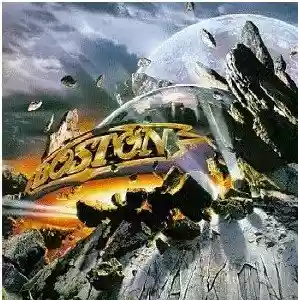
"Walk On" is the fourth album of a thirty-year career that includes only five (plus a collection with some unreleased tracks), and it is certainly not bad, but it doesn't particularly shine, being much better than the last "Corporate America" (released in 2002, terrible), but in my opinion, it doesn't deserve more than three stars, when the first self-titled and the second "Don't Look Back", released in 1978, were five stars, and the third "Third Stage", released in 1986, was worth four. And then Delp is not in the band (the only Boston album to see him absent), replaced by the good but not equally special Fran Cosmo.
The standout song from the work is the melancholic ballad "Livin' For You", perfect for Cosmo's range and with a sumptuous mantle of guitars, orchestrated and mixed brilliantly by the ingenious Sholtz, initially simulating a string section and then creating a layered, bombastic solo, albeit practically made of two notes.
The closing "We Can Make It" is evocative even if only in part, because the beautiful chiming arpeggio that supports the verses resolves into the usual, predictable Boston refrain. However, its epilogue is highly original and impressive: from the usual orgy of lead guitars, left to wander in the background after the rhythm section has faded, emerges a thundering low guitar note, swollen with bass frequencies until it bursts, slowly sinking until it dissolves... into the rustling of leaves! Listening to this passage with headphones is a spectacle.
The album's centerpiece should be the titular medley, divided into four movements. The first sees Sholtz indulging all alone with his big guitar in a free form improvisation: nothing monumental except the usual, incomparable, beastly sound, turgid and massive to the nth degree. The second and fourth parts consist of classic Boston rock'n'roll, driving but already heard. In the third part, Tom elegantly riffs with the Hammond organ, an instrument for which he shows even greater skill than with the guitar... after all, as a boy Sholtz had studied classical piano for years, only to become passionate about the six strings when he was already grown up.
The mortal sin committed on this album, however, is the extensive use of electronic drums, a true heresy for rock music, which needs the natural groove given by a human being striking drums and cymbals, to literally bring life and warmth to the rhythm. Sholtz's self-indulgence in this regard is self-destructive and frankly irritating, given that it's impossible to think it wasn't a precise choice.
"Walk On" is thus the only Boston album that can be described with moderate adjectives. It is mediocre, decent, or good depending on taste (assuming the genre is of interest, of course). The remaining four releases under the Boston name must be rated much more radically: in my opinion, the first is a world heritage, the second a masterpiece, the third a very good album, and the fifth and last a bitter disappointment.
Loading comments slowly
Summary by Bot
Boston's Walk On is a decent album that suffers from the absence of legendary vocalist Brad Delp and overuse of electronic drums. While technically well-produced by Tom Sholtz, the music feels less inspired compared to earlier classics. Some standout tracks like "Livin' For You" and the medley "Walk On" show the band's technical skill. Ultimately, the album ranks as average within Boston's celebrated discography.Tracklist Lyrics Videos
Boston
Boston is an American rock band formed in Boston, led by guitarist/engineer Tom Scholz. Their 1976 debut became one of the best‑selling rock debuts, powered by meticulously crafted guitars and Brad Delp’s soaring vocals. Signature songs include More Than a Feeling and Amanda.13 Reviews
