
 •
Rating:
•
Rating:
THE REVIEW
With Agents of Fortune (’76), the second part of the Blue Öyster Cult's career officially begins. This phase started five years earlier and evolved through the release of three excellent studio albums and a live one. The change implemented by the New York quintet isn’t painless for the fans, given that the music produced from now on by Bloom and company will be characterized by less inventiveness and impact, in favor of more refined and muffled sounds, in line with the American rock blues tradition: especially overseas, the audience will gather in large numbers, and BÖC's name will become part of the mainstream, together with contemporary acts like Aerosmith, Grand Funk Railroad, Kiss, Styx, ZZ Top, Journey, Kansas, labeled as part of the so-called "Arena rock" that was so popular in the latter part of the '70s and continuously played by many FM radios of the era. This leaves a taste of bitterness for those who remember BÖC's underground origins, essentially relegated to the discography of the average American à la Homer Simpson, who, unsurprisingly, is a declared fan of the group, mentioned in some episodes of the well-known cartoon. The reader should not think that this introduction implies an inexorable failure for the album under review, which, at times, is a more than good product, even if it irreparably marks the loss of the magic present in the eponymous debut album, in Tyranny and Mutation and in Secret Treaties.
Rather than describing the album track by track, I prefer to rearrange the order of the songs, dividing them between those that most clearly express the group's sonic shift and those that better reconnect to tradition. The first category includes the opener This ain't The Summer Of Love, a track that doesn’t reach three minutes and frankly seems banal, with rather irritating vocals for the band’s standards, almost mannerist, the trivial True Confessions, written by Allen Lanier, the first concession to pop rock in the group's career. A separate discussion is warranted for the now famous Don’t Fear the Reaper, written and sung by Donald Roeser, a well-crafted track with a beautiful melodic appeal, especially famous for being included by John Carpenter in the Halloween (’78) soundtrack and being highly appreciated by Stephen King: the melancholy of the lyrics coordinates well with the electroacoustic sounds of the guitars, although listening to the track repeatedly can become tiresome.
Always characterized by strong melodicism is E. T. I. (Extra Terrestrial Intelligence), in which the band revisits the established sci-fi references, with an excellent guitar work and a nice off-beat riff closing the chorus: one of the most enjoyable tracks on the album. A debt to American classic rock is also Debbie Denise, a touching ballad closing the album with intense acoustic passages and a relaxed chorus, written by Patty Smith (with original lyrics hinting at lesbianism, later changed during the process). The second category includes more atypical and less predictable tracks, where the hand of the Bouchard brothers is evident, who in hindsight are the true architects of the group’s darker side: The Revenge Of Vera Gemini, written with the usual Patty Smith, sees Bloom at the top of his form and perhaps more at ease in a piece particularly modern for its time, alternating with the female voice that gives a particular unease to the track, almost from another dimension. Note the excellent guitar work, more focused on the rhythmic texture and emotional tension creation than on the rock evolutions one might expect from the group. Sinful Love, a rhythmic track built around drums, with a killer riff, benefits from the intervention of female choirs to create an obsessive and perverse climax, in line with the lyrics. Tattoo Vampire, written by the bassist, is almost a sped-up version of the old Hot Rails To Hell, and thus the most violent track of the entire album, a devilish and defiant rock‘n’roll. Also by Joe Bouchard is the splendid Morning Final, a ballad with debts to late '70s psychedelia, with uncommon development and refined arrangements: the splendid lyrics reference city life and the urban decay of New York of those years, depicted in "Serpico" or in "Dog Day Afternoon" with Al Pacino. Tenderloin is an excellent contribution by Lanier to the album, also a mid-tempo supported by keyboards and synthesizers, with great melody and excellent development.
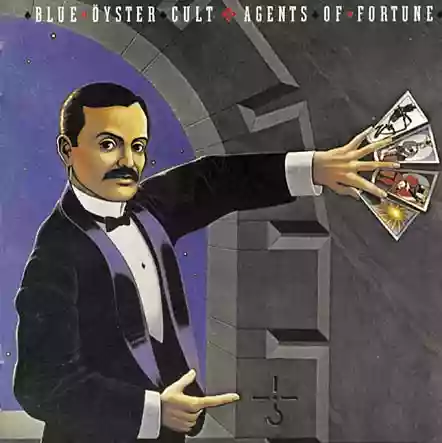
At the end of the listening, there remains doubt about the rating to attribute to the album: I settle on a 4/5 in view of the intrinsic quality of the work, although true fans of BÖC might feel authorized to give a lower rating. Overall, it is still a recommended work for those who are not familiar with the group, and want to approach, step by step in the sonic universe of the best American band of the '70s. A concluding note on the cover: "Agents Of Fortune" are the cards held by the magician pictured on the cover, but beware of the individual’s index: it points to the cross of Kronos/chaos cross, of disorder and of the "non-sense" that governs the group's cosmogony. Genius and subtly disturbing.
Loading comments slowly
Summary by Bot
Agents of Fortune marks a shift in Blue Öyster Cult's sound from inventive and impactful to more refined American rock blues. The album features iconic tracks like 'Don't Fear the Reaper' and blends ballads with heavier rock elements. While some fans may miss the band's earlier underground style, this album achieved mainstream success and remains a recommended entry point. The musical craftsmanship and lyrics create a memorable listening experience despite some less compelling tracks.
Blue Öyster Cult
Blue Öyster Cult is an American rock band formed in New York in 1967, known for dark, theatrical hard rock blending sci-fi, horror, and occult-tinged storytelling. The group’s classic era spans the early-to-mid 1970s and includes influential albums and staples like “(Don’t Fear) The Reaper.”22 Reviews
