
 •
Rating:
•
Rating:
THE REVIEW
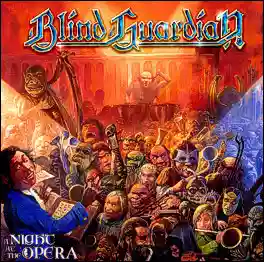
Year 2002: After a full 4 years since its predecessor “Nightfall In Middle Earth,” in my opinion the highest point in the Bards' discography, “A Night And Opera” (who said Queen?) was released, causing quite a stir. Already, some foreshadowing signs emerged with the cover, completely different – and less inspired – compared to the previous ones. The CD showcases an almost obsessive attention to every little detail, first and foremost an excellent production. I was rather skeptical about listening to this work, having read not-so-positive comments from fans, who criticized the CD for an excessive presence of choirs and the overwhelming complexity of the compositions, as if it were a very challenging prog metal work. In my opinion, the choirs in this CD are absolutely perfect, and the songs are not at all as complex as some claim; in fact, they are much more direct than “Nightfall…”. This is why perhaps ANAO returns to some elements of “Imagination From The Other Side.” The themes related to Tolkien's universe, so dear to the group, are absent, as is almost gone the medieval aura that hovered in their previous works, with ANAO being much more sunny.
The CD opens with “Precious Jerusalem,” a track with rhythms more suited to a prog band and an air more suited to a group from sunny South America (it reminds me of Angra!). An excellent experimental piece. It continues strongly with the majestic “Battlefield” where, for a moment, the epic and medieval air of old returns: The piece truly has an extraordinary and emotional feeling, and the choirs are superbly utilized. It continues with “Under the Ice,” a very sunny piece dedicated to the Trojan War. “Sadly Sings Destiny” is definitely the track that impressed me the least, both in singing and structure. The mid-tempo “The Maiden and the Minstrel Knight” is very beautiful, truly evocative. “Wait for an Answer” is also beautiful, an aggressive piece with very dynamic and powerful rhythms. “The Soulforged” is the next piece, featuring an absolutely fabulous chorus and excellent riffs. One of the peaks of the CD. “Age of False Innocence” alternates powerful moments with more reflective ones while “Punishment Divine” takes us back to the early albums and gives us a speed song with uncommon charm and power. Track number 10 is the famous “And Then There Was Silence,” which, in its mammoth duration, recounts the visions of Cassandra. The piece is a masterpiece, a true metal opera, where tension is maintained throughout the work. Many have accused it of excessive prolixity, but detractors should reconsider. The CD closes with the bonus track “Frutto Del Buio,” performed in Italian. The same song has been translated into French, English, Spanish, and Argentinian. Indeed, Hansi's pronunciation is hilarious, yet the Bards must have made a significant effort.
This is true progression: Evolving one's sound. Of course, I still consider NIME their best work, but “A Night And Opera” holds its own very well with “Imagination From The Other Side.”
Loading comments slowly
Summary by Bot
Released in 2002, Blind Guardian's 'A Night At The Opera' marked a significant evolution in the band's style, emphasizing intricate choirs and more direct compositions. Although some fans criticized its complexity, the reviewer praises the album's production and standout tracks like 'And Then There Was Silence.' The album departs from Tolkien themes but retains emotional and epic qualities, blending prog and power metal elements. Despite some weaker moments, it holds its ground alongside the band's best work.Tracklist Lyrics Videos
Blind Guardian
Blind Guardian is a German power‑metal band formed in 1984, known for epic, melody‑driven albums and frequent literary/Tolkien references. Their work ranges from early speed‑metal to large‑scale, choir‑and‑orchestra arrangements.29 Reviews
Other reviews
By Masahiro
"This 'A Night At The Opera' is an album so gaudy, so boring, so baroque, so epic that it makes a tremendous racket without playing a single minute."
"The problem with this album doesn’t lie in the compositional technique or the originality of the group. It lies in its being absurd, in its desperate attempt not to emulate 'Nightfall In Middle-Earth.'"
By Ragnaròk
"Pompous and grandiose, that's how we could define 'A Night At The Opera' by the mellowed Blind Guardian."
"Not a masterpiece, but the blind guardians came very close, a must-have!!!"
By Proscriptor
Just listen to the first seconds of the opener 'Precious Jerusalem' to understand that the music has changed... and a lot!!
The 14-minute suite 'And Then There Was Silence' alone is worth the purchase of the CD and our guys are forgiven for some slightly excessive experimentation.
