
 •
Rating:
•
Rating:
THE REVIEW
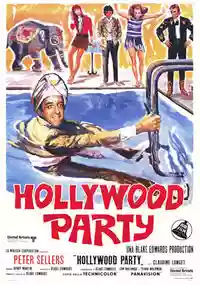
Following the first episodes of "Pink Panther," the sparkling, outdated "The Great Race," the lackluster "What Did You Do in the War, Daddy?," the intriguing "Peter Gunn: 24 Hours to Kill," Edwards calls Peter Sellers to portray on screen one of his successful radio characters, the bumbling Indian Hrundi Bakshi. The result of this meeting is "The Party," known in Italy as "Hollywood Party" (as usual, you never know, Italians might be idiots and not go to see a film with too concise a title).
Despite the expectations, the film did not achieve the desired success. Perhaps people expected a bumbling, generous, and obtuse Closeau, comically full of himself. Instead, Hrundi Bakshi is slow, subtle, and relentless, and perhaps many viewers did not have the patience to follow his diabolical plan of destruction.
Over time, "Hollywood Party", thanks to the blessed word of mouth that saved films like "2001," has become a cult film, so much so that it has achieved the status of a masterpiece of comedy.
And indeed, it is a masterpiece.
For those who haven't seen it, here's a summary of the plot: we are on the set of a colonial adventure film, in the style of "Gunga Din"; a purebred Indian extra (Sellers) manages to cause such disasters that they have to halt the film's production.
Noted by the production manager to the producer, Clutterbuck, he writes down the complex name on a sheet of paper on the desk. He orders the secretary to contact, through written invitations, all the names listed for the production party.
Fate has it that this sheet, as if added at the last minute, includes the name of Bakshi...
What follows is a dizzying parade of catastrophes, leading to the final debacle. The splendid villa of General Clutterbuck will be literally flooded by a torrent of bubbles...
Slim storyline: and inside, a finely crafted comedic mechanism akin to "Play Time" by Jacques Tati, coincidentally from the same year. The gags of Bakshi's disasters follow the same path as those that happened on the film set where he was an extra. The dazzling and phony world of half-wit presences that infest certain environments, as well as the snobbish powers that dominate them, find an unwitting avenger in the meek Indian.
The satirical side of this film has often been highlighted: apparently, it may seem like a mere diversion, but the representatives of the cinematic underworld (the cowboy, the fanatic actress with a toupee, the rogue production manager sleeping with actresses, the idiotic wife of General Clutterbuck) are too proverbially caricatured and paradigmatic to dismiss this hypothesis.
In "Hollywood Party" it is the world of the defeated that find justice: Bakshi, a heroic figure of an antihero, the starlet Michele Monet (played by the real starlet/singer Claudine Longet, a sort of French Astrud Gilberto) who doesn't compromise for her career, the alcoholic waiter Levinson, a character who looms large in the film almost like Sellers, and who finds love with a starlet alcoholic like him. The hypocritical order of conveniences and formalities, the vacuous world of appearances (the substance of the film industry) is shattered, or rather, sunk (literally) by this little Indian person, typically Gandhian in her frailty and determination, with a transparent smile and innocent manners, whose formality of manners derives from genuine kindness of soul. perhaps the only character "from the other side" that is saved is indeed General Clutterbuck, an industrialist of art yes, but he endures, suppressing irritation like a stalled car, all the nagging of his wife and employees (rarely in film does one perceive the actor so clearly as a worker rather than an artist, the famous "beast" of Hitchcockian memory).
According to this perspective, in my opinion, the key scene is where Bakshi approaches the remote control panel of the splendid villa. Like a child, Bakshi has the habit of touching everything and acts on the controls; he will alternately extend the water jet that flows from the bronze cherub peeing into the pool, suddenly ignite a flame from the central fireplace, warming the backside of many bigwigs, and, noticing an oscilloscope that moves the wave when he speaks, squawk parrot sounds and words previously directed at the cowboy. Silence falls: everyone is stunned to hear the voice of this Exterminating Angel with graceful and subversive systems.
Despite time having accustomed people to fast, predictable comedy, made of jokes and catchphrases, "Hollywood Party" can still be a wonderful antidote to this: it distills drop by drop the nitroglycerin of a humor with a highly disruptive charge. Highly recommended viewing in the original language, although the Italian version is really well done.
Loading comments slowly
Summary by Bot
Hollywood Party, directed by Blake Edwards and starring Peter Sellers as Hrundi Bakshi, is a satirical comedy that initially saw mixed success but grew into a cult classic. The film presents a slow-burning, subtle humor that contrasts with more predictable slapstick, highlighting the chaotic world of film production. Edwards crafts a masterpiece of comedy with an antihero protagonist whose innocent disruption exposes the hypocrisy of Hollywood. The film's carefully structured gags and sharp satire continue to entertain and provoke thought decades after its release.
Blake Edwards
Blake Edwards was an American film director, screenwriter and producer known for elegant comedy, incisive satire, and character-driven drama. He created the Pink Panther series, directed Breakfast at Tiffany’s and Days of Wine and Roses, and frequently collaborated with composer Henry Mancini and actor Peter Sellers.07 Reviews
