
 •
Rating:
•
Rating:
THE REVIEW
In the early Nineties, Black Sabbath must have seemed to many like fish out of water, old fossils unwilling to give up, even though the scene around them had drastically changed in the meantime.
Already considered the fathers of heavy metal twenty-five years ago, Tony Iommi and company had miraculously survived the Eighties. While Ozzy, after his dismissal in '79, embarked on a sold-out solo career, the guitarist had more than one headache: the number of singers to find themselves with the Sabs' microphone was countless, and drummers and bassists often became mere session players. Only in 1987 did a fresh breeze begin to blow from Birmingham, with the permanent arrival of young Tony Martin, who was urgently called to rerecord the vocal parts for “The Eternal Idol,” an LP as remarkable as it was unknown to most. With seasoned Cozy Powell also on board, the group seemed to regain some popularity with “Headless Cross”, far from the glory of the past but still enjoyable. Evidently, the only one not convinced of how things were going was Iommi himself, who after the excellent “Tyr” of '90 decided to embark on a cardboard reunion with Ronnie Dio, yielding the decent “Dehumanizer” and a plethora of quarrels and discussions. The arenas were filling up again, the bank account too, but the singer of “Heaven And Hell” was certainly no nonentity and his ego was what it was. Having bid farewell (not really!) to the New York elf, all that was left was to call back the trusty Martin, who very patiently agreed to resume his place after being unceremoniously dismissed.
Black Sabbath version 1994 reappears with a lineup that combines old and new and is one of the best in the band’s history on paper. If Martin represents the new beginning of the late Eighties, Geezer Butler, who had rejoined a couple of years earlier, embodies the spirit of the golden era. Yet another change behind the drums, with the seat now occupied by Bobby Rondinelli, a classy drummer with an impressive resume, mainly Rainbow, while, according to the credits, it seems that for the first time Geoff Nicholls is officially recognized as a full-fledged member of the group and no longer just a session player. It is pointless to mention who wields the six strings.
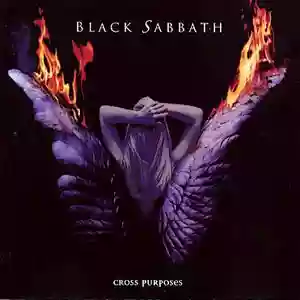
“Cross Purposes” hit the stores in January '94, an annus horribilis for any classic metal band: between grunge tornadoes and alternative storms, does the old English Sabbath still have a reason to exist? The answer is yes. Much like their “cousins” Motorhead, Black Sabbath managed to navigate through very different musical eras without ever really overturning their proposal or caving into passing trends, much like a fossil preserved over time regardless of what happened around it. “I Witness” is a tight track, great for opening the album, showcasing, along with the already known abilities of the members, an excellent production. “Cross Of Thorns” is rhythmic and atmospheric, supported by the voice of the ever-praiseworthy Martin, the only one truly capable of not making listeners miss the legendary Ozzy and Dio, while “Psychophobia” does not deviate an inch from what has been offered so far, with powerful and melodic hard rock. If “Virtual Death” echoes the early doom Sabbath too much, “Immaculate Deception”, with Nicholls' keyboards ever prominent, perfectly captures a now well-established band, despite the many lineup changes. “Dying For Love” is a beautiful ballad but the subsequent “Back To Eden” and “The Hand That Rocks The Cradle” feel déjà vu, and even “Cardinal Sin” does not shine for originality. The album concludes with “Evil Eye,” a decent track but nothing more.
“Cross Purposes” thus turns out to be a pleasant melodic hard rock album, starting very well but losing its way with some tracks that are not always on target: sometimes there's a feeling that, at the “mere” seventeenth LP, they began to feel a bit fatigued, at least in the compositional phase. For years, the album has been out of catalog, like much of those with Tony Martin, but rumors of a new collaboration between the singer and the guitarist are circulating: maybe it will be a good opportunity to open the archives and reissue some of the old material.
Black Sabbath:
- Tony Martin, vocals
- Tony Iommi, guitars
- Geezer Butler, bass
- Bobby Rondinelli, drums
- Geoff Nicholls, keyboards
“Cross Purposes”:
- I Witness
- Cross Of Thorns
- Psychophobia
- Virtual Death
- Immaculate Deception
- Dying For Love
- Back To Eden
- The Hand That Rocks The Cradle
- Cardinal Sin
- Evil Eye
Loading comments slowly
Summary by Bot
Black Sabbath's 1994 album Cross Purposes marked a determined return amid the grunge and alternative wave dominating the music scene. Featuring a lineup mixing old and new members, the album presents strong melodic hard rock tracks but falters with some less inspired songs. Tony Martin’s vocals are praised for fitting well into the band's legacy, although the album doesn’t reach past glories. Despite some compositional fatigue, it stands as a respectable entry in their late career discography.Tracklist Lyrics Videos
Black Sabbath
English heavy metal band formed in Birmingham in 1968, widely credited as pioneers of heavy metal and led musically by guitarist Tony Iommi.91 Reviews
Other reviews
By Damned Soul
It’s a good album that perhaps lacks something, that ‘hand’ of God—Ronnie James, to be clear.
Black Sabbath has never just thrown together four notes and lyrics, and therefore on this front, we can’t help but achieve a certain quality: texts almost always sensible and coherent and an excellent record production.
