
 •
Rating:
•
Rating:
THE REVIEW
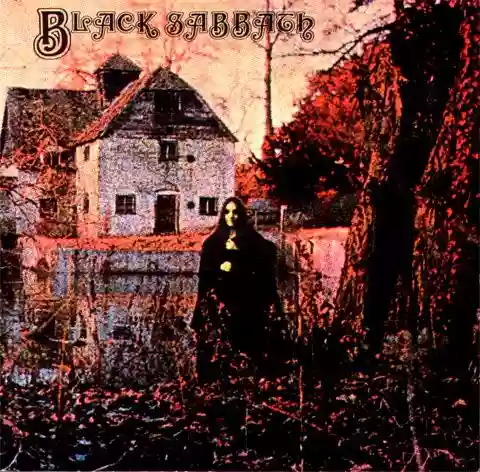
"Black Sabbath" (Castle, 1970)
In 1970, the music world was shaken to its core by a new force: Black Sabbath. Four young musicians from Birmingham: John Michael (Ozzy) Osbourne with his powerful and wildly off-key, dramatic voice; Frank Anthony (Tony) Iommi, who had a short stint with Jethro Tull, on a dark and distorted guitar; Torrence Michael (Geezer) Butler with his smooth and enveloping bass; William (Bill) Ward, a solid yet refined drummer of British hard rock. They debuted with their self-titled album, recorded in a studio with only four tracks at a cost of just three hundred pounds.
The start is horrifying: pouring rain and rumbling thunder, a death knell tolls in the distance... Then a solid, slow riff from Iommi's Gibson breaks in forcefully. Welcome to "Black Sabbath". The everyday world vanishes, and the listener is catapulted into a nightmare landscape, subdued by the enchantment of the eerie opening riff repeated endlessly, as if it were a ritual, a kind of dark sorcery; the evocative power of three single notes is astonishing: the fundamental doubled at the octave and the diminished fifth, a combination known as the "devil's interval" (since the Middle Ages, when it was called "Diabolus in musica"), create a sinister and evil atmosphere. Extraordinary is the work of the musicians, with the perfect rhythmic carpet of Geezer's bass, and Ward on percussion. Then everything calms down, the sounds become muffled, and here enters for the first time the elongated voice of Ozzy, reciting words of fear over the terrifying instrumental scenario. In the end, the track quickly evolves into a rocky, hammering, obsessive riff, then explodes into a monstrous solo by Iommi. Ladies and gentlemen, black hard rock is born, and the foundation is laid for all the dark sound of the years to follow.
Next comes "The Wizard," distinctive in its heavy blues with the pleasant novelty of a harmonica played by Ozzy that entwines and blends with Iommi's "wicked" riff. The result is a dynamic, lively atmosphere: the coming of the wizard who chases away the forces of evil seems to bring back the calm ("Sun is shining / Clouds are gone by / All the people / Give a happy sigh"), dissipating the stormy clouds of the opener and shattering the grip of immobility that gripped the listener in the first six minutes.
The next track, "Behind The Wall Of Sleep", presents typically Zeppelin solutions, a lively intro, with the bass and guitar exchanging endless pleasantries, even if the sound is the dark trademark of Black Sabbath. The song explores the realm of dreams (which in this case, naturally, equals nightmares) and the distortion of reality through the use of alcohol and various drugs, the first chapter of a story that will recur throughout the subsequent Sabbath production: just think of "Sweet Leaf", the opening track of "Master Of Reality" (1973), "Snowblind", the central track of "Vol 4" (1974), even pushing as far as "Trashed," the opener with "rival" Ian Gillan on vocals, "Born Again" (1983).
"N.I.B." ("Nativity In Black") takes its cue from Iommi's preferred compositional technique: a single, solid riff, interspersed with a slowdown at each of the two choruses, and embellished by two powerful solos, one in the middle and one at the end. Also noteworthy is the excellent work of Geezer on the bass, treating us to a tasty solo opening the track. The lyrics are, believe it or not, a love declaration from Lucifer himself(!), lyrics perhaps somewhat immature from that sensational songwriter Geezer Butler. On the notes of the incredibly explosive closing solo, the first half of the album ends.
The second part opens with "Evil Woman", a cover by Cow, a track that, despite the good work of the musicians, Geezer first of all, remains overall quite mediocre, lacking the inventiveness and typical style of Black Sabbath. Even the lyrics are very different from those written by the bassist.
With "Sleeping Village", back to optimum levels: a very brief sung intro, accompanied by an arpeggio in dark and decadent tones, followed by a very enjoyable instrumental section.
In the seventh position, we find "The Warning", with Iommi and Butler delighting us with another fantastic duel, while an inspired Ozzy sings the pain of abandonment and lost love, and Bill Ward keeps time with precision like a remote control, adept at appearing and disappearing, continually adapting to the piece's fluctuating dynamics. The only flaw: the continuity of the track is broken by the long jam session of a perhaps too eager Iommi wanting to showcase his extraordinary qualities (issues of ego), somewhat detached from the rest of the song.
The whole thing closes with "Wicked World", a testament to how well Iommi capitalized on his brief experience with Jethro Tull. It is Iommi himself who gives us another excellent solo, while Ozzy sings as only he can, the lyrics of the ever-present Butler, a depiction of the world's pain and problems. A track that is an effective musical translation of the desperate grey factory world of Birmingham.
Loading comments slowly
Summary by Bot
This review praises Black Sabbath’s 1970 self-titled debut as the genesis of heavy metal, highlighting Ozzy Osbourne's unique vocals, Tony Iommi's iconic dark riffs, and the solid rhythm section. The album’s atmospheric and sinister sound is expertly dissected song by song, emphasizing its lasting influence. Despite a minor criticism of one track, the overall assessment is highly favorable.Tracklist Lyrics Videos
Black Sabbath
English heavy metal band formed in Birmingham in 1968, widely credited as pioneers of heavy metal and led musically by guitarist Tony Iommi.91 Reviews
Other reviews
By TenshiSell
The black demon we have evoked is now before us. The gates of hell are now open.
"Black Sabbath" appears simple yet unsettling, starting slow and then exploding into a frantic finale.
By AR (Anonima Recensori)
This CD is a presentation of the apocalypse, a journey into territories unexplored until then.
The riffs of Iommi and Butler, accompanied by Ozzy’s distinctive singing, would become the fundamental blueprint of Heavy music.
By Axlspark
"The album that started Metal."
Tony Iommi proves from the start he can crank out riffs like few others in rock history.
By mezza
The blues matrix on which all of Sabbath’s sound would later evolve has its strongest presence in their debut album.
The album closes in the best possible way, marking the history of music and serving as a springboard for a formidable group that will churn out many more masterpieces!!!
By Confaloni
The sinister charm of the opening track 'Black Sabbath' is undeniable, with ominous bells tolling and a storm approaching.
Just to have a certain completeness in the collection of historic vinyls, it is worth having Black Sabbath’s debut album, from which the whole dark metal genre starts.
