 •
Rating:
•
Rating: THE REVIEW
"Like blood, but even deeper and darker".
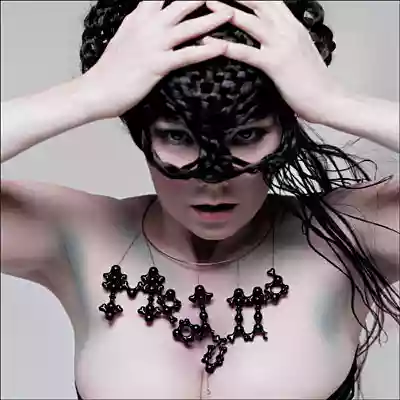
A human being, a body in motion. Veins, capillaries, tendons, muscles, and bones. And voice. Björk herself had hinted at wanting to create something extremely human, viscerally almost annoyingly so.
In the years leading up to the release of Medúlla, the little Icelander had scoured China, America, England, and Iceland with the goal of gathering all the most bizarre and capable voices of the most animalistic verses and guiding them in her ambitious project of extreme humanization of music. In this album, instruments are almost completely absent. The melodies are densely woven, giving rise to a thick tapestry of voices, making the presence of instruments seem superfluous.
From the very first song, Pleasure Is All Mine, it's clear that we've been introduced to something completely new, never heard before, yet... intensely familiar. Tagaq's sighs and guttural sounds blend with Björk's unmistakable voice, and when the choir inserts itself into the fabric to fill the gaps between one note and another, a true journey into the simple human essence begins.
In the following track Show Me Forgiveness, Björk's voice ventures completely unaccompanied into a cold and vast silence, shaping a solitary and hypnotic chant.
The album's tone maintains the same atmosphere until the appearance of the twisted Öll Birtan, where Björk's incredible vocal abilities peek through obsessively whispered words and hypnotic overlays of the singer's own voices in an episode of pure compositional madness.
However, Björk's passion for electronic sounds prevails in tracks like Desired Constellation, a song of rare brightness and purity, which clashes with the rest of the album and would undoubtedly have blended better in an album like Vespertine.
The album's climax, the song summarizing all of its contents, is the spectral Ancestors. Which, as it happens, is the only track featuring a real musical instrument: piano notes, bare and solitary. Tagaq's breathy sigh that opens the song gradually transforms into a rasp, while Björk weaves sweet and distant litanies in an excruciating falsetto, eventually degenerating into an explosion of astonishing high notes interspersed with genuine frenzied growls. All accompanied by a melancholic piano that abruptly stops to leave the stage to the multiple voices of the two singers intertwining more and more densely in a breathtaking crescendo.
The understanding of this album starts precisely after listening to this track, which reminds us of our origins, our "human" side, in the strict sense of the term.
In my opinion, once again Björk has managed to perfectly hit her target of communicating to the human soul sensations that are otherwise inexplicable, given the absolute inadequacy of human language to express those emotions you feel in your skin, under the skin, too close to the core that generated them to be externalized in any way other than music.
Loading comments slowly
Summary by Bot
Bjork's album Medulla offers an innovative journey through human voice textures, replacing instruments with layers of vocals. Collaborations with diverse vocalists create a dense, emotional tapestry. Tracks vary from hypnotic chants to electronic brightness, culminating in the climactic and deeply moving 'Ancestors'. The album successfully conveys raw human emotions beyond words.Tracklist Lyrics Videos
06 Who Is It (Carry My Joy on the Left, Carry My Pain on the Right) (03:57)
Read lyrics10 Sonnets/Unrealities XI (01:59)
12 Mouth's Cradle (03:59)
15 Komið (02:00)
Björk
Björk Guðmundsdóttir is an Icelandic singer, songwriter and producer known for her solo work since the early 1990s (after earlier projects including the Sugarcubes). She is noted for vocal experimentation, genre-defying albums and inventive live shows.40 Reviews
Other reviews
By janis
A truly subtle army of voices leading to atmospheres of devastating peace and profound restlessness.
A delightful discovery, appreciated especially because it is pleasant to reconsider things and abandon resignation for genuine complacency.
By Adil
Only Björk, muse of psychotic directors and anti-pop icon par excellence, could have created an album so unbearably snobbish in its disarming simplicity.
Bjork never repeats herself. All this for the (joy?) of her loyal listeners.
By Me Myself & I
Medulla is a masterpiece of modern music, an avant-garde work.
The music tries to communicate through its absence, where there is an attempt to find greater simplicity in art.
By The_dull_flame
"Medúlla is not a mere experiment, it’s poetry."
"Medúlla is the artistic peak of this small great Icelandic woman."
