 •
Rating:
•
Rating: THE REVIEW
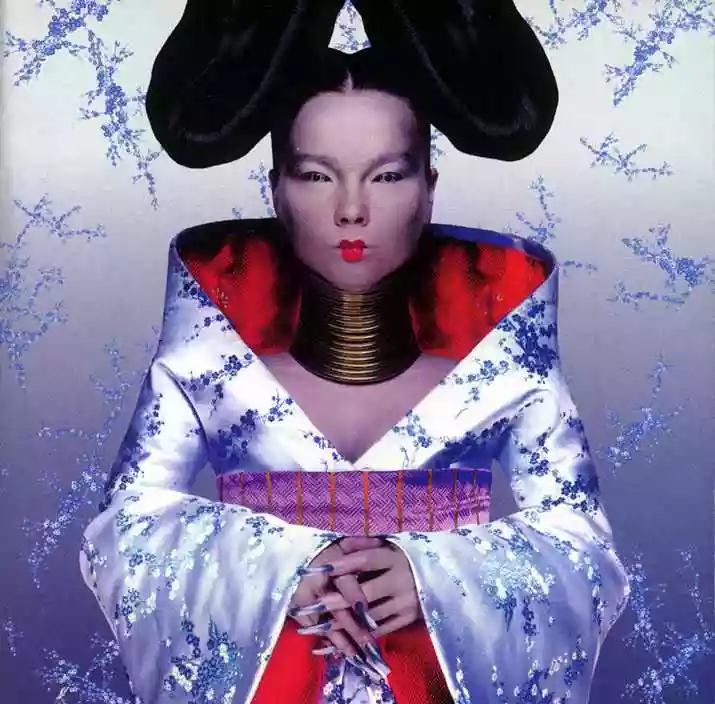
In 1997, Björk, the now famous Icelandic singer who, after the jazz of glin glò, the rhythmic and "ethnic" Debut, and the reflective transition album that Post seems to represent, reaches a major turning point. Björk is no longer a young girl. Björk is a mature composer, and she demonstrates this in Homogenic. Homogenic is not just a collection of songs. Homogenic stands as a journey, a path, traced and narrated by Björk's fantastic voice.
The album opens with the subdued percussion of "Hunter," where Björk seems to declare herself the huntress, who is searching and determined to find. The cold and clear voice already begins to open new horizons for us, gradually leading us to follow the search for what the huntress wants to understand deeply: love in all its forms. And so we are guided to Iceland, through the violins of "Joga," and Björk's voice, which seems to emulate the echo among the high and untouched mountains, shudders, explodes, and demonstrates the artist's elevated technical ability. In the same way, in the same place, we will be shown the cave of "Unravel," a splendid "serenade," a melancholic realization of how painful the wait for lost love is, where Björk doubles and overlays, groaning resignedly on a subdued background of static sounds... but when love returns, there is no escape. Passion overwhelms us, like the stormy sea of "Bacherolette." Here Björk reworks in her own way, with her beloved strings laid over electronic sounds, a classic form of song, akin to the Neapolitan sceneggiata. Here the effect of the ice gives beautiful effects, as its apparent coldness explodes into the greatest emotion, with vocal performances that are perhaps among the best of her entire career. But when we move away from the passion, the electronic drop of "All Neon Like" is already waiting for us, which this time will fall on a river of artificial sounds, yet aiming to recreate natural ones, conversely.
The river soon dries up when it flows onto the rocky notes of 5 years, where Björk growls, curses, in the metaphor of love-hate. At this point, abruptly, we find ourselves among the reproaches of "Immature," and we already see the night falling, among the few piano chords and frantic and disordered sounds. And after "Immature"... a song seems to arrive that is quite inappropriate for Homogenic. We indeed find the "dance pop" for which Björk became known. Definitely to be interpreted. Then we have "Pluto," the reinvention, the rebirth, which brings through screams the awareness, the solution. Everything is full of love. And it is then that Björk's voice emulates the sun's rays, which melt the ice, bringing a message that has always been known deep down. This album is not a search for originality or experimentation. On the contrary, it is an album that sets itself a single goal without any pretensions: to express emotions in the most open, simple, and direct way. To the heart, that is.
Loading comments slowly
Summary by Bot
Bjork's Homogenic marks a turning point in her career, showcasing her maturity as a composer. The album blends electronic beats with strings and raw vocals to explore themes of love in its many forms. Each track contributes to a cohesive journey inspired by Iceland’s landscapes and emotional depth. The album’s simplicity and directness powerfully connect with listeners.Tracklist Lyrics Videos
Björk
Björk Guðmundsdóttir is an Icelandic singer, songwriter and producer known for her solo work since the early 1990s (after earlier projects including the Sugarcubes). She is noted for vocal experimentation, genre-defying albums and inventive live shows.40 Reviews
Other reviews
By Cleo
In Homogenic, the moment of awareness and renewal that emerges after great suffering seems frozen in time.
From this inner journey comes a difficult album of great sound and vocal experimentation.
By geektheboy
Bjork finally finds her true voice, creating her most cohesive and unified work ever.
Nature and its primordial aridity constitute the ideal core around which the stories revolve.
