
 •
Rating:
•
Rating:
THE REVIEW
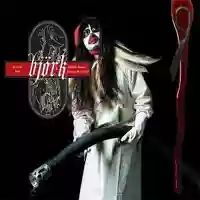
Björk returns, after Dancer in the Dark, to the big screen, this time in the film Drawing Restraint 9, by her husband Matthew Barney. The film, presented at the Venice exhibition, is said by many critics to be an experimental, hermetic, and inconceivable work, while others describe it as snobbish and useless... but the only thing that can be certain is that this film is characterized by a great particularity, an oddity, that does not allow it to spread to a wide audience, to the masses.
And yet, we managed to find the music. Fortunately.
Drawing Restraint 9 is a soundtrack signed and produced by Björk, who lends her voice to only a few songs. The album indeed opens with "Gratitude," a letter of gratitude narrated by the uncertain and melancholic words of Will Oldham, which float among the pure harps and the pure children's choirs... it seems like the beginning of a fairy tale. A decidedly sinister fairy tale, followed by the primordial echoes of a tagaq in excellent form, balancing between terror and excitement, but not exceeding in either. A piece relevant mainly for its clear reference to Medùlla, not fully understood in context, at least by most. To the last sighs of the tagaq, follows the march. The celebration. The bells. Yet, one cannot define "Ambergris March" as joy. The atmosphere is dark, heavy, suitable for a melancholic sigh during a cry, a truce between two wars... forced joy. and the other instruments suffocate the bells, abruptly. A few piano notes mark the beginning of "Bath," where gradually we recognize a completely different Björk. The voice whispers, hypothesizes, sad, melancholic, sinister, without collapsing, or uplifting itself... Until it doubles, triples, overlaps, and eventually breaks down, reconstructs, and reaches unison only at the end. Needless to say, "Bath" may result, upon careless listening, as a set of moans without an apparent conclusion. Yet... After Björk's moans, we find ourselves in front of the trio "Hunter Vessel"/"Shimenawa"/"Vessel Shimenawa". We face instruments, only instruments, distorted in recreating the darkest sense of oppression in the listener. Yet, the danger never arrives. At this point, there is the storm... not ordinary, though. The cold and indifferent sounds of Björk collaborate with natural, atmospheric, and artificial, electronic sounds, in recreating a dark, tense, sinister atmosphere. There are no surges, waves, everything is calm, silent, and that's why it instills so much fear, so much oppression. And among the high-pitched sounds and a frantic electronic beat, we cross the sea to find ourselves in the front row of a NO theater show, a typical Japanese "specialty". Certainly, it must be said that the friendly Japanese has the arcane power to bring the listener, already from the first minutes, to exasperation, who quickly skips the moans and hurries to the next track... but this track perfectly conveys the idea of what NO theater is, and has a certain charm in some way. In any case, it is not a pretension of originality or a manifestation of how snobbish the composer is... she simply showed us a bit of traditional Japan... (just to cheer you up, I remind you that usually, this kind of shows lasts many, many more hours. Hours, not minutes.) And here comes the ethereal "Cetacea". The song appears empty, bare, plaintive, uncertain... Björk's voice trembles, unsure, and barely vents. A possibly failed experiment. And then... the end credits. "Antartic Return". Instrumental, the protagonist is the Sho. The Sho, resigned, seems to pick up the previous songs, guided by Mayumi Miyata's mastery, and slowly, gradually, tells us there's nothing more to describe.
Drawing Restraint 9 is a soundtrack. Produced by Björk, certainly, but it is by no means her album. That is why in the 11 tracks we do not find the emotions and ideas of Björk, which from Glin Gló to Medùlla have always been explosive, irrepressible, passionate. The music of this soundtrack, instead, seems chained to a flat line, and as soon as it strays from it, it is slowly restrained and brought back to where it attempted to escape. The record is dark, ominous, melancholic, resigned... oppressive. Björk is among the most important COMPONENTS of this work, directing, perfecting... always for the expression of emotions, of course... but this time not hers. Those of her husband, Matthew Barney. If the record is not satisfactory, we are faced with an irremediable consequence of the film. If a film "sucks," only an equally "sucky" soundtrack will have succeeded well. Otherwise, it would no longer be a soundtrack.
Loading comments slowly
Summary by Bot
Bjork's Drawing Restraint 9 soundtrack is an atmospheric, dark, and melancholic work tied closely to her husband Matthew Barney's film. Unlike Bjork's usual explosive and passionate albums, this one is restrained, experimental, and oppressively calm. The music blends traditional Japanese sounds and experimental vocal techniques but may feel distant and obscure to casual listeners. It serves primarily as a fitting accompaniment to an enigmatic, hermetic film rather than a standalone Bjork album.Tracklist Lyrics Videos
Björk
Björk Guðmundsdóttir is an Icelandic singer, songwriter and producer known for her solo work since the early 1990s (after earlier projects including the Sugarcubes). She is noted for vocal experimentation, genre-defying albums and inventive live shows.40 Reviews
Other reviews
By The Punisher
I dare say a deeply dull, rarefied, and vacuous album. Too vacuous.
Once you say 'Bjork' they take it with their eyes closed. Just like I did, damn it...
By The_dull_flame
"Drawing Restraint 9 is not just a musical homage to the film... it's a true album that works even without the film's delusional images."
"The first notes of the harp in 'Gratitude' are enough to be enthralled: a dark, deep, and intangible song with a charming chorus of Japanese children at the end."
By tetsuoironman
This soundtrack is much more than just a simple record. It is a treasure chest of secrets that must be discovered fully before being appreciated for its intensity.
"Storm" is the masterpiece of the album: indefinable electronic outbursts, devastating sound waves, thunderstorms, sound storms confront Bjork’s restless voice.
