
 •
Rating:
•
Rating:
THE REVIEW
A night so empty can only be painless.
Stuart Adamson died by suicide in a hotel room in Honolulu. He died in solitude, without the clamor of a rock star, first succumbing to depression and then to a rope. Unfortunately, alcohol had long since worn down all resistance. But if I sit down to write these few lines, it's because I believe he left us a legacy worth remembering.
You could endure my pain and love it. But you will never know how I live.
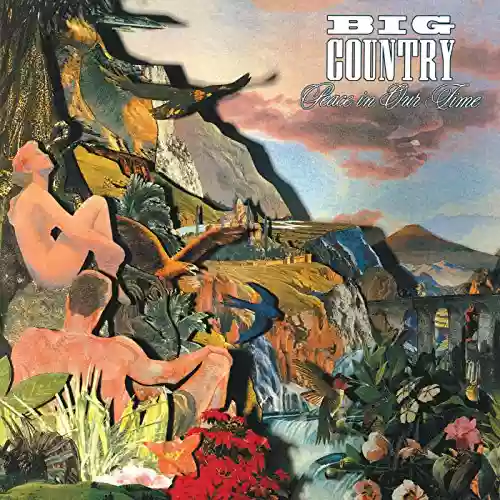
I started listening to Big Country as a kid. I was the only one in my circle of friends who was captivated by their magical guitar weavings that sounded like bagpipes and smelled of Scotland. My baptism was this very "Peace in our time", an album criticized by the critics but also by many of the group’s fans, who poorly digested this (pseudo) commercial shift and the more polished sound. I, for a change, am the voice crying in the wilderness. Here I find a variety of styles that weren't present in previous works. The sector's "experts" themselves complained that the band's distinct, recognizable sound was both a blessing and a curse. Well, that was proven wrong. And anyway, for me, this album has a lot of substance, simply because I have never skipped a track, something that often happens with more inconsistent albums.
Memories always exaggerate. And nothing is more false and true at the same time.
There are those albums that you love deeply and cannot really explain why. At the time, it could be said it was a new sound to my ears; today I probably still smell the scent of my adolescence in it. Music, after all, is more linked to instinct than to reason. It marks our time, accompanies our emotions day by day, and crystallizes the events of our lives. And so even if deep down we all feel the need to tell something about ourselves and our listening experiences, the truth is we remain alone with our lives and our music. Like a second skin with which to share sweat and scars.
It is the river of hope, it is the river we lost for years.
Big Country always accompanied their “bagpipe rock” with lyrics that managed to combine poetry and social commitment, attempting to lay bare the problems and divisions of the United Kingdom, from the crisis of the suburbs and rampant unemployment, to the mirage of Steeltown and the lingering colonialism of the Falklands. Important themes that aligned them with the early U2 and The Alarm, the famous Celtic trio, and which become a considerable added value to the group's musical offering. And even if destiny decided to reward the Irish from a record industry standpoint, I can assert without hesitation that Big Country did not show any weaknesses artistically and instrumentally.
That shop will not have my soul, but it will certainly take my money.
Back then, there were not the means we have today to dive in real-time into the music of the bands we were interested in. Buying an original cassette was a true act of faith. If you were lucky, you knew 2 or 3 songs out of 10. You still had a 70% chance of having wasted those 20,000 lire (or thereabouts), which wasn't a small amount for a family that wasn't exactly swimming in money. But Faith decided on that act. It decided to trust the two singles that rotated on radio and TV at the time: the more energetic and rocking "King of Emotion" and the melancholy folk-tinged "Broken Heart (Thirteen Valleys)". The trust was well placed if today, as thirty years ago, I continue to fall in love with these sounds. Crushed by the power of chromosomes, every day we try to recover that air that enveloped everything, making it mysteriously magical. “Peace in our time” is part of that magic.
Loading comments slowly
Summary by Bot
This review reflects on Big Country’s album Peace in Our Time, highlighting its underrated status and emotional significance. Despite criticism for its more polished sound, the reviewer appreciates the album's variety and the band’s consistent artistic strength. The review intertwines personal nostalgia with recognition of Stuart Adamson’s deep legacy and the band's socially conscious lyrics. Ultimately, it presents the album as a magical part of 80s Celtic rock history.Tracklist Lyrics Videos
Big Country
Big Country is a Scottish rock band formed in 1981 by Stuart Adamson and Bruce Watson, joined by Tony Butler and Mark Brzezicki. Known for Celtic-tinged “bagpipe” guitar lines often crafted with the e-bow, they scored major success with The Crossing (1983), Steeltown (1984) and The Seer (1986). Stuart Adamson died in 2001; the group later returned to the stage, including shows with Mike Peters.05 Reviews
