
 •
Rating:
•
Rating:
THE REVIEW
Beggars Opera was the typical British progressive group of the early '70s, skilled and creative in solos yet somewhat weak and uninspired in rhythms. The sextet’s primary strength was the evocative and virtuosic Hammond work of organist Alan Park, a musician with evident classical training and great execution agility. Just a step below him on the proscenium was guitarist Ricky Gardiner (later at the court of David Bowie), very close to Ritchie Blackmore’s school in both the timbral explorations on his Fender Stratocaster and the substantial and penetrating use of the vibrato arm. The third soloist was the very blond singer Martin Griffiths, possessing grit and unusual vocal power, although not supported by adequate technique and expressiveness.
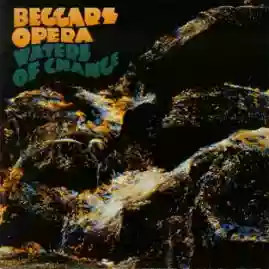
'Waters Of Change' was released in 1971 as the second album, following the debut the previous year with the curious 'Act One', a work unmistakable for its 'Fellini-style' cover and highly derivative content, largely formed by long suites filled with quotations and passages of classical music. This time the group works more organically, composing songs of normal length (for progressive, some then seven, eight minutes long, why not?), managing to establish their own sound, their own style. They work with texts, choirs, and melodies to strengthen the vocal side and define the role of Alan Park, freeing him from the endless keyboard fugues that filled the first album, and always returning his virtuosity to the song format. The outcome is a very accessible, rounded progressive with no rough edges, featuring beautiful sounds and a 100% British evocative flair. Just ideal, for instance, to 'play' in the car while going around castles in some Northern European country, perhaps alternating it with more famous Jethro Tull, Gentle Giant, and Fairport Convention. 'Time Machine' is the pleasant opening of the work, with Griffiths’ powerful voice tending to dominate the sound landscape, enriched beyond measure by the waves of 'mellotronist' Virginia Scott (no other instrument credited to her, although she is curiously the main composer of the group), on which both organ and guitar carve out effective solos.
The following 'Lament' is a brief instrumental featuring only Park on the proscenium, intoning an evocative lament (as it were) on the organ that couldn't be more Elizabethan, supported only by distant and muffled percussion. Perfect to listen to while lingering 'on-site' among the ruins of Stonehenge, glimpses of Canterbury, and the like. The collected and ancient atmosphere is broken by the arrival of the rock whirlwind (so to speak) of 'I've No Idea', with its tight rhythm (again, so to speak) and riffing, only to quiet again towards a new instrumental lullaby called 'Nimbus', another gem good for both psychedelic and medieval reflections. The second side (for those who love the old LP habit) opens with the Scottish reel-like 'Festival', very cheerful and sparkling as it should be, paying homage to their homeland (Beggars Opera was based in Glasgow), then continuing with the collection's most instrumentally brilliant piece, titled 'Silver Peacock': a short and lavish announcement followed by a rapid-fire arpeggio by good Park, agile as a hare on his Hammond’s registers. But it’s just an intro as the piece then develops into a more laid-back and stately sung part. Griffiths attempts again to emulate Greg Lake, whose vocal presence he certainly has, but not exactly, indeed not at all, the exquisite timbre.
Two more tracks, the umpteenth brief instrumental 'Impromptu' and the insipid 'The Fox', close the discussion: nothing essential, but still a lot of evocative and pleasant in this work with a typically well-conceived artisanal aura, a common trait in many (not all, some are flat and useless) of the progressive releases on the Vertigo label from the early seventies. Worth knowing.
Loading comments slowly
Summary by Bot
Beggars Opera's second album 'Waters Of Change' showcases skilled musicianship with standout Hammond organ solos by Alan Park and expressive guitar work by Ricky Gardiner. The album marks a step toward more accessible song structures compared to their debut. Vocalist Martin Griffiths delivers a powerful but technically limited performance. The album is an evocative journey with a distinct British prog flavor, appealing to fans of the genre and era.Tracklist Videos
Beggars Opera
Beggars Opera are a Scottish progressive rock band formed in Glasgow in 1969, best known for their early-’70s Vertigo LPs Act One, Waters of Change, and Pathfinder. The lineup featured guitarist Ricky Gardiner, keyboardist Alan Park, singer Martin Griffiths, and mellotron player Virginia Scott.03 Reviews
